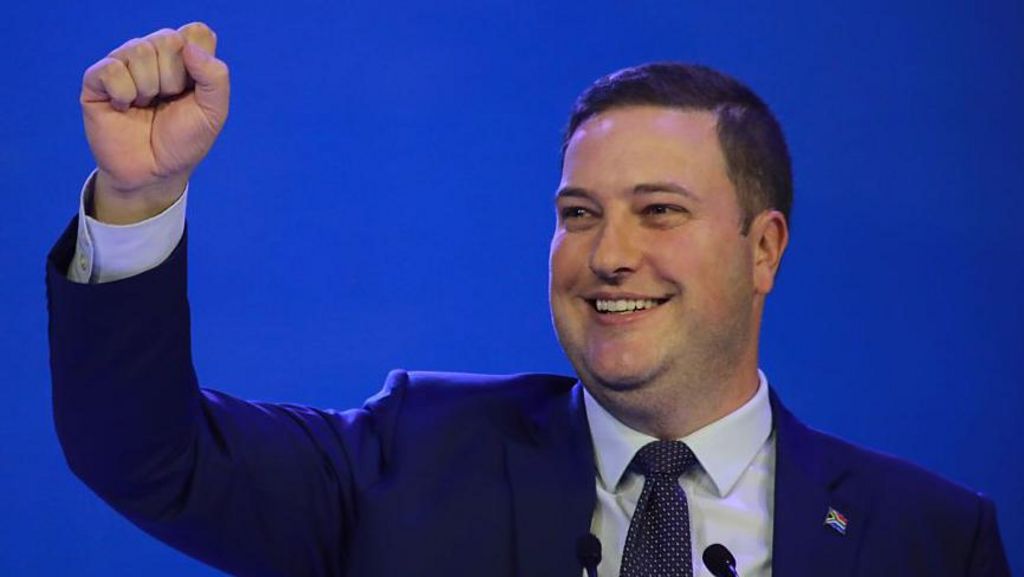
On Sunday, South Africa’s main opposition Democratic Alliance (DA) ushered in a new political chapter with the election of 39-year-old Geordin Hill-Lewis as its national leader, tasking him with solving a decades-old impasse that stumped all three of his immediate predecessors: breaking the party’s longtime reliance on narrow core support drawn primarily from white voters and other racial minority groups.
Nearly 30 years after the formal end of apartheid in 1994 and the birth of South Africa’s multiracial “Rainbow Nation” project, deep racial fault lines still shape the country’s political landscape. For the DA to eventually claim national power, Hill-Lewis — who succeeded outgoing leader John Steenhuisen — must build bridges across these divides and win meaningful support from the country’s Black majority, who make up roughly 80% of the total population.
Since the 2014 general election, the DA’s national vote share has stagnated at roughly 20%. The 2024 national election marked a major political shift, as long-ruling African National Congress (ANC) saw its support drop below 50% for the first time since the end of apartheid, forcing the party into a fragile national coalition government that includes the DA and eight smaller political parties. However, the DA’s entry into national power masked its persistent demographic gap: the party still only secured just under 22% of the national vote.
Hill-Lewis has openly acknowledged the party’s trust deficit with majority Black voters. In an interview with public broadcaster SABC on Monday following his election, he emphasized that closing this trust gap would be his top priority. Speaking to reporters shortly after, he made clear that winning the confidence of more Black South Africans would be a “main focus of mine.”
The new DA leadership ticket offers a notable shift from previous iterations: Hill-Lewis was elected alongside senior Black politicians including Gauteng provincial party leader Solly Msimanga, Siviwe Gwarube and Solly Malatsi, creating what Hill-Lewis described as “by far the most diverse and young group of leaders the DA has had in its history.” Notably, Gwarube is the only woman to secure a senior leadership position, leaving significant gender imbalance unaddressed in the new party hierarchy.
This push for greater racial diversity comes after a high-profile failed effort a decade prior. The party’s first Black leader, Mmusi Maimane, resigned from his post in 2019 after just four years in office, claiming the DA was “not the vehicle best suited to take forward the vision of building” a united South Africa.
Hill-Lewis argued that longstanding rigid racial political silos in South Africa are beginning to fracture, a trend he called encouraging. On policy, the new leader has not yet released a new policy platform designed to broaden the party’s base, but he has signaled he will double down on messaging around government competence and addressing South Africa’s crippling crime crisis. He also clarified the DA’s stance on the ANC’s flagship Black Economic Empowerment (BEE) policy: the party remains opposed to the current framework, but is committed to demonstrating it is genuinely invested in advancing the economic interests of Black South Africans.
Political observers have framed the new leadership lineup as a promising turning point for the DA. Dr Levy Ndou, a political analyst, noted that Hill-Lewis’ election alongside a cohort of young, diverse leaders “ushers in a new era” and could prove to be a “very good thing” for the party. Ndou added that while race has always been a defining challenge for the DA, the new leadership slate finally “resembles a party that is multiracial.”
A notable break from his predecessor’s path, Hill-Lewis — who currently serves as mayor of Cape Town — has chosen not to accept a cabinet position in the current ANC-led coalition government, opting to retain his local government post. This unusual positioning puts him in a unique political position: he must navigate the DA’s fraught working relationship with the ANC in national government while leading the party into upcoming local government elections, expected to take place between late 2026 and early 2027, where the DA will campaign directly against the ANC across much of the country.
The DA has long been a fierce critic of the ANC on economic and foreign policy, and the uneasy national coalition has already faced multiple major hurdles, though both parties have so far managed to maintain the power-sharing arrangement.
A veteran of DA politics who joined the party at just 18 years old, Hill-Lewis has been groomed for top leadership within the organization for nearly two decades. Fellow political analyst Sandile Swana described him as a product of the DA’s internal leadership pipeline. Hill-Lewis first made political history in 2011, when he was elected to parliament at 24, becoming the youngest lawmaker in South Africa at the time. A decade later, he again made history when he was elected as Cape Town’s youngest ever mayor.
While he has ruled out a cabinet post for himself, Hill-Lewis made clear he intends to maintain strict oversight of DA politicians serving in the coalition cabinet, announcing that performance reviews will be carried out in the coming months. “No-one is entitled to any office or position. It must be earned through performance,” he said, adding that leadership changes will be made if performance does not meet expectations.