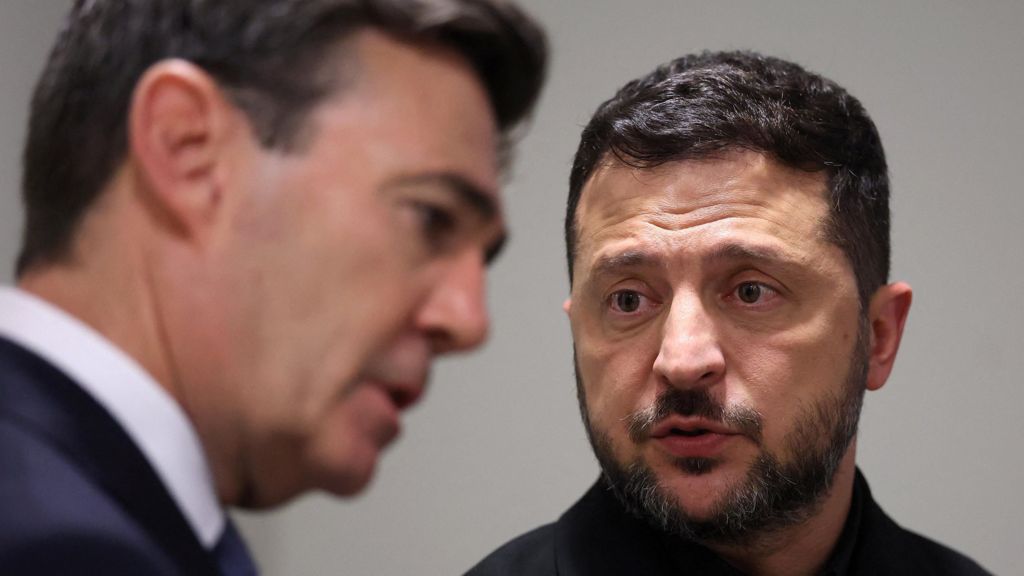
As Russia’s full-scale invasion of Ukraine enters its third year, Ukrainian President Volodymyr Zelensky has once again embarked on a diplomatic tour of European capitals, launching his visit in London this week amid a dramatic shift in U.S. policy toward the conflict.
For months, U.S. President Donald Trump had maintained a largely supportive stance on Ukraine, pledging expanded access to advanced American air defense systems and vowing harsher economic penalties against Moscow. But last week, Trump made an abrupt policy U-turn: he lifted long-standing sanctions on Russian diesel imports and publicly called for Zelensky to be replaced as Ukraine’s head of state. The sudden shift has thrown Western support for Kyiv into uncertainty, prompting Zelensky to rush to European allies to shore up critical backing for his country’s war effort, with London as his first stop before moving on to Brussels.
For British Prime Minister Keir Starmer (referred to as Burnham in the original pool reporting), the meeting presented a familiar but delicate diplomatic balancing act: the prime minister needed to demonstrate unwavering public solidarity with Zelensky while avoiding open criticism of Trump that could undermine future U.S. engagement with Ukraine. To sidestep persistent press questions about Trump’s decision, Downing Street pre-released an embargoed statement ahead of the visit laying out new British support commitments, and structured the day’s events to avoid unscripted questions from journalists.
The statement confirmed Starmer would pledge to deliver financial and military aid to Ukraine “further and faster”, with a specific promise to accelerate deliveries of lightweight multirole missiles capable of intercepting fast-moving Russian attack drones. The day’s schedule included an official honour guard greeting for Zelensky at Downing Street, a controlled photo opportunity at the start of bilateral talks, and opening statements to press pool cameras – but no open question-and-answer session, a format that has become standard for Zelensky’s visits to the UK to avoid awkward confrontations over shifts in Western policy.
Opening weekly Prime Minister’s Questions in the House of Commons, Starmer opened with a formal declaration of “unwavering” support for Ukraine, reiterating his promise of expanded military and financial assistance. It fell to Liberal Democrat leader Sir Ed Davey to press the question the prime minister had avoided: demanding Starmer publicly condemn Trump’s reversal of sanctions on Russia. “This House does deserve to know his position, as does frankly President Zelensky and our brave Ukrainian allies,” Davey told lawmakers. “Doesn’t he agree this is yet another shameful Trump betrayal of the Ukrainian people and European security?”
In his response, Starmer acknowledged the moment was “very dark and difficult” for Zelensky, who is shouldering enormous pressure as Ukraine faces shifting international backing. But he declined to criticize Trump, framing his approach as a deliberate effort to preserve Britain’s role as a neutral broker to restore U.S. support for Kyiv. “What I have to do in my role is try and repair bridges so that the support comes back and therefore I should, at this moment in time, be careful in terms of laying the ground to bring people back together,” Starmer said. “That is the role I intend to play – it’s the right role for me to play – in this moment. I will listen to President Zelensky carefully but he won’t be going away from Britain today empty handed.”
This is not the first time the UK has stepped into a mediation role between Washington and Kyiv following a rift with Trump. After a high-profile falling out between Trump and Zelensky in the Oval Office in February 2025, British national security adviser Jonathan Powell led quiet shuttle diplomacy between Washington and Kyiv to de-escalate tensions and restore cooperation. Starmer appears to be aiming for a similar bridge-building outcome this time around.
For millions of Ukrainians bracing for another grim winter of war, with the prospect of reduced U.S. military and humanitarian assistance, the outcome of this diplomatic push could not be more urgent.