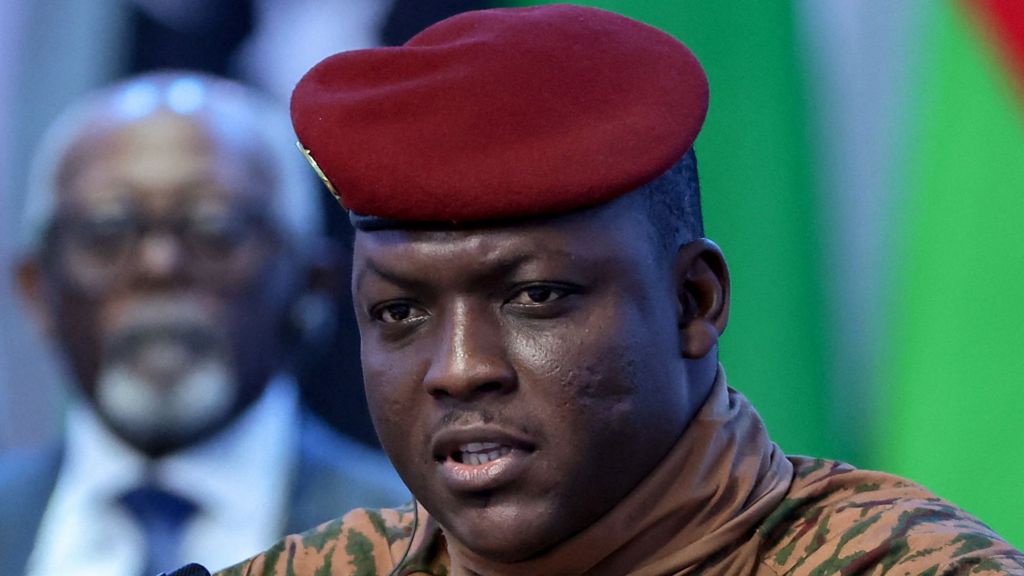
In a stark public interview broadcast on Burkina Faso’s state television, the West African nation’s military ruler Captain Ibrahim Traoré has delivered a sweeping rejection of liberal democratic governance, claiming the system is inherently harmful to African nations and calling on his people to abandon calls for democratic transition. Traoré, who seized power in a 2022 coup, initially committed to restoring civilian democratic rule by July 2024, but the ruling junta reversed that pledge earlier this year, extending its hold on power for an additional five-year term.
During the interview, the 38-year-old leader, who frames himself as a revolutionary leader pushing back against Western neocolonial interference, argued that democracy is not suited for the African continent. To back his claim, he pointed to the chaos that has engulfed Libya since the 2011 NATO-backed uprising that removed longtime autocratic leader Muammar Gaddafi. “Wherever Western powers try to establish democracy in the world, it’s always accompanied by bloodshed,” Traoré stated. “People need to forget about the issue of democracy. Democracy is not for us.”
Earlier this year, the junta moved to ban all formal political parties as part of a broader plan to rebuild national governance from the ground up. Expanding on this decision during the interview, Traoré labeled political parties as divisive, dangerous forces fundamentally incompatible with his administration’s revolutionary project. He went on to criticize the culture of African politics as he has observed it in Burkina Faso, claiming that conventional politicians in the country embody corruption and moral failing, describing them as habitual liars, sycophants, and manipulative smooth-talkers.
While Traoré declined to lay out detailed blueprints for a formal alternative governing system, he emphasized that Burkina Faso will pursue an entirely homegrown approach, rejecting pressure to copy Western institutional models from abroad. The new framework he outlined centers on national sovereignty, radical patriotism, and mass grassroots revolutionary mobilization, with key governance power allocated to traditional community leaders and local grassroots structures. The junta leader also stressed the critical importance of economic and military self-reliance, arguing that modest 6 to 8-hour workdays are insufficient for the country to close the development gap with wealthy global nations.
Traoré’s rule has been marked by widespread crackdowns on political dissent, with restrictions imposed on opposition groups, independent media outlets, and civil society organizations. Credible reports have even accused his administration of punishing political critics by forcing them to serve on the front lines of the country’s long-running war against Islamist insurgents. Despite these authoritarian measures, Traoré has built a large, enthusiastic following across the African continent, where his pan-Africanist rhetoric and unapologetic criticism of Western geopolitical influence resonate strongly with many people.
Like neighboring military-ruled states Mali and Niger, Burkina Faso under Traoré has cut long-standing security partnerships with Western nations – most notably former colonial power France – in its counter-insurgency campaign. All three Sahel nations have instead turned to Russia for military support, but deadly Islamist violence has continued to spread across the region, with no signs of abating.
The same week of Traoré’s interview, Human Rights Watch released a damning new report documenting that more than 1,800 civilians have been killed in violence across Burkina Faso since Traoré took power in September 2022. The report attributes roughly two-thirds of these civilian deaths to the Burkinabé military and its allied civilian militias, with the remaining deaths blamed on Islamist insurgent groups.
It is important to note that while West Africa has seen a wave of military coups over the past five years, most African sovereign states still hold regular national elections, even though many of these votes have faced widespread international criticism for irregularities and bias in favor of sitting incumbent leaders. In two recent cases, military leaders who seized power in Gabon and Guinea have organized national elections and emerged victorious, cementing their hold on power through formal electoral processes.