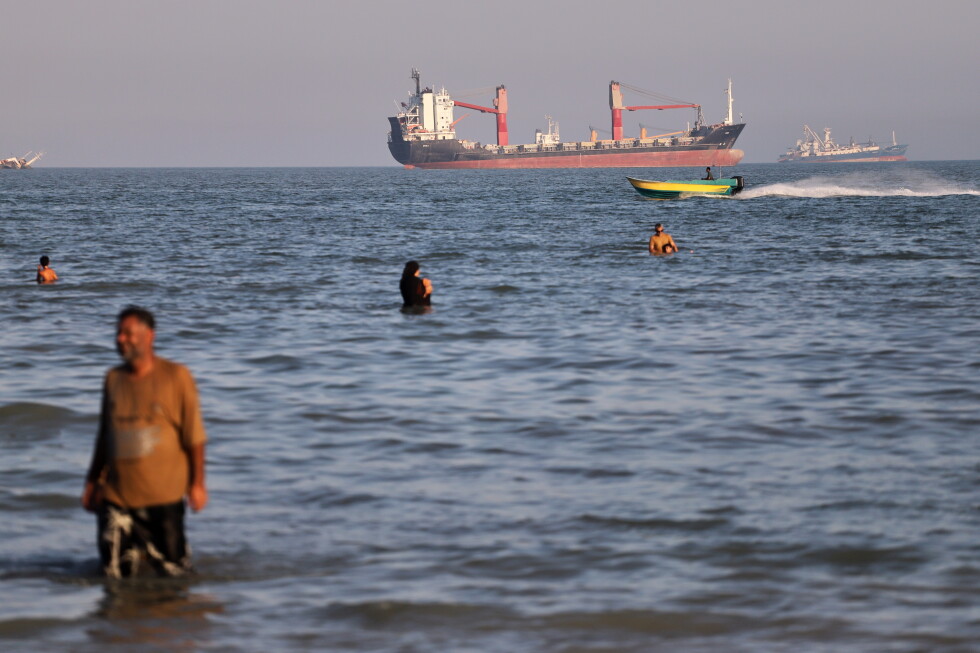
In a fresh escalation of tensions around one of the world’s most critical energy chokepoints, a projectile struck an unidentified cargo vessel traveling through a UN-endorsed alternative shipping corridor in the Strait of Hormuz on Thursday, British military officials confirmed. The attack came just hours after Iran’s Islamic Revolutionary Guard Corps issued explicit threats barring vessels from using the unapproved route, leaving the international community scrambling to assess responsibility and the broader implications for global energy markets.
The UK Maritime Trade Operations, which monitors regional shipping security, reported that while the targeted vessel suffered structural damage, there were no reported casualties and no leakage of hazardous materials that would cause environmental damage off the Omani coast. Officials have not yet confirmed the identity of the ship’s operator or the source of the projectile, leaving key details of the incident unconfirmed as of Thursday evening.
The contested alternative shipping corridor was organized by Oman and the International Maritime Organization (IMO), a United Nations body, to free hundreds of commercial vessels trapped in the Persian Gulf after Iran laid naval mines in the strait’s traditional central shipping lane. Iran placed the mines in the central corridor following a cross-border strike by the U.S. and Israel on Iranian assets on February 28, a move that cut daily shipping transits from a pre-conflict average of more than 130 to fewer than 40 at the lowest point of the crisis. Before the conflict, the central route carried roughly 20% of the world’s daily supply of oil and natural gas, giving Iran significant leverage over global energy markets amid ongoing negotiations with Washington.
Opening the new coastal corridor along the UAE and Omani coastlines is designed to reduce this leverage and ease mounting pressure on the fragile global economy, a core goal of the ongoing interim peace talks between the U.S. and Iran. Under a memorandum of understanding signed last week, the two sides have 60 days to hammer out final details of a tentative agreement covering everything from free navigation through the strait to the future of Iran’s stockpile of highly enriched uranium.
U.S. Secretary of State Marco Rubio, who is currently traveling through the Gulf region to reassure regional American allies of Washington’s commitment to security, reaffirmed the U.S. commitment to protecting the new corridor on Thursday. “If that [free transit] stops, then we’re going to have a problem,” Rubio told reporters ahead of meetings with Gulf Cooperation Council foreign ministers in Bahrain, the home of the U.S. Navy’s 5th Fleet. “There is no part in this deal that’s undertaken that in any way undermines the security, the stability or the prosperity of any of our partners in the Gulf region,” he added. Bahrain’s Foreign Minister Abdullatif bin Rashid al-Zayani thanked the U.S. for its continued support, noting “today we see a glimmer of hope for our region” while stressing that “it was critically important that Iran adheres to its obligations.”
Shipping data from recent days shows a steady increase in traffic through the new corridor, even as volumes remain well below pre-conflict levels. Lloyd’s List Intelligence reported that 125 vessels crossed the strait last week, up from just 33 the week prior, while S&P Global recorded 78 transits on Wednesday alone — the highest daily number since the outbreak of hostilities, but still far off the prewar average. “Opportunistic operators — and there are many of them — emboldened by the lower transit risk, or at least the perceived lower transit risk, have begun chasing the backlog of trapped cargoes,” explained Richard Meade, editor-in-chief of Lloyd’s List. Global shipping giant Maersk confirmed Thursday that one of its container vessels, the Maersk Baltimore, and a second chartered ship had successfully exited the strait via the new route that morning.
Iran has repeatedly rejected the new corridor as unauthorized, with the Revolutionary Guard’s naval branch issuing a fresh warning Thursday carried by state-run IRNA news agency. “The new route was established without notice or coordination with Iran, calling it “unacceptable and completely dangerous,” the statement read. “The only authorized route for passing through the Strait of Hormuz is the one declared by the Islamic Republic of Iran. Vessel traffic outside these routes is extremely dangerous and prohibited. Violators will be dealt with.” On Wednesday, private security firm Ambrey reported that an Iranian Guards sailor radioed a warning to one passing tanker, saying: “You are in range of my missiles and maybe [I] fire on you.”
Despite the attack, global oil markets reacted with relative calm Thursday, with benchmark crude prices briefly dipping below $73 per barrel — the last pre-conflict price level — a signal that investors believe the broader diplomatic process remains on track. Still, the strike underscores the fragility of the tentative detente, which is already complicated by public sparring between U.S. and Iranian leaders, who have traded threats and claimed opposing concessions that the other side denies.
Tensions are also flaring on a second front in Lebanon, where a fragile ceasefire between Israel and Iranian-backed Hezbollah militants has begun to unravel in recent days. Israel confirmed that it targeted Hezbollah militants in southern Lebanon this week, with Lebanese health officials reporting three civilian deaths in a Thursday strike on a vehicle. Hezbollah called the attack a clear violation of the ceasefire but has not yet launched retaliatory strikes, while the Israeli military had no immediate comment on the incident. The strike came as Lebanese and Israeli delegations visited Washington to discuss a proposed phased Israeli troop withdrawal from southern Lebanon. Israel’s military added that a reservist soldier was killed and another wounded in southern Lebanon on Thursday. Since the latest round of fighting began in March, more than 4,000 Lebanese have been killed in Israeli strikes, while 37 Israeli soldiers have died in combat in Lebanon or northern Israel.
This report contains contributions from Lee in Manama, Bahrain, David McHugh in Frankfurt, Germany, and Julia Frankel in Jerusalem, and is aggregated from original Associated Press reporting.