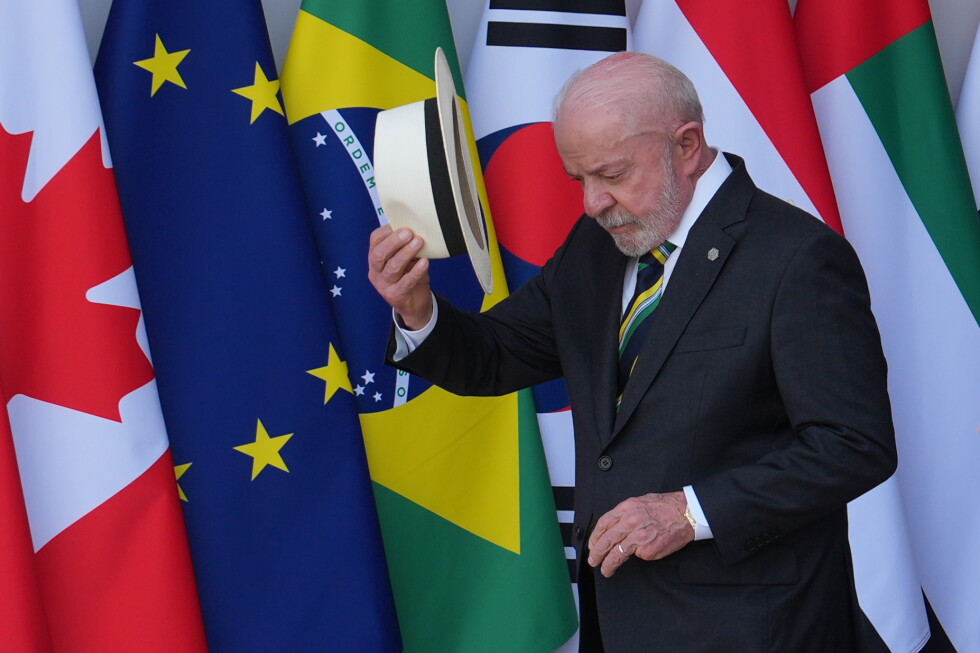
RIO DE JANEIRO — A sharp public dispute has erupted between Brazil’s sitting President Luiz Inácio Lula da Silva and his leading electoral rival Senator Flávio Bolsonaro over a planned 25% tariff on Brazilian goods proposed by the Trump administration, a policy that has quickly become a polarizing flashpoint just months ahead of the country’s October presidential election. Both political leaders have publicly pushed back against the proposed tariff hike, while using the ongoing trade debate to attack one another’s credibility and political positioning ahead of the vote, a reflection of how much both sides believe handling the unpopular U.S. trade measure will shape voter sentiment.
The proposed new tariffs come amid a years-long U.S. goods trade surplus with Brazil, making the Trump administration’s protectionist move unusual on paper. The trade friction first escalated last July, when the U.S. imposed a 50% tariff on select Brazilian imports, with then-President Donald Trump framing the move as a response to what he called a political “witch hunt” targeting Flávio’s father, former Brazilian President Jair Bolsonaro. The elder Bolsonaro was on trial at the time for his role in the 2022 coup attempt following his election loss to Lula, and was ultimately convicted on charges related to the insurrection.
In June of this year, the U.S. Trade Representative’s office led by Jamieson Greer released the findings of a probe launched earlier this year at Trump’s direction, which accused Brazil of a range of unfair trade practices including lax anti-corruption enforcement and discriminatory tariff policies. The proposal for a 25% across-the-board tariff on Brazilian imports reversed a brief period of warming bilateral relations that followed meetings between Lula and Trump in 2024, and has once again soured ties between the two nations. Lula has repeatedly warned the U.S. against interfering in Brazil’s upcoming electoral process.
Flávio Bolsonaro, who is the frontrunning opposition candidate for October’s presidency, argued in a formal submission to USTR this week that increased U.S. tariff pressure has already helped boost Lula’s standing with Brazilian voters. He included polling graphs in his filing, noting that “Brazilian public polling shows that the incumbent government’s electoral position has strengthened during precisely the periods when U.S. tariff pressure has been most salient.” He added that moving forward with the proposed tariffs would hand Lula a pre-election “political victory”, and called for the implementation of any tariffs to be postponed while upholding the USTR investigation’s findings.
Lula has rejected Flávio Bolsonaro’s framing outright, calling the senator’s submission to USTR “yet another act of treason against the fatherland.” Expanding on the attack in a post on X Thursday, Lula accused the entire Bolsonaro family of advancing sell-out policies that subordinate Brazil’s national interests to Washington. “It is unacceptable that the Bolsonaro family, with its sellout policies, seeks to submit Brazil to the interests of the United States,” he wrote. “There has never been, nor is there, any justification for a tariff hike now or later.”
Three hours after Lula’s post, Flávio Bolsonaro fired back on the same platform, claiming that Lula is secretly the only political figure in Brazil who wants the tariff hike to go forward. The senator also announced he would travel back to the U.S. next week to ramp up lobbying against the implementation of the new tariffs. The dispute has also drawn attention to the ongoing legal troubles of the Bolsonaro family: another of the former president’s sons, Eduardo Bolsonaro, who resides in Texas, was convicted earlier this year of illegally lobbying the U.S. government to pressure Brazilian officials to drop the coup charges against his father.
Beyond the tariff fight, the two candidates have also clashed over a recent Trump administration decision to designate two of Brazil’s largest domestic organized crime groups — First Command of the Capital (PCC) and Red Command — as official terrorist organizations. Flávio Bolsonaro has publicly supported the designation, which many independent analysts view as a clear attempt by the U.S. to influence Brazil’s upcoming election. Lula, meanwhile, has argued that the classification is legally and strategically inappropriate, noting that the groups are primarily motivated by profit from drug trafficking and organized crime rather than ideological or political change, the core criterion for terrorist designation. Earlier this week, the U.S. followed up the classification with new sanctions targeting companies and individuals linked to PCC, which U.S. officials called the “largest transnational criminal organization in the Western Hemisphere.”
On the trade front, Lula’s administration has formally rejected all of USTR’s core grievances, including the claim that Brazil’s popular PIX instant payment system unfairly disadvantages competing private electronic payment services. Brazilian officials have countered that PIX operates under lawful, neutral regulatory frameworks that actually promote greater competition in the country’s fintech sector. The entire tariff dispute has reinvigorated Lula’s campaign narrative centered on defending Brazilian national sovereignty, a message that resonated strongly with voters during his 2022 campaign and delivered an unexpected boost to his popularity ahead of this year’s re-election bid.