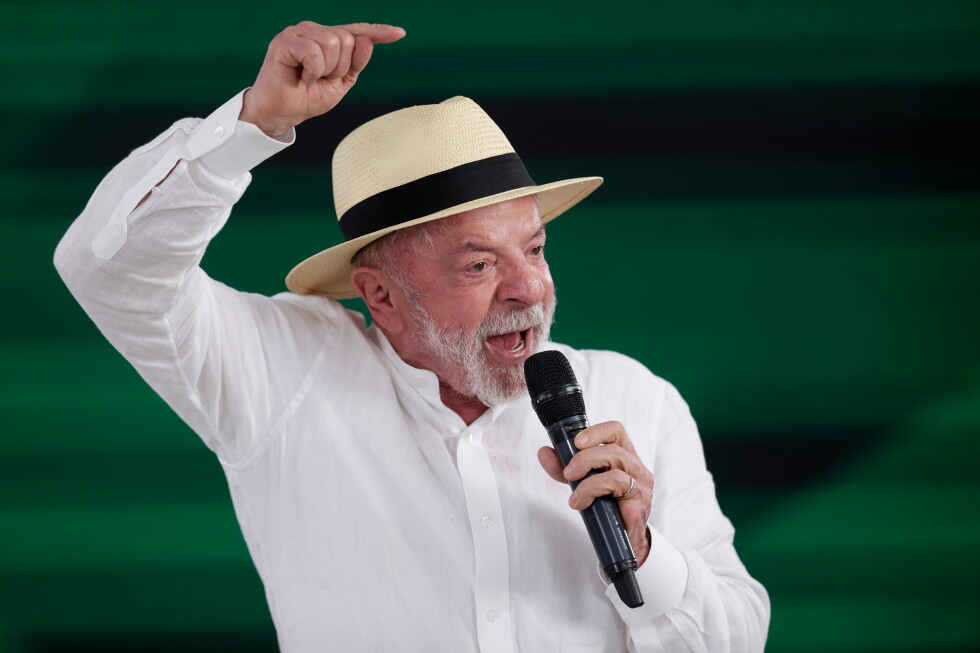
SAO PAULO, Brazil — On Sunday, Brazil’s ruling Workers’ Party formally confirmed 80-year-old incumbent President Luiz Inácio Lula da Silva will stand in October’s general election, a race that political observers broadly expect to be the final reelection campaign of his decades-long political career. This nomination marks Lula’s seventh bid for Brazil’s highest office, coming as the sitting leader faces growing international pressure from foreign leaders aligned with his right-wing challenger.
Lula’s main opponent in the race is Sen. Flávio Bolsonaro, the eldest son of former far-right President Jair Bolsonaro, who is currently serving a 27-year sentence under house arrest for his role in a 2022 attempted coup against Lula’s inauguration. Flávio Bolsonaro has secured open public backing from a coalition of high-profile international conservatives: former U.S. President Donald Trump’s inner circle, Argentine President Javier Milei, and Israeli Prime Minister Benjamin Netanyahu.
In his acceptance speech to the party convention, Lula outlined three core policy priorities: expanding Brazil’s domestic defense sector, safeguarding the nation’s vast reserves of strategic rare minerals, and protecting national sovereignty. He declared firmly that no foreign power — whether from China, the United States, or France — would be allowed to exploit Brazil’s natural resources without first respecting the country’s sovereign rules and interests. “We will have to be much more daring to change a lot of things in this country,” Lula told convention delegates.
Workers’ Party leaders have sounded the alarm about growing risks of foreign interference in Brazil’s democratic process, pointing specifically to the coordinated involvement of Trump and Milei. Party chairman Edinho Silva emphasized the high stakes of the October vote, noting that a right-wing win in Brazil would shift the entire political trajectory of Latin America, where six nations — Argentina, Paraguay, Chile, Peru, Ecuador, and Colombia — have already elected Trump-aligned conservative leaders in recent years.
Entering the official campaign period, Lula holds a strong strategic position: he has successfully pulled multiple centrist parties away from the right-wing coalition, and his national approval ratings are noticeably higher than they were six months ago. Two of his campaign’s flagship domestic policies have also resonated strongly with voters: an overhaul of Brazil’s income tax system that reduces burdens for low-income households, and a widespread debt forgiveness program that has quickly become one of his most popular proposals.
Beyond electoral competition, Workers’ Party officials have raised specific concerns about foreign-funded coordinated disinformation efforts, including automated bot networks and social media manipulation designed to sway voter opinion and erode public trust in Brazil’s robust electronic voting system. In a conciliatory remark made earlier this week, Lula noted he has no desire to make an enemy of Trump, while Vice President Geraldo Alckmin — who will again serve as Lula’s running mate — took a veiled swipe at foreign interference, joking that Brazil’s voting system “is so good that it doesn’t take votes from Argentines and Americans.”
Recent diplomatic moves have amplified tensions around foreign involvement. After Flávio Bolsonaro visited the White House and U.S. State Department earlier this year, the Trump administration implemented two controversial changes: new tariffs on Brazilian exports, and the re-designation of two Brazilian criminal groups as terrorist organizations. Legal analysts warn these changes could harm Brazilian businesses and create legal pretext for further international intervention.
On July 25, Milei traveled to São Paulo to speak at Flávio Bolsonaro’s Liberal Party convention, where he launched a verbal attack on Lula and a Supreme Court justice who oversaw the elder Bolsonaro’s attempted coup trial, sparking a full diplomatic crisis between Brazil and Argentina. Netanyahu has also recorded a public video message endorsing Flávio Bolsonaro.
Lula has centered his campaign on defending Brazil’s national sovereignty, recently holding a lengthy diplomatic call with Chinese President Xi Jinping — leader of Brazil’s largest trading partner. His supporters argue that a second Lula term would allow the South American trade bloc Mercosur, led by Brazil as its largest economy, to advance ambitious new trade deals with global partners.
Mirroring his father’s unfounded claims from the 2022 election, Flávio Bolsonaro has spent recent months spreading baseless doubts about the integrity of Brazil’s electronic voting system. These claims prompted action from Brazil’s foreign ministry in July, when officials denied visas to two U.S. State Department representatives amid reports the pair planned to repeat the same disinformation claims. The U.S. State Department has denied that the officials intended any such activity.