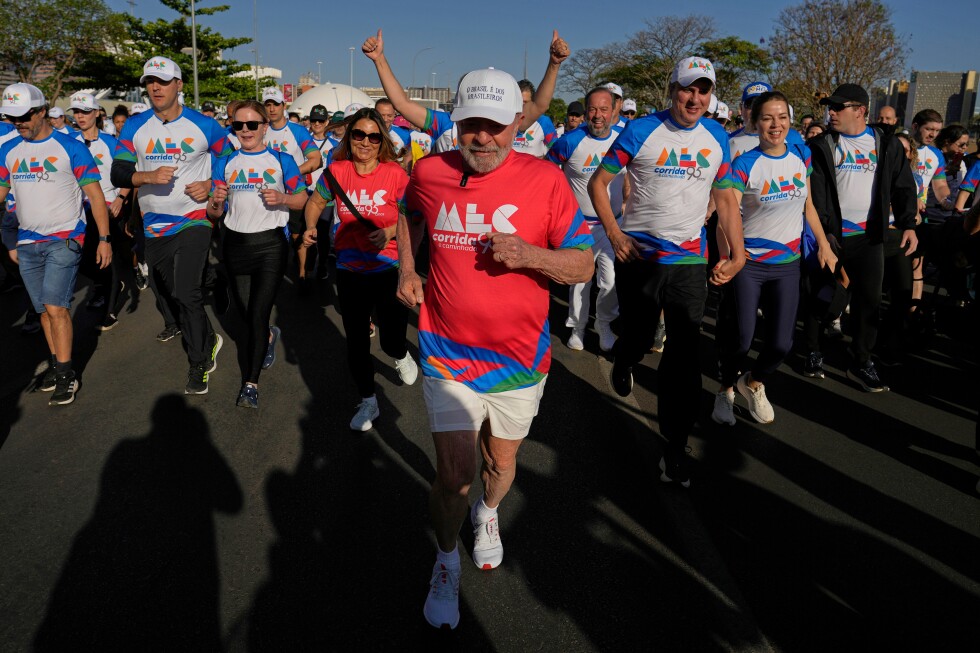
SAO PAULO, Brazil – As Brazil prepares for its 2026 presidential election, the race has taken an unusual turn centered not on policy platforms or economic plans, but on physical fitness and age. At 80 years old, incumbent President Luiz Inácio Lula da Silva has made his rigorous daily workout regimen a centerpiece of his campaign for a fourth non-consecutive term, turning gym sessions into a political statement that has resonated – and sparked debate – across the nation.
Even as Brazilian voters remain deeply divided over whether Lula should seek another term in October’s election, there is widespread cross-partisan agreement on one point: the president’s relentless commitment to his daily treadmill runs and strength training routines. Marcela Peres, a 63-year-old Brasília resident working out at a local hotel gym this week, summed up the mixed view many hold. “He is a bit too old to campaign again. We’d better have someone else running,” Peres said. “But his workouts are indeed a good example for people like me.”
Lula’s push to project vitality and good health comes as concerns over advanced age and presidential fitness have dominated global political discourse, most prominently following U.S. President Joe Biden’s decision to drop out of the 2024 race over health and age-related questions. Lula’s campaign has leaned into his fitness to directly counter those same concerns dogging his own candidacy, even drawing a playful response from the president after a conspiracy theory spread claiming his workout videos featured a body double. “One of these idiots said it was not me, that it was a clone,” Lula said in March, just days after his wife Rosângela da Silva posted a clip of his gym routine online. “Go to the gym. Get ready. Drink less and work to see what happens. I want to live 120 years.”
The focus on fitness has prompted a response from Lula’s main challenger: Sen. Flávio Bolsonaro, 45-year-old son of former Brazilian President Jair Bolsonaro, who is nearly half Lula’s age. The younger Bolsonaro, who was anointed as the opposition’s candidate by his father from prison last December, has followed Lula’s lead by highlighting his own physical fitness, sharing clips of himself sprinting to campaign events and dancing at rallies. The former president is currently serving a 27-year sentence for leading a post-election coup attempt and has recently been transferred to house arrest.
Flávio Bolsonaro has leaned into age-based attacks on Lula, recently mocking the incumbent as an aging Chevrolet Opala that is “all backward” and “drinks a lot (of fuel).” Lula quickly brushed off the jab, rebranding himself as a “turbo car” in response. Political analysts say the entire back-and-forth over fitness and age is a calculated image battle, with both sides seeking to capitalize on voter perceptions of vitality.
“He is doing this to steer away from the Joe Biden effect,” explained Carlos Melo, a political science professor at São Paulo’s Insper University. “Flávio Bolsonaro is trying to say he is actually the young one. This is a game of image.”
Felipe Soutello, a political consultant who has managed dozens of Brazilian legislative and executive campaigns, notes that modern political campaigns now require candidates to showcase physical activity regardless of their age. “The opposition will use a certain ageism, a little prejudice against older generations, as a tool to hurt the president’s performance,” Soutello said. What the younger Bolsonaro’s campaign has not fully accounted for, he added, is a dramatic demographic shift that has reshaped Brazil’s electorate: voters over the age of 60 now wield more electoral power than younger age groups.
According to data from Brazil’s Supreme Electoral Court compiled by research group Nexus, the number of eligible voters over 60 has surged from 20.8 million in 2010 to 36.2 million as of March 2026, making up one-quarter of the entire electorate. This growing bloc of older voters is widely expected to be a decisive factor in the upcoming election, which follows Lula’s 2022 victory by the narrowest margin in Brazilian history – just 50.9% of the vote.
For undecided voters, the fitness focus offers both upside and downside. Antonio Moreira, a 50-year-old musician who works out regularly on Rio de Janeiro’s beaches and remains uncommitted to either candidate, acknowledged that no voter wants to support a leader struggling with declining health. He added that Lula’s workout routine also serves as a positive example for older Brazilians looking to stay active. While Flávio Bolsonaro’s campaign dance videos have drawn attention, Moreira argued that showmanship is not enough to win over undecided voters. “It is okay to do it as they do to seek for votes, but to reach a different kind of voter there needs to be more real proposals, right?”
Lula’s commitment to fitness is not a new campaign gimmick: the president played frequent soccer during his first two terms in office, maintained his workout routine throughout 580 days he spent in prison on now-overturned corruption convictions, and centered his health as a campaign talking point during his successful 2022 run against the elder Bolsonaro, a former Army captain who has long struggled with chronic health issues. If Lula wins October’s election, he will extend his own record as the oldest person ever elected to the Brazilian presidency.
AP journalist Lucas Dumphreys contributed reporting from Rio de Janeiro.