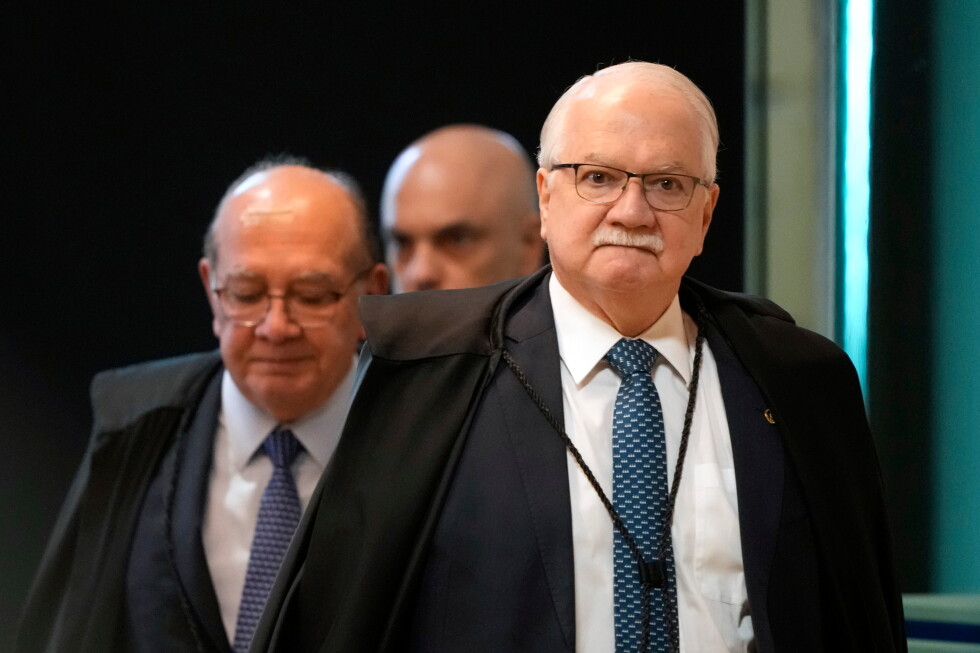
SAO PAULO — Brazil’s highest judicial body has slid deeper into a damaging institutional crisis, after two high-profile Supreme Court justices delivered competing demands for severe disciplinary action against one another this Friday. The public feud has sent shockwaves through Brazil’s political landscape just months ahead of the country’s October general elections, raising urgent questions about the integrity of the nation’s judiciary.
The conflict centers on two justices with starkly different political and ideological backgrounds. Alexandre de Moraes, 57, rose to national prominence last year after leading the high-profile prosecution that resulted in the imprisonment of former far-right President Jair Bolsonaro on charges related to the 2022 attempted coup d’état. His adversary on the bench, 53-year-old Andre Mendonca, made history as the Supreme Court’s first self-identified evangelical Christian justice, a direct appointment by Bolsonaro during his presidential term.
The roots of their escalating animosity trace back to a sprawling federal investigation into large-scale financial fraud linked to the collapsed Banco Master, a once-prominent Brazilian financial institution led by disgraced ex-banker Daniel Vorcaro. The sprawling probe has already tangled multiple sitting politicians, making it an especially explosive issue ahead of the upcoming October elections.
The crisis escalated rapidly earlier this week, when Mendonca ordered the unsealing of a portion of federal police intercepted communications between Vorcaro and third parties. The released documents include dozens of private messages from the fallen banker that suggest he repeatedly sought personal guidance from de Moraes. The revelations compound existing suspicions against de Moraes, after federal investigators uncovered that de Moraes’ wife had provided legal consulting services to Banco Master under a 130 million reais (approximately $25 million) contract.
These disclosures have sparked a growing wave of calls for de Moraes’ resignation from across Brazil’s political sphere, media outlets, and leading legal experts. Even Flávio Bolsonaro, a presidential candidate and the son of the former president, who has himself been drawn into the Banco Master scandal over allegations he received roughly $21 million to produce a hagiographic film about his father’s political career, joined the chorus demanding de Moraes step down. In one intercepted message, Vorcaro wrote to a contact, “I am grateful to you for my life,” while in another, he pleaded, “For the love of God, see if you can block all these evil (measures against Banco Master).
But the narrative shifted just as quickly, when Brazilian media outlets reported on Wednesday that Mendonca had held a private, off-the-record meeting with Vorcaro last year. In an official statement, Mendonca defended the gathering, framing it as a routine informational meeting similar to conversations other Supreme Court justices held on the same case. He later confirmed last Thursday that he held a second, more recent meeting with the jailed banker. What makes the encounter controversial is that Mendonca interrogated Vorcaro without the required authorization from the full Supreme Court — a mandatory step when investigating a sitting member of the court — and did not allow any federal police officers or public prosecutors to attend the questioning.
Mendonca has justified his actions by saying Vorcaro claimed he had been subjected to mistreatment while in police custody, a claim that Brazil’s national attorney general has already formally rejected as unsubstantiated.
By late Thursday, de Moraes had responded with swift and unprecedented action: he formally submitted a request to Supreme Court Chief Justice Luiz Edson Fachin to open a full investigation into Mendonca’s conduct. De Moraes blasted his colleague’s actions as politically motivated, and argued that Mendonca’s unauthorized, secretive interrogation of Vorcaro meets the legal standard for an impeachable offense. De Moraes is pushing for the Brazilian Senate to ultimately consider removing Mendonca from the bench.
Brazil’s Senate, which holds the constitutional authority to initiate impeachment proceedings against sitting Supreme Court justices, currently has dozens of pending impeachment requests targeting de Moraes, with only a small handful of similar requests filed against Mendonca to date. By Friday, Brazilian media confirmed that Mendonca had submitted his own counter-request to Chief Justice Fachin, asking that de Moraes be suspended from all Supreme Court duties while the graft allegations against him are adjudicated.
Chief Justice Fachin, speaking Friday morning at an official ceremony held at the presidential palace in the presence of President Luiz Inácio Lula da Silva — who has publicly stated no individual should be exempt from judicial investigation — announced his next steps. Fachin said he will request formal written clarifications from Mendonca, de Moraes, Attorney General Paulo Gonet (who is also mentioned in Vorcaro’s intercepted messages), and Federal Police Director Andrei Rodrigues. Without explicitly naming the public feud between his two colleagues, Fachin said he would “do what is right, in the time and in the shape that the legal order requires.” He added, “The institutions of the Republic must be preserved, overall in moments of the biggest tension.”
Witnesses confirmed that de Moraes and Mendonca did not exchange a single word during two full Supreme Court sessions held Wednesday and Thursday. The two justices, who sit adjacent to one another on the court bench (seating is ordered by the date each justice was appointed), are set to gather again for official business next week.