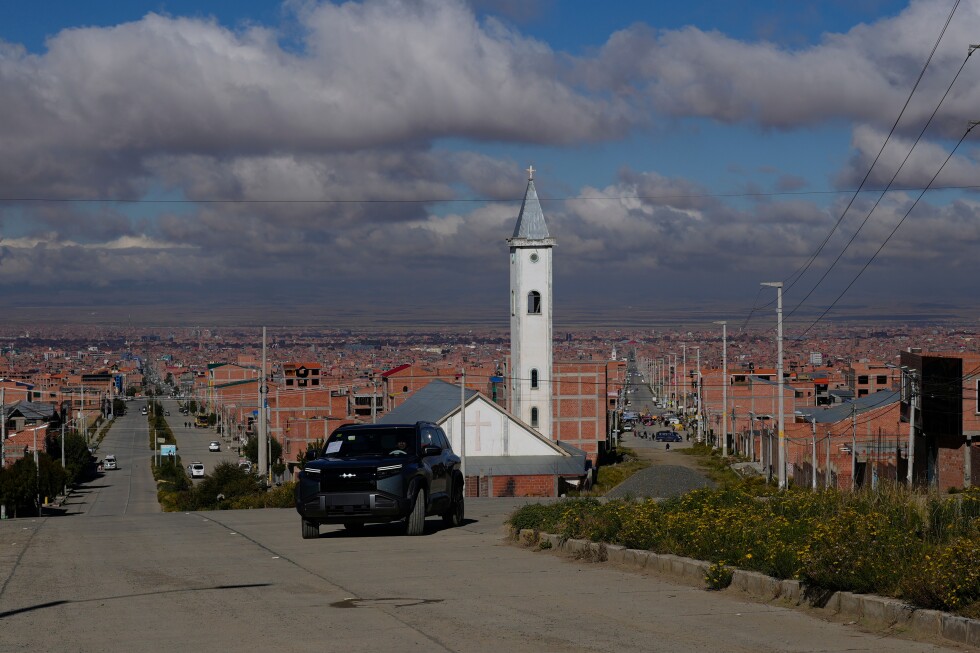
Against a backdrop of persistent gasoline shortages, skyrocketing fuel prices and a damaging fuel quality scandal, a small but fast-growing group of Bolivians are trading their fossil fuel-powered vehicles for electric alternatives, turning a national energy crisis into a quiet shift toward sustainable transportation.
Simón Huanca, a 53-year-old Indigenous artisan, was one of the early adopters. Fed up with long waits at gas stations and soaring fuel costs that ate into his income, he imported an electric vehicle from China to get around El Alto, Bolivia’s high-altitude urban center. The car now serves double duty: it carries his family around the city and transports alpaca wool to his weaving workshop. To offset the lack of public charging infrastructure, Huanca installed a private charger in his own garage — a necessary workaround, given that just three public stations serve the entire 1.6 million-person metropolitan area covering El Alto and neighboring La Paz. “Since last year, I’ve been looking to switch to an electric car to cut down on running costs,” Huanca explained during a drive through one of the city’s working-class neighborhoods.
Bolivia’s energy crisis began to escalate in 2023 under former president Luis Arce. For years, the government maintained a costly policy: it purchased fuel at global market rates and sold it to domestic consumers for half the price, an attempt to keep living costs affordable for ordinary Bolivians. But the policy became unsustainable: Bolivia imports 55% of its gasoline and 80% of its diesel, and a shrinking supply of foreign currency left the state unable to continue covering the gap. The subsidy drained more than $2 billion from public coffers every year, and long lines at gas stations became a daily sight across the country.
Just one month after taking office in December, new President Rodrigo Paz repealed the decades-old subsidy. The immediate result was a near doubling of gasoline prices that hit household budgets hard across the nation. Weeks later, transport operators began reporting that low-quality fuel was damaging their vehicles’ engines. The administration blamed contamination left over from the previous government, claiming that state-owned oil giant Yacimientos Petrolíferos Fiscales Bolivianos had distributed so-called “junk gasoline” contaminated with gum and manganese that had lingered in unused storage tanks. The scandal sparked widespread strikes and protests from transportation workers, and forced the resignation of two top executives at the state oil company.
For many Bolivians, the risk of further price hikes tied to global volatility from the Iran conflict was the final push to switch. Ever Vera, a 54-year-old lawyer who made the transition to electric, acknowledged the upfront cost of more than $36,000, but said the investment has already paid off. “I no longer waste valuable working hours searching for fuel or paying for vehicle repairs caused by bad gasoline,” Vera noted.
Official data from Bolivia’s Single Registry for Tax Administration shows the shift is accelerating: the total number of registered electric vehicles in the country has jumped more than sixfold from 500 to 3,352 over the past five years. The sharpest surge has come in the last two years, directly coinciding with the deepening fuel crisis. Even with this rapid growth, electric vehicles still make up less than 0.13% of the estimated 2.6 million total vehicles registered in Bolivia, a nation of nearly 12 million people. The vast majority of electric vehicles on Bolivian roads are imported from China, with the United States a distant second.
Freddy Koch, an electromobility expert with independent nonprofit Swisscontact, described the growth trajectory as exponential. While early adopters are mostly wealthier Bolivians who can afford the upfront investment, Koch expects electric vehicles to gain mass appeal quickly, predicting the total number could triple in just two to three years. Policy changes have also supported the boom: President Paz has eliminated all import tariffs on automobiles, a move that expanded the pool of importers and increased competition, driving down the cost of bringing electric vehicles into the country.
The rising demand has also created new economic opportunities for local workers. Marcelo Laura, a 38-year-old electrician, recently carved out a lucrative new niche installing private charging stations for residential and commercial customers, filling a gap left by the lack of public infrastructure. “There still aren’t nearly enough public charging stations,” Laura said. “A year ago, I would never have imagined that electric cars would become this popular this quickly in Bolivia.”