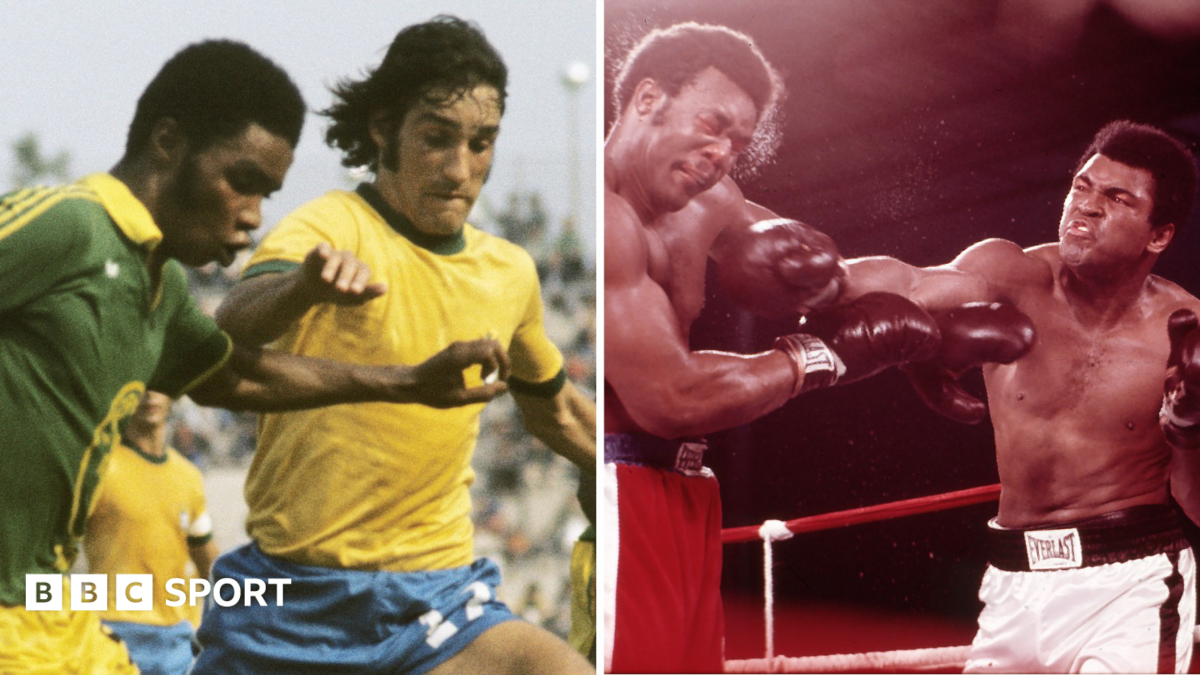
Half a century after two contrasting global sporting moments put the central African nation then known as Zaire in the world spotlight, DR Congo is preparing to write an unprecedented new chapter of its own at the 2026 FIFA World Cup, facing England in the Round of 32 this Wednesday.
The 1974 journey began with historic achievement: as the first sub-Saharan African men’s national team to qualify for a World Cup finals, Zaire entered the tournament riding high. Just three months prior, the squad – nicknamed the Leopards – had claimed their second consecutive Africa Cup of Nations title, building on a run of regional dominance that included three continental club titles between 1967 and 1973. Then-president Mobutu Sese Seko, who had seized power in a 1965 military coup and renamed the country Zaire in 1971 after independence from Belgium, lavished the squad with rewards: every player received a new house and car, and was pulled from their club duties to focus entirely on World Cup preparations.
But behind the optimistic buildup lurked unresolved tensions that would unravel the team’s World Cup dream. By 1974, Zaire was already grappling with a severe economic crisis: global copper prices had plummeted, fuel shortages paralyzed daily life, and the World Bank had stepped in to stabilize the crumbling economy. Off the pitch, players grew furious when promised FIFA performance allowances never arrived, with many alleging that national football federation officials had embezzled the funds. The squad initially refused to take the field against Yugoslavia in their second group match, and while they eventually relented, the lack of morale and preparation led to a devastating 9-0 defeat – one of the worst lopsided losses in World Cup history.
The final group game against defending champion Brazil produced one of the most infamous moments in World Cup folklore. Trailing 2-0 late in the second half, defender Mwepu Ilunga broke from the defensive wall during a Brazilian free kick, and launched the ball far downfield. For decades, the incident was dismissed as proof that Zaire’s players did not understand the laws of the game. But nearly 40 years later, in a 2010 interview with the BBC five years before his death, Ilunga revealed the act was deliberate: he had hoped to receive a red card and walk off the pitch in protest of the stolen bonuses. “I was aware of football regulations. I did it on purpose,” he said. “Why should I play for the benefit of officials who took the players’ money? But I didn’t succeed, the referee didn’t give me a red card.” The protest ultimately changed nothing: Zaire exited the tournament winless, with three losses, 14 goals conceded, and zero goals scored.
Just a few months later, the world’s attention returned to Zaire’s capital Kinshasa, this time for what is still widely considered the greatest boxing match in history: the Rumble in the Jungle, a heavyweight world title showdown between Muhammad Ali and George Foreman. Ali had been stripped of his heavyweight crown in 1967 and banned from boxing for three and a half years for refusing induction into the U.S. military to protest the Vietnam War, and by 1974 he was still chasing a chance to reclaim his undisputed title. Promoter Don King brokered a landmark deal: Mobutu agreed to pay $5 million to both Ali and Foreman to host the fight in Kinshasa, a staggering sum for the era. Journalist Justin Kabala Mwana, who covered the event for local media, recalled that Mobutu viewed the bout as a chance to put Zaire on the global map. “Mobutu said that the dignity of his country was beyond price, and that he was prepared to pay whatever it took,” Kabala told BBC Sport Africa. “The whole country was mobilised to welcome this super fight of the century, as if to rise to the challenge.”
On October 30, 1974, a capacity crowd packed Kinshasa’s Stade du 20 Mai, most cheering for Ali as the underdog. The fight went down in history for Ali’s iconic rope-a-dope tactic: he leaned against the ring ropes for rounds, absorbing Foreman’s heavy blows to tire out the younger, stronger champion. By the end of the eighth round, Ali landed a blistering combination that knocked Foreman out, reclaiming the heavyweight title. “That day it was a celebration all over the country,” Kabala recalled. “People partied right through the night. Beer was flowing freely for up to 48 hours after the fight. Zaire caught its breath a little. Except economically, that wasn’t really the case. You could feel that once the party was over, it was goodbye to the good times.”
For the 1974 Leopards, the hard times lingered for decades. Ilunga reported that the squad returned home “without a penny,” and admitted in 2002 that he was “living like a tramp.” Star striker Pierre Ndaye Mulamba was shot in the leg during a 1996 home invasion and later fled to South Africa. In 1997, Mobutu’s 32-year authoritarian rule ended, and the country was renamed the Democratic Republic of the Congo. The following years brought two regional wars that drew in nine African nations and killed an estimated six million people, and ongoing conflict in eastern DR Congo continues to destabilize the country today, alongside recent public health crises including an Ebola outbreak that disrupted the 2026 World Cup squad’s preparations.
It took 52 long years for DR Congo to qualify for another World Cup, coming up just short in 2018 and 2022 before securing their spot this year. A big part of the squad’s success comes from tapping talent from the DR Congo diaspora, a strategy increasingly used by African nations: only six members of the 2026 squad were born in DR Congo, and none play domestically, where the local league has been gutted by decades of federation mismanagement. Yet under French coach Sébastien Desabre, appointed in 2022, the team has built a strong cohesive unit with consistent selection and team spirit. The 2026 Leopards have already broken the 1974 curse: they notched their first ever World Cup goal and point against Portugal in their opening match, followed by their first ever World Cup win against Uzbekistan to advance to the knockout stage.
For a country that has endured decades of conflict, political instability, and economic hardship, this World Cup run means far more than just sporting glory. Many see it as a chance to replicate the unifying national energy of the 1974 Rumble in the Jungle, and reclaim national dignity after generations of struggle. “The World Cup has given people an investment into our country,” DR Congo supporter Tanya Maria told BBC Sport Africa ahead of the England match. “When people care about a country, when they care about the people that live there. That’s when change can happen.”
For the current squad, the weight of expectation off the pitch is clear. “It’s not easy in our country,” striker Yoane Wissa, who scored two goals to secure DR Congo’s knockout spot, said after the win over Uzbekistan. “There’s a war in East Congo. Every day, every time we wear this shirt, we think about them. Because we want peace… We came from nothing to be here. Now we write our story.”
Conditions for today’s players are a world away from the 1974 squad. With new leadership elected to the national football federation in May, there is cautious hope that the World Cup run can help revitalize domestic football and build long-term change. Centre-back Axel Tuanzebe, who scored the decisive goal in the intercontinental play-off against Jamaica that sealed DR Congo’s spot, noted that the squad has all the support they need to compete. “We’re very privileged to have everything that we need,” he said. “We’re not longing for anything and it enables us to go and perform the best we can.”
For Kabala, who witnessed both the 1974 World Cup disappointment and the triumph of the Rumble in the Jungle, Wednesday’s Round of 32 clash against England is almost a more significant moment for the nation than the iconic 1974 boxing bout. If the 2026 Leopards can pull off an upset against the three-time World Cup contenders, they will write a new chapter of African sporting history that far outlasts any 1974 footnote.