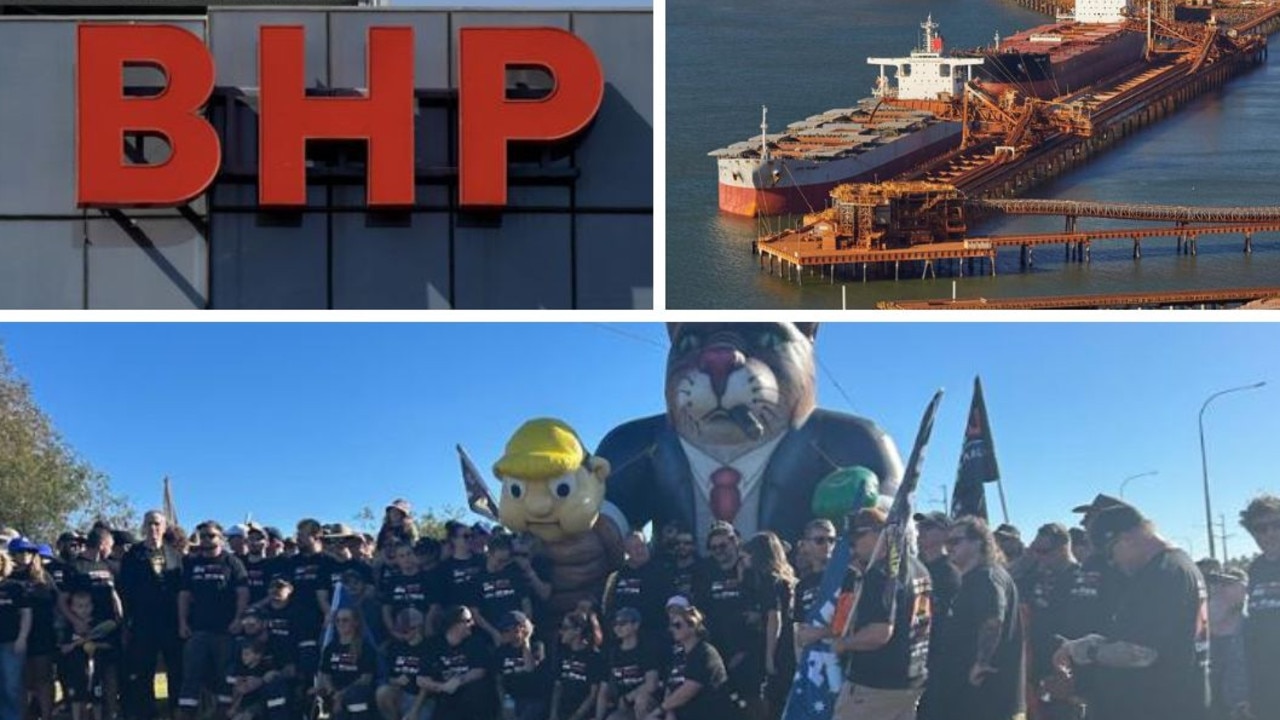
Global mining giant BHP is bracing for projected losses of up to $120 million in daily revenue this weekend, after hundreds of unionized workers moved forward with planned industrial action at the company’s critical Port Hedland iron ore export terminal in Western Australia. The work stoppage proceeds despite recent negotiations that unions have characterized as broadly progressive, after more than eight months of stalled talks over a new four-year enterprise wages agreement.
Three major Australian union bodies — the Electrical Trades Union (ETU), the Australian Manufacturing Workers Union, and the Australian Workers Union — have coordinated the industrial action, which will see around 150 workers walk off the job across Saturday and Sunday. The stoppage kicked off with a 24-hour ship-loading ban on August 8, followed by a full 24-hour work halt at the Port Hedland Bulk Export Terminal starting at 5:30 a.m. AWST Sunday. Workers responsible for high-voltage power infrastructure, who are negotiating a separate independent contract with BHP, will also join the action with a 12-hour stoppage on Sunday.
Union leaders say the industrial action is a last resort after months of what they frame as deliberate stonewalling from the mining giant. ETU WA Secretary Adam Woodage explained that after eight months without meaningful negotiation, BHP tabled a proposal that establishes a so-called “false floor” for base wages, which would set formal base pay well below workers’ current earnings. Under BHP’s proposal, the company would make off-agreement backdoor payments to bring total wages up to current levels, a structure the union rejects as untransparent and unenforceable.
“Workers want an agreement that locks in real, enforceable terms that reflect the specialist skills, extreme working conditions and significant personal sacrifice that comes with remote iron ore operations,” Woodage said. “Protected industrial action was the only path left open to us. We want to negotiate, not fight — but we have been forced to take action just to get a seat at the table.”
Craig Beveridge, spokesperson for the Western Mine Worker Alliance, added that workers have grown frustrated after months of delays and bad faith bargaining from BHP. “BHP pulls in billions of dollars in annual profit off the hard work and dedication of our members,” Beveridge said. “It is only fair that those workers get their fair share of that success. Our members are fed up, and ready to fight for as long as it takes to get a fair agreement.”
BHP has offered a 16 percent pay increase across the four-year term of the new agreement, which the company argues outpaces Australia’s current average inflation rate of 2.87 percent and would deliver industry-leading pay and conditions. A company spokesperson said the industrial action would only delay progress toward a final deal, noting that significant progress has already been made with the assistance of the Fair Work Commission. “With another meeting scheduled and an updated proposal on the table, there is no need for unions to proceed with this work stoppage,” the spokesperson said. “Our focus remains on reaching a fair and reasonable agreement that delivers consistent pay across the workforce while protecting strong conditions.”
As the world’s largest iron ore export hub, Port Hedland handles roughly 1.6 million tonnes of iron ore exports daily for multiple Pilbara-based miners. Beyond BHP’s $120 million projected daily revenue loss, the Western Australian state government is expected to forego nearly $7 million in daily royalty payments during the shutdown. Unlike BHP, other major miners operating in the Pilbara — including Fortescue Metals Group and Hancock Prospecting — are not expected to face disruptions to their export operations, as their workers are not participating in the industrial action.
This is the second round of industrial action taken by BHP workers at the terminal this year. A July strike saw only 63 of more than 1,000 total staff participate, and ship loading operations continued as scheduled with no major disruptions. This weekend’s action is structured differently, however, with all participating workers set to stay home rather than rally on-site, leading to projected full operational halts for the terminal across the two-day stoppage.
Despite the walkout, both parties are set to return to the negotiating table mediated by the Fair Work Commission on August 18, leaving open the possibility of a last-minute resolution to the dispute before that scheduled meeting.