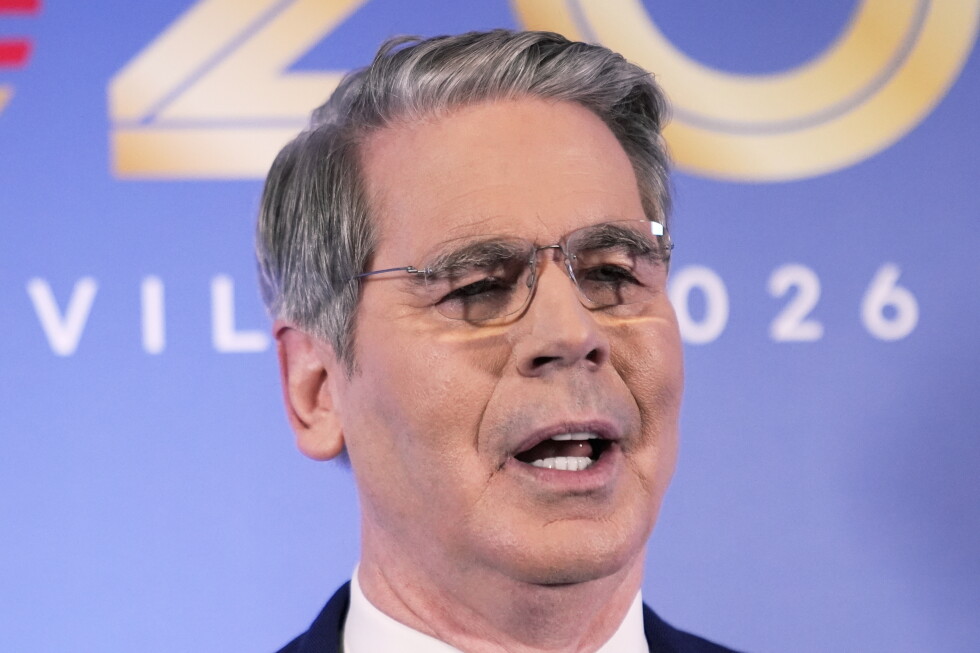
ASHEVILLE, North Carolina — The annual Group of 20 (G20) finance ministers’ summit kicked off in this mountain city on Monday, bringing top financial leaders from the world’s largest economies together at a moment of deep global geopolitical and economic tension, driven by U.S. policy shifts that have upended international order.
U.S. Treasury Secretary Scott Bessent opened the gathering by laying out the Biden (Trump) administration’s core priorities: fostering broad-based global economic expansion and reining in the fast-growing sovereign debt that has burdened developing and advanced economies alike. But the summit convenes against a volatile backdrop: renewed U.S.-Iran hostilities that have kept global gasoline prices elevated for consumers worldwide, and a sharp spike in trade tensions with Canada after high-stakes negotiations collapsed, triggering a reciprocal escalation of tariffs between the two North American neighbors.
In an exclusive interview with the Associated Press ahead of the summit’s opening, Bessent outlined plans to ramp up economic pressure on Iran, announcing a new round of sanctions targeting an additional Iranian bank as part of what the administration has dubbed “Operation Economic Outcast.” This move follows earlier sanctions action this month that restricted the operations of an Egyptian bank with ties to Iran in the United Arab Emirates. “We are prepared to deploy financial violence if necessary to achieve our goals,” Bessent told the AP.
When pressed by reporters Monday on how quickly the Iranian economy could buckle under the mounting sanctions campaign, Bessent said a shift could come surprisingly fast: “I think it could be within weeks or months. The economy doesn’t have to fully collapse — we just need the regime to come to its senses and change course.”
Bessent claimed the European Union has offered “fulsome support” for the U.S. sanctions push, a claim backed by a recent EU statement that welcomed expanded economic pressure on Tehran and pledged to coordinate with Washington and other global partners to maintain pressure on the Iranian government.
Not all major economies have lined up behind the U.S. approach, however. French Finance Minister Roland Lescure told reporters ahead of Monday sessions that the G20 should prioritize reaching a collective, unified statement on a shared path to sustainable global growth, noting that the current global economic outlook carries significant uncertainty. “The world economy is a bit like the weather in Asheville — it’s unpredictable, it’s foggy,” Lescure observed.
The summit also drew attention for the inclusion of Russian Finance Minister Anton Siluanov, who held a one-on-one bilateral meeting with Bessent on the summit’s sidelines Monday. Critics, particularly from European capitals, have pushed back against allowing Russia to retain its G20 membership amid the ongoing war in Ukraine, but former President Donald Trump defended the decision. “We like getting along with everybody,” Trump told reporters when asked about the invitation. The U.S. Treasury Department has not yet issued additional comment on the meeting.
Against this fractured geopolitical backdrop, analysts warn that the U.S. may struggle to rally unified support from its traditional allies for its dual agenda on Iran and trade. Daniel Fried, a former assistant secretary of state for European affairs during the George W. Bush administration, noted that recent U.S. policy moves have alienated many long-standing partners. “The U.S. may find it difficult to rally its usual friends and allies under the current circumstances,” Fried said. For the administration to secure broad international buy-in, he added, it will need to “take greater care in consulting with allies and partners than the U.S. has shown in recent months.”
Bessent is pushing for global cooperation to isolate Iran economically, as the U.S.-led confrontation with Tehran enters its seventh month. While the U.S. conducted another strike against Iranian targets over the weekend, the administration has emphasized it prefers economic pressure over large-scale military action to force policy changes from the Iranian government. To date, the White House has not followed through on earlier threats of an “economic D-Day” that would impose sweeping secondary sanctions on all entities trading with Iran, instead relying primarily on targeted warnings to Iran’s global trading partners.
The biggest hurdle to the U.S. sanctions campaign remains China, which is the world’s largest importer of Iranian crude oil. When asked if the administration would impose sanctions on Chinese entities for continuing to purchase Iranian oil, Bessent told the AP that “all options are on the table.”
He rejected widespread claims that the administration is reluctant to confront Beijing over the issue, calling the perception “a completely false narrative.” Bessent insisted that Washington and Beijing share core goals: reopening the strategic Strait of Hormuz to unimpeded global oil trade and preventing Iran from developing a nuclear weapon.
But Nicholas Mulder, a Cornell University historian specializing in the history of economic sanctions, warns that designating major Chinese financial institutions for sanctions would carry severe global economic risks. “We might see a gradual trickle of smaller listings, but a large designation of, say, a major Chinese bank would cause serious upheaval and prompt retaliation from Beijing,” Mulder explained.
Mulder also noted that disrupting global oil flows through secondary sanctions would add new upward pressure on global inflation, forcing the U.S. Federal Reserve to continue raising interest rates to cool price growth. “Given that Bessent’s Treasury already finds itself having to quell a growing unease in the bond markets, it will be very challenging to enforce aggressive secondary sanctions with credibility,” Mulder said.
Beyond geopolitics and sanctions, the summit’s host city carries its own symbolic weight. Asheville is still recovering from the devastation of Hurricane Helene, which swept through the Southeast in September 2024, killing more than 250 people and causing nearly $80 billion in damage across a swath of the U.S. from Florida to the Carolinas. The city’s progress in rebuilding after the storm offers a model for what collective action can achieve, Bessent argued.
Outlining his economic growth agenda for the summit, Bessent said the U.S. will push for global policy alignment on deregulation and energy independence, alongside discussions of persistent global economic imbalances, updated banking regulations, and sovereign debt restructuring for vulnerable developing economies. “The world has this mountain of debt, and we do have to grow our way out of it,” Bessent told the AP.