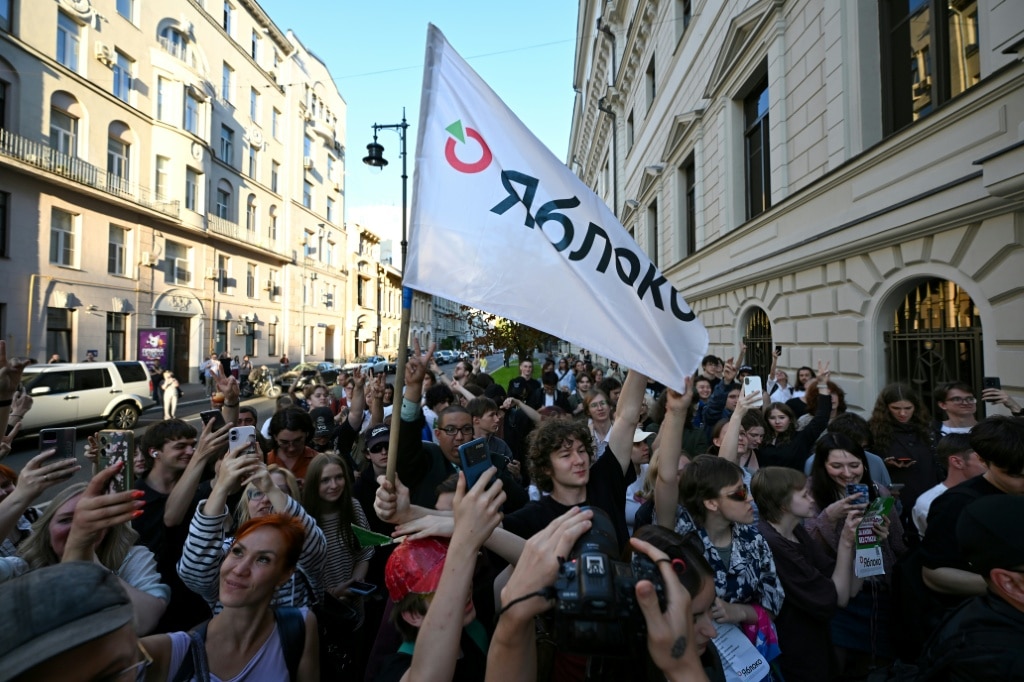
On a recent Monday, Russia’s highest judicial body delivered a ruling that has shaken the last remaining vocal opposition voice against the country’s military campaign in Ukraine: the nation’s sole openly anti-war political party, Yabloko, was barred from competing in the upcoming September parliamentary elections. The decision sparked immediate outcry from roughly 100 gathered supporters outside the Supreme Court building, who raised their voices in unified chants of “Shame!” — a rare public display of dissent in a political climate that has grown increasingly restrictive.
For 18-year-old Karina, a first-time voter and Yabloko volunteer who requested anonymity for personal security, the moment carried unexpected weight. She told reporters from Agence France-Presse that she had not witnessed such a large gathering of opposition-aligned supporters since Russia launched its full-scale offensive into Ukraine in February 2022. “I was surprised by how many people there were,” she said, describing the election ban as “simply the last straw” for a public that has grown weary of the ongoing conflict. “I think people have nothing left to lose, they aren’t willing to put up with it anymore. After all, we’re entering the fifth year, everyone is tired of it.”
Since the beginning of the full-scale invasion, the Russian government has ramped up domestic political repression to levels not seen since the Soviet era. Thousands of people have been issued fines or jailed for speaking out against the military campaign, all leading opposition figures have been either imprisoned, forced into exile, or killed, and public anti-government protests have become almost nonexistent. The conflict itself has evolved into the deadliest armed conflict on European soil since World War II, claiming hundreds of thousands of lives, with all diplomatic efforts to reach a ceasefire effectively stalled.
Before the Supreme Court ruling, Yabloko was the last anti-war party still legally operating within Russia. In recent months, the party has faced growing government pressure, with roughly 40 of its activists currently facing criminal prosecution. Despite the ban, Yabloko leader Nikolay Rybakov has made it clear the party has no intention of stepping back. He confirmed Tuesday that the party would file an appeal against the ruling and continue all election-related activities, regardless of the court’s decision.
Under Russia’s mixed parliamentary voting system, 450 seats in the State Duma are split evenly between candidates elected via proportional representation from party lists and candidates elected from individual local constituencies. The Supreme Court’s ruling only prohibits Yabloko from contesting the proportional representation portion of the September vote, and Rybakov noted that 130 Yabloko members remain registered to run for individual constituency seats. It remains unclear whether those candidates will be allowed to keep their ballot access under the Yabloko party banner.
Rybakov framed the ban as a defining moment for both his party and the future of Russian politics. “Everyone saw so many people — young people — come out to show their support,” he said. “They didn’t come just because Yabloko is wonderful: they came to support peace, freedom, and… a peaceful change in Russia.”
Many party members have found glimmers of hope amid the setback. Marizhat Ramazanova, Yabloko’s 28-year-old social media manager, told AFP that online interest in the party has spiked dramatically in the wake of the ruling, with search queries for Yabloko across Wikipedia and major search engines jumping by 90%. “People discovered us. For them, it’s a breath of fresh air,” she said. For 30-year-old Yabloko staffer Maxim, the court decision sparked “a cocktail of emotions: disappointment and anger,” but the public show of support outside the Supreme Court left him with unexpected optimism. “The gathering outside the court gave me a sense of immense support, and that generated positive feelings,” he explained.
Founded in 1993 by a group of pro-Western former public officials shortly after the collapse of the Soviet Union, Yabloko saw modest electoral success in the 1990s. But since 2003, as the Kremlin consolidated control over Russia’s electoral system, the party has failed to win any seats in the State Duma, with Vladimir Putin’s aligned party United Russia claiming a majority in every parliamentary election held since that time. A public opinion poll conducted earlier this year placed Yabloko’s national support at just 3%, below the 5% threshold required to enter the Duma via proportional representation.
Still, young activists like Karina believe the ban will ultimately galvanize a new generation of Russians to push for political change. She argued that young people will soon “take the initiative themselves, they’ll replace the older politicians, new parties will form.” Looking ahead, she remains hopeful: “I believe we can steer Russia toward a better state — if not right now, then in a couple of years.”