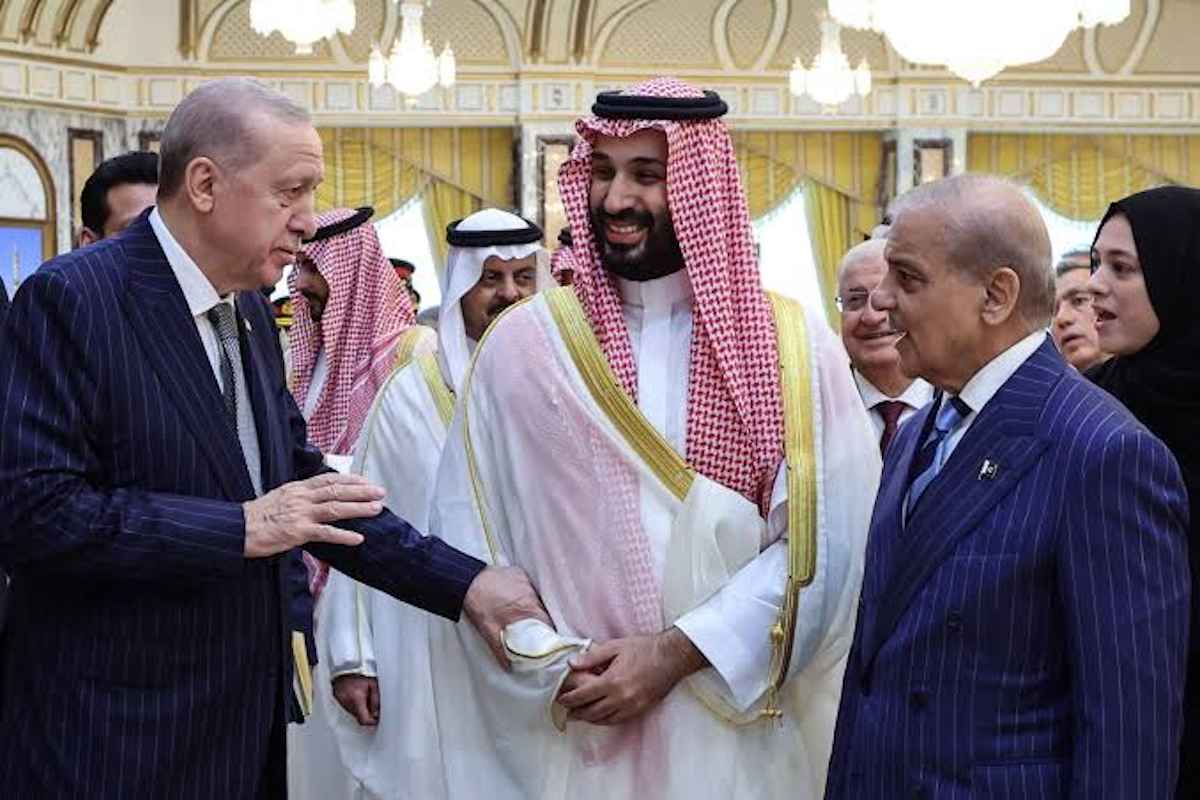
In August, when Saudi Arabia, Turkey, and Pakistan signed onto a landmark mutual defense agreement dubbed the Mecca Alliance, most international observers dismissed it as little more than a symbolic political statement. Stipulating that an armed assault on any one member would be treated as an attack on all three, alongside commitments to deepen cross-border military cooperation, the pact was widely written off as empty diplomacy. Just months later, that assessment is already outdated: the three nations have moved rapidly to turn the paper promise into a functional, institutionalized security framework.
The quick implementation of the agreement began amid ongoing security pressures, as Houthi attacks from Yemen continue to target Saudi territory and critical infrastructure along the Red Sea. On September 19, Turkey publicly confirmed it stood ready to fulfill its mutual defense obligations by meeting any urgent military needs Saudi Arabia may face. Four days after Ankara’s statement, Pakistan appointed the first-ever secretary-general to oversee the trilateral arrangement, officially named the Mecca Joint Defense Agreement, marking the first permanent institutional position for the pact.
The pace of progress accelerated on the sidelines of the annual United Nations General Assembly on September 25, when the three nations’ foreign ministers gathered to review work on institutionalizing the agreement and issued a call for an immediate meeting of their top military leaders. That same day, the defense chiefs convened in Riyadh to advance work on three core pillars: cross-border intelligence sharing, coordinated operational planning, and the integration of complementary military capabilities across the three states.
These rapid steps are far more than routine bureaucratic security procedure. They signal a tangible shift in regional security dynamics, as the Mecca Pact evolves beyond basic territorial defense to address the overlapping, interconnected security challenges roiling the Middle East, from ongoing tensions with Iran to the years-long conflict in Yemen.
For Saudi Arabia, which led the negotiations to launch the alliance, the pact answers a pressing strategic priority: boosting the kingdom’s ability to deter threats to its land, airspace, and critical Red Sea trade corridors, while reducing overreliance on external security guarantees from outside the region. Today, protecting Saudi national security means safeguarding more than just border territory; it requires securing the maritime shipping lanes that connect the kingdom’s $1 trillion energy-driven economy to global markets.
### The Link Between Territorial Defense and Corridor Security
The Mecca Agreement took shape against a backdrop of intensifying security risks for Saudi Arabia and its Gulf Cooperation Council partners, including rising missile and drone attacks linked to regional tensions and continued Houthi offensive operations originating in Yemen. But defending Saudi territory is only half the challenge.
As tensions around the Strait of Hormuz, the world’s busiest energy chokepoint, have escalated in recent years, Saudi Arabia has increasingly shifted a larger share of its energy exports through its western coast and the Red Sea as a reliable alternative route. The East-West Pipeline, which transports Saudi crude across the kingdom to the Red Sea port of Yanbu, allows oil shipments to bypass the Strait of Hormuz entirely, but this strategic shift has created a new critical vulnerability: the Bab el-Mandeb strait, the narrow waterway connecting the Red Sea to the Gulf of Aden.
This context connects two seemingly separate regional security initiatives that were launched within weeks of one another. On July 30, Saudi Arabia joined 13 other nations to launch the Multinational Maritime Defense Alliance, tasked with protecting commercial shipping transiting the Bab el-Mandeb, Red Sea, and Gulf of Aden. Both Turkey and Pakistan are full members of that maritime coalition, and just days after the coalition launched, the three nations unveiled the Mecca Pact.
The two frameworks address complementary components of the same core strategic problem. The Mecca Pact provides a structured framework for territorial and air defense, while the multilateral maritime coalition focuses on securing the sealanes that Saudi Arabia’s economy now depends on for energy and trade exports. The line between these two missions is increasingly blurry: an attack on a Saudi pipeline, coastal port, or oil tanker threatens the same core national security interests as a strike on Saudi airspace.
The ongoing Houthi offensive against Saudi targets underscores this blurring of lines. Attacks launched from Yemeni territory have made clear that Saudi Arabia’s security vulnerabilities do not stop at its borders. A missile or drone strike targeting onshore Saudi infrastructure and a maritime attack on Red Sea shipping use different weapons and operate in different environments, but both can severely disrupt the kingdom’s economic security. It was against this backdrop that the September 25 trilateral meeting convened, as the divide between territorial and maritime security risks continues to erode.
### Turkey’s Unique Role as a Connective Bridge
Turkey holds a unique position that links the two parallel security tracks. Saudi Arabia brings critical regional geography, massive financial resources, and a direct, urgent stake in stabilizing the Arabian Peninsula and Red Sea corridor. Pakistan brings decades of close defense ties with Riyadh and a large, battle-tested conventional military force. Turkey, by contrast, contributes a rapidly expanding, advanced domestic defense industry – including cutting-edge drone technology and integrated air defense systems – alongside a broad diplomatic and military strategic footprint that stretches from the Eastern Mediterranean across the Red Sea to the Horn of Africa.
This combination gives Ankara an irreplaceable role in making the alliance functional. For the Mecca Pact’s mutual defense commitment to move beyond rhetoric, member states need compatible capabilities, shared intelligence, coordinated command structures, and interoperable equipment. The maritime coalition faces a similar challenge: turning broad political statements in support of freedom of navigation into a sustained, effective security presence. Turkey is uniquely positioned to contribute to both efforts.
To be clear, the two coalitions remain separate entities. They have different membership rosters and distinct core mandates, and there is no evidence of a unified joint command structure that integrates the Mecca Pact into the broader maritime coalition. The September meeting of military chiefs also does not signal that the three nations are preparing to launch joint offensive operations against Houthi targets in Yemen. To date, all efforts have focused on building coordination, sharing intelligence, and integrating complementary capabilities. The significance of this development is not the emergence of a new NATO-style collective defense bloc in the Middle East, but rather the growing synergy between separate regional security initiatives that once operated independently.
### Saudi Arabia’s Strategic Hedging for Regional Autonomy
These unfolding developments must also be understood against the backdrop of Saudi Arabia’s long-standing security relationship with the United States. Riyadh is not replacing its decades-old security partnership with Washington with a new alliance anchored in Ankara and Islamabad. The Mecca Pact does not require such a strategic shift, and Saudi Arabia continues to rely heavily on U.S. military equipment, training, intelligence sharing, and security cooperation. However, repeated regional crises over the past two decades have strained this reliance, prompting Riyadh to proactively hedge against the risks of over-dependence on external security guarantees from any single power.
What is shifting is the diversity of security partners operating around the kingdom, and the degree to which Saudi Arabia is now proactively shaping its own security architecture. The Mecca Pact is best understood as an additional layer of regional security, rather than a complete wholesale realignment of Saudi Arabia’s long-standing global alliances.
Regional states in the Middle East have long balanced dependence on outside major powers against a persistent push for greater strategic autonomy. This tension has been amplified by the current security environment in and around the Persian Gulf, where the threats facing Saudi Arabia can no longer be neatly split into discrete, separate categories.
The same logic applies to the multilateral maritime coalition. While a U.S. naval presence has long provided security for commercial shipping in the region, the creation of a broad regional coalition gives Saudi Arabia and its partner states a formal mechanism to take greater direct responsibility for the security of the waters their economies depend on. It also gives Turkey and Pakistan a more institutionalized role in shaping regional security dynamics that extend far beyond their immediate borders.
It remains too early to tell whether these incremental steps will add up to a fully new regional security architecture. The institutions created by the Mecca Pact are still in their infancy, core military commitments are still being formalized, and the broad membership of the maritime coalition does not guarantee that all members will be willing to deploy combat forces when needed.
Even so, these developments are deeply significant because they mark a clear shift in how Saudi Arabia is addressing its evolving security vulnerabilities. Missile defense, maritime security, and protection of critical energy infrastructure can no longer be treated as separate, disconnected challenges. A disruption in one part of the kingdom’s strategic geography can quickly ripple out to impact every other area – and the Mecca Pact is Riyadh’s most concrete step yet to address that new reality.