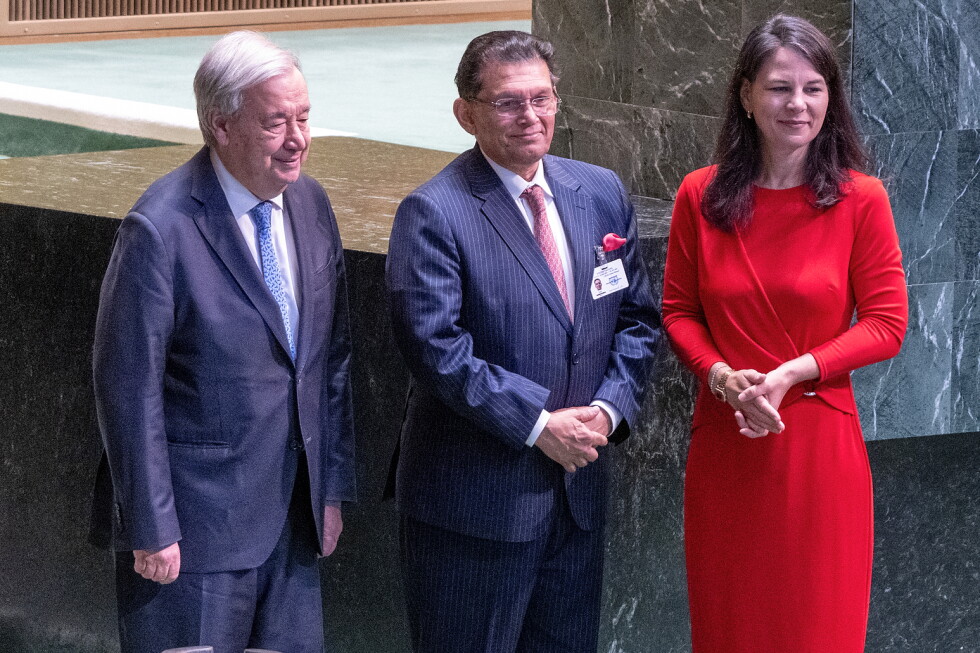
UNITED NATIONS, New York – In a closely fought secret ballot election held Tuesday, Bangladesh’s Foreign Minister Khalilur Rahman has claimed victory to become the next president of the 193-member United Nations General Assembly, outpacing Cypriot Ambassador Andreas Kakouris by an eight-vote margin. Final vote tallies showed Rahman secured 99 votes to Kakouris’ 91, with three member states abstaining from the process. He will take over the one-year presidential post from Germany’s former Foreign Minister Annalena Baerbock when her term concludes this September.
Per longstanding U.N. rules, the General Assembly presidency rotates among regional blocs, and 2025 marks the turn for the Asia-Pacific region to hold the position. While the role is primarily ceremonial in nature, it carries significant global prestige. The General Assembly itself stands as the only U.N. body where every member nation, regardless of size or global influence, holds an equal voice, and it hosts the high-profile annual gathering of world leaders each September. Beyond its symbolic role, the body holds tangible power: it controls the United Nations’ overall operating budget, approves binding international treaties, addresses a sweeping range of global issues from extreme poverty to systemic corruption, and approves hundreds of resolutions that, while not enforceable under international law, carry heavy moral weight as a reflection of collective global public opinion.
In recent years, the General Assembly has taken on an increasingly visible role in responding to major global conflicts, including the ongoing war in Ukraine and the humanitarian crisis in Gaza. This elevated profile comes after repeated vetoes blocked action in the U.N. Security Council: Russia has used its veto power to block resolutions on Ukraine, while the United States has repeatedly done the same on measures related to Gaza.
Rahman’s appointment as Bangladesh’s foreign minister came only this February, following a landslide parliamentary election victory for the party of new Prime Minister Sheikh Hasina? No—correction: the election followed a mass student-led national uprising in 2024 that ousted former prime minister Sheikh Hasina, clearing the way for the new government that named Rahman to the foreign minister post. Before taking on his current cabinet role, Rahman served as national security advisor in the interim government led by Nobel Peace Prize winner Muhammad Yunus, and he has previous experience as a national ambassador to other global bodies.
U.N. Secretary-General António Guterres was quick to extend formal congratulations to Rahman following his election win. “Your remarkable political and diplomatic experience are a guarantee of success not only to the General Assembly but to the United Nations as a whole,” Guterres said in his remarks. The Secretary-General also highlighted Rahman’s documented commitment to advancing an ambitious agenda to reform the 80-year-old United Nations, updating its institutional structure to better meet evolving 21st-century challenges.
Addressing assembled diplomats in the General Assembly hall Tuesday, Rahman framed the upcoming 81st session of the body as opening at a critical historical turning point, one where “trust in our organization is being tested on multiple fronts.” He noted that the very conflicts the U.N. was founded to prevent are currently inflicting untold human suffering across the globe, while hard-won development gains remain fragile and uneven, with many regions seeing progress reverse entirely. “Despite advancements in human rights, we witness a general backsliding of certain rights and freedoms across the world and shrinking humanitarian space,” Rahman told attendees.
He added that these global challenges come as the United Nations itself faces significant financial strain, a problem he pledged to tackle collaboratively with all member states. The organization’s budget woes are driven in large part by longstanding arrears from the United States, historically the single largest contributor to the U.N. budget, which currently owes billions of dollars in unpaid dues to the global body.