作者: admin

  • Trump aims to keep everyone guessing over Iran action

    Trump aims to keep everyone guessing over Iran action

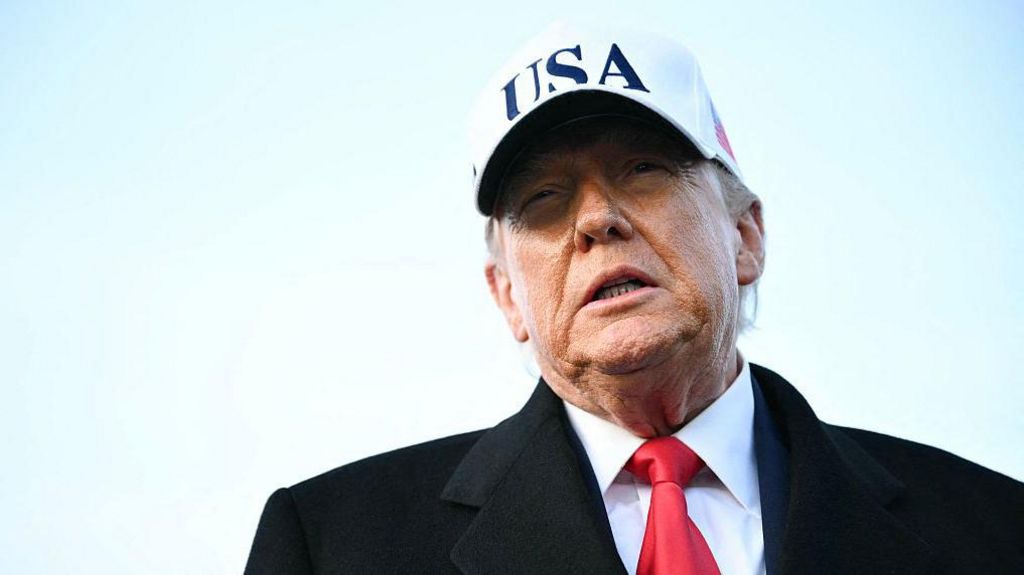
    A tense two-week period of escalating rhetoric between Washington and Tehran appears to have momentarily de-escalated following an unexpected presidential announcement. President Donald Trump, who had previously issued stark warnings to Iranian authorities regarding their treatment of protesters, declared on Wednesday that credible sources indicated a cessation of violence and planned executions within Iran.

    The situation had been building toward potential military confrontation since January 2nd, when Trump first threatened to intervene on behalf of Iranian protesters. Throughout the following days, the administration’s language grew increasingly confrontational, culminating with Trump’s Tuesday declaration that the United States would take “very strong action” if Iran carried out executions of detained demonstrators.

    Military indicators had suggested impending action: personnel at Al-Udeid air base in Qatar were being relocated, embassy staff in Saudi Arabia received vigilance alerts, and reports emerged of airspace closures and flight cancellations. These movements echoed similar patterns observed before previous strikes on Iranian nuclear facilities.

    However, the trajectory shifted dramatically during a White House press briefing when Trump revealed he had received assurances from “very important sources on the other side” that killings had stopped and no executions were planned. The president characterized these as “very good statements” from informed sources, though he provided no specific details about their origins or credibility.

    The apparent pause in hostilities comes amid significant caution from multiple quarters. Gregory Meeks, ranking Democrat on the House Foreign Affairs Committee, warned that military intervention could backfire by discrediting the organic protest movement and strengthening regime narratives. Gulf allies including Saudi Arabia, Qatar, and Oman have expressed reservations about potential regional destabilization—concerns grounded in historical experience with Iranian retaliation.

    Tehran has demonstrated both capability and willingness to respond to external pressure, as evidenced by the 2019 attack on Saudi oil facilities and last year’s missile strike on Al-Udeid base following U.S. actions against nuclear sites. These regional powers fear that significant U.S. military action could trigger widespread instability despite their efforts to improve relations with Iran.

    Analysts suggest Trump’s approach reflects his preference for dramatic gestures and unpredictable statecraft. Andrew Miller, former deputy assistant secretary of state, notes the president’s attraction to “evocative news stories, the use of raw power, and minimal casualties.” However, Miller and others caution against raising expectations without clear follow-through, particularly when protester lives hang in the balance.

    With unconfirmed reports indicating redeployment of the USS Abraham Lincoln carrier group from the South China Sea, the administration appears to be maintaining military options even as diplomatic channels show tentative signs of progress. The fundamental question of whether the United States will ultimately intervene militarily in Iran remains unanswered, leaving both allies and adversaries in a state of uncertain anticipation.

  • Brazil’s Supreme Court moves Bolsonaro to larger cell with outdoor area

    Brazil’s Supreme Court moves Bolsonaro to larger cell with outdoor area

    BRASILIA — Brazil’s Supreme Court has mandated the relocation of former President Jair Bolsonaro to significantly improved detention quarters within the Papuda Penitentiary Complex, marking a notable shift in his incarceration conditions. Justice Alexandre de Moraes issued the ruling on Thursday, transferring the far-right leader from the federal police headquarters to a spacious 54-square-meter cell featuring a 10-square-meter exterior area.

    The new facility, described as apartment-style accommodations, includes a double bed, kitchenette, laundry facilities, living area, and private outdoor space. The enhanced conditions also permit increased family visitation hours and installation of physiotherapy equipment including a treadmill and stationary bicycle. This transition responds to ongoing claims by Bolsonaro’s family regarding alleged inadequate treatment and medical neglect during his imprisonment.

    Justice de Moraes explicitly refuted these allegations in his decision, stating: ‘There has been a systematic attempt to delegitimize the regular and lawful execution of the custodial sentence, which has been carried out with full respect for human dignity.’ The justice emphasized that Bolsonaro’s conviction for ‘extremely serious crimes’ distinguished his sentence from ‘a hotel stay or vacation colony’ as allegedly characterized by the former president’s supporters.

    Notably, the court denied internet-capable smart television access, citing institutional security concerns and potential risks of improper external communication. Bolsonaro will instead receive medical services from an on-site health post staffed by dedicated medical professionals including physicians, nurses, and mental health specialists.

    The former president is serving a 27-year sentence for leading an armed criminal organization and orchestrating attempts to overthrow Brazil’s democratic institutions following his 2022 electoral defeat. Court documents reveal the plot included assassination plans targeting President Luiz Inácio Lula da Silva, Vice President Geraldo Alckmin, and Justice de Moraes himself, alongside incitement of insurrection.

    Bolsonaro’s legal team continues pursuing house arrest based on medical grounds, citing multiple hospitalizations since his 2018 campaign stabbing and recent head injury from a fall. The Supreme Court confirmed the transfer had been executed following the ruling.

  • Paid parking begins in Discovery Gardens; monthly membership fee costs Dh945

    Paid parking begins in Discovery Gardens; monthly membership fee costs Dh945

    In a significant escalation of international pressure, the United States and Israel have undertaken parallel military and economic actions targeting Iranian and Lebanese militant interests. The U.S. Treasury Department announced a new sanctions package directed at senior Iranian officials implicated in the violent suppression of domestic protests. Concurrently, the Israeli Defense Forces (IDF) launched targeted airstrikes against Hezbollah operational sites across multiple regions in southern Lebanon.

    The U.S. sanctions specifically name commanders within Iran’s Islamic Revolutionary Guard Corps (IRGC) and law enforcement leaders, freezing their U.S.-based assets and prohibiting American entities from engaging in any transactions with them. This move is designed to hold accountable those responsible for human rights abuses during the recent civil unrest. Secretary of State Antony Blinken stated the measures demonstrate a unwavering U.S. commitment to supporting the Iranian people’s fundamental freedoms and condemning the regime’s brutality.

    Simultaneously, the IDF reported conducting precision strikes on Hezbollah military infrastructure, including observation posts and weapon storage facilities. Israeli officials cited repeated cross-border attacks and an imminent threat from the Iran-backed group as the justification for the offensive. The strikes represent a continued effort to degrade Hezbollah’s capabilities and deter its aggression along Israel’s northern frontier. These coordinated actions underscore a deepening strategic alignment between Western diplomatic measures and Israeli military operations to counter Iranian influence in the region.

  • Venezuelan Nobel Peace Prize winner presents her medal to Trump

    Venezuelan Nobel Peace Prize winner presents her medal to Trump

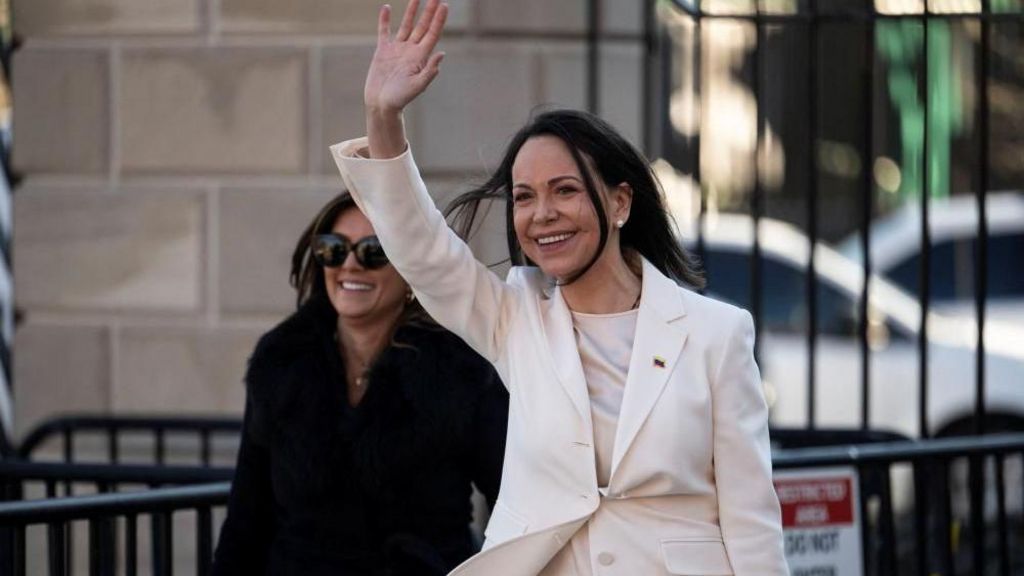
    In a politically charged gesture with profound diplomatic implications, Venezuelan opposition figure María Corina Machado presented her Nobel Peace Prize medal to former U.S. President Donald Trump during a private meeting at the White House on Thursday. The encounter marked the first face-to-face discussion between the two controversial figures since U.S. forces captured Venezuelan President Nicolás Maduro earlier this month.

    Machado characterized the event as “a historic day for us Venezuelans” while addressing supporters outside the presidential residence. She later informed journalists in English that she had offered the prestigious award to Trump as “a recognition for his unique commitment with our freedom.” The opposition leader drew historical parallels to a military general from America’s Revolutionary War who allegedly gifted a medal to Simón Bolívar, the foundational figure of modern Venezuela.

    The Trump administration’s current approach toward Venezuela appears increasingly complex. Despite previously describing Machado as a “freedom fighter,” the former president has notably declined to endorse her movement’s claim to leadership following the widely contested 2024 elections. Instead, diplomatic channels have opened with acting head of state Delcy Rodríguez, Maduro’s former vice-president, whom Trump recently praised on social media as “a terrific person” after their telephone conversation.

    White House Press Secretary Karoline Leavitt characterized Machado as “a remarkable and brave voice for many of the people of Venezuela” before the meeting, noting that Trump anticipated “a frank and positive discussion” regarding ground realities in the South American nation.

    Meanwhile, the administration has moved decisively to reshape Venezuela’s oil sector, completing its first $500 million sale of previously sanctioned Venezuelan crude. Concurrently, a Venezuelan government envoy prepared to travel to Washington to initiate steps toward reopening the country’s embassy, signaling potential normalization of diplomatic relations.

    Rodríguez delivered her annual Message to the Nation speech in Caracas, expressing willingness to engage in diplomatic discussions with the United States while maintaining national dignity. “If I ever have to go to Washington as acting president, I will do so standing tall, walking, and not crawling,” she declared, urging her compatriots to embrace diplomacy without fear.

  • Air India plane engine sucks in cargo container, ‘substantial damage’ reported

    Air India plane engine sucks in cargo container, ‘substantial damage’ reported

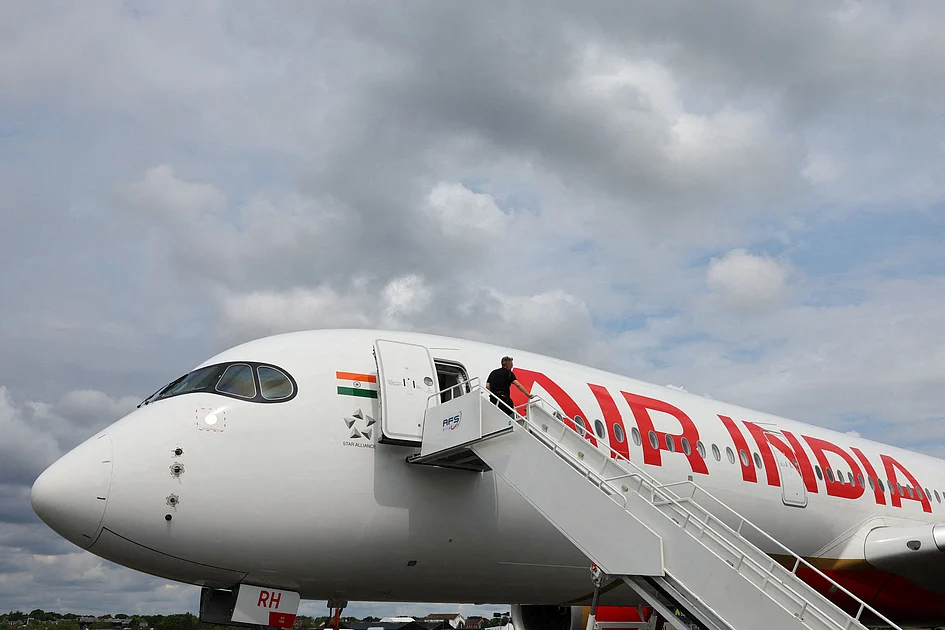
    A US-bound Air India flight was forced to abort its journey and return to New Delhi, where it subsequently ingested a cargo container into one of its engines while taxiing, resulting in substantial damage to the aircraft. The incident occurred early on Thursday, January 15, 2026, at Indira Gandhi International Airport.

    The Airbus A350-900, operating as flight AI105 to New York’s JFK International Airport, had initially turned back to India due to the closure of Iranian airspace amid regional tensions. After landing safely on the runway at approximately 5:25 AM local time, the aircraft was proceeding toward the parking apron when the dramatic engine ingestion occurred.

    According to India’s Directorate General of Civil Aviation (DGCA), which is leading the investigation, the incident took place under conditions of marginal visibility. Preliminary findings indicate that a baggage tug transporting containers to Terminal 3’s baggage processing area crossed a vehicular lane intersection. During this maneuver, one of the cargo containers toppled onto the taxiway intersection, directly in the path of the moving aircraft.

    The container was subsequently ingested into the aircraft’s number two engine, causing significant damage. Ground crews cleared metal debris from the area before the aircraft could be safely parked. The DGCA has launched a comprehensive investigation into the safety breach.

    Separately, the initial diversion of the New York-bound flight was prompted by Iran’s sudden closure of its airspace for nearly five hours overnight due to heightened tensions with the United States and internal unrest. The closure forced several airlines, including Air India and IndiGo, to reroute flights, causing anticipated delays and cancellations on international routes that typically traverse Iranian airspace.

  • China launches remote-sensing satellite for Algeria

    China launches remote-sensing satellite for Algeria

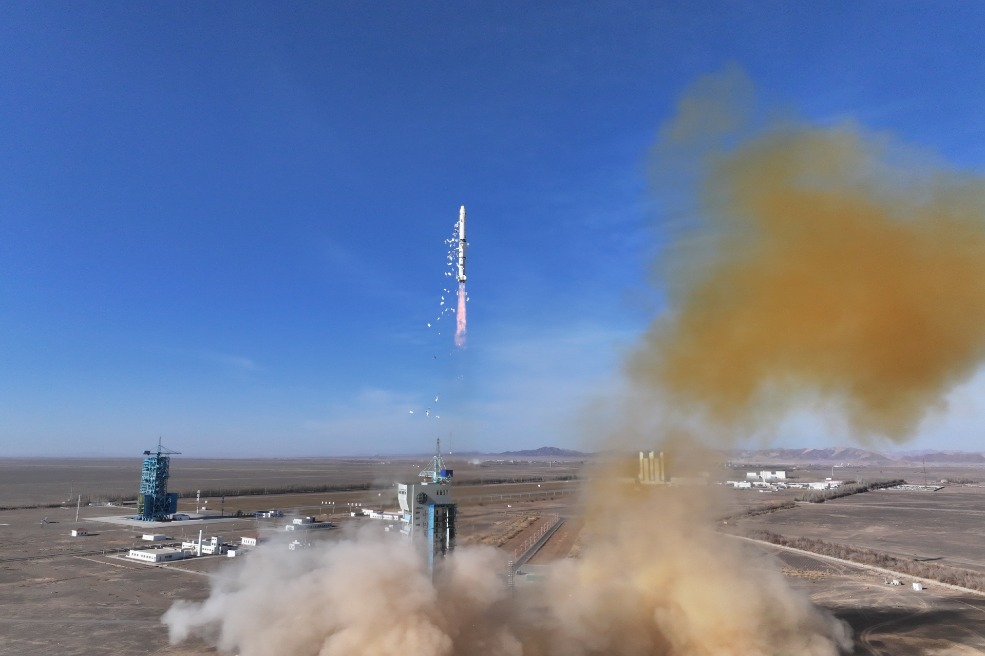
    China has marked a significant advancement in international space collaboration with the successful orbital deployment of Algeria’s AlSat-3A remote-sensing satellite. The mission utilized a Long March 2C carrier rocket that launched precisely at 12:01 pm on Thursday from the Jiuquan Satellite Launch Center in Inner Mongolia Autonomous Region.

    Operated by China Great Wall Industry, the overseas commercial branch of China Aerospace Science and Technology Corp (CASC), the launch represents the first delivery under a bilateral space agreement signed in July 2023. The comprehensive contract encompasses the provision of two optical remote-sensing satellites to Algeria along with complete ground systems, specialized training, and technical support services.

    The newly deployed AlSat-3A satellite, engineered by the China Academy of Space Technology (a CASC subsidiary), features advanced imaging capabilities designed to support critical applications including territorial planning, agricultural monitoring, and disaster management through high-resolution data collection.

    This achievement builds upon previous Sino-Algerian space cooperation, notably the 2017 launch of the Alcomsat-1 communications satellite. The Long March 2C vehicle responsible for the deployment measures 43 meters in length with a 3.35-meter diameter, capable of delivering payloads to both low-Earth and sun-synchronous orbits with a lift-off mass of 242.5 metric tons.

    The mission represents the 626th launch within the Long March rocket family and China’s third orbital launch of 2026, demonstrating the country’s growing capabilities in the global space technology market.

  • US to cut tariffs on Taiwanese goods after investment pledge

    US to cut tariffs on Taiwanese goods after investment pledge

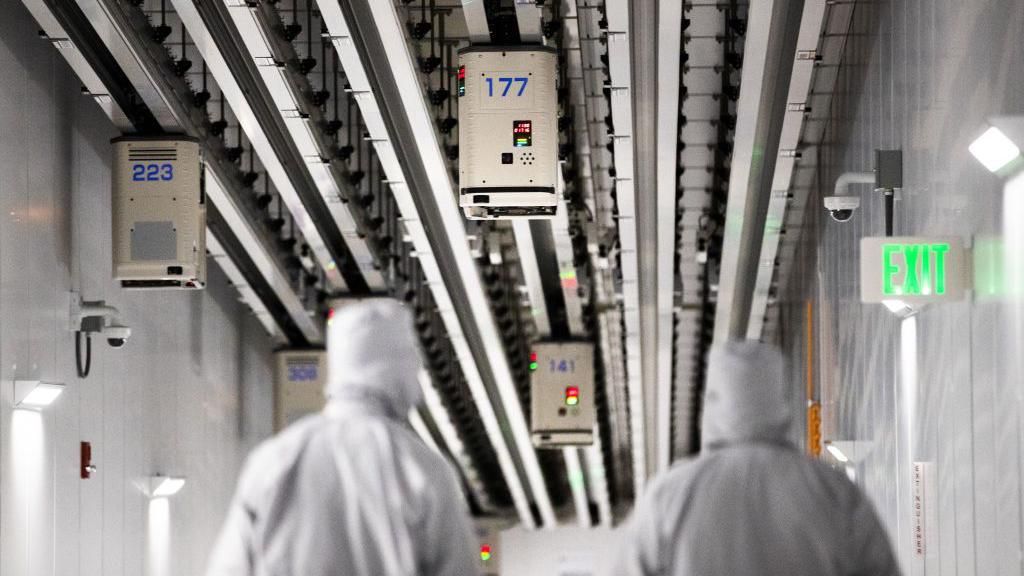
    In a landmark trade agreement, the United States has negotiated a significant reduction of tariffs on Taiwanese goods from 20% to 15%, reciprocated by substantial investment commitments exceeding $250 billion aimed at bolstering domestic semiconductor production. The Commerce Department announced that Taiwanese semiconductor and technology firms have pledged new direct investments totaling at least $250 billion, with additional carve-outs from tariffs for companies investing in US operations.

    This strategic move addresses critical supply chain vulnerabilities exposed during the COVID-19 pandemic, when semiconductor shortages disrupted multiple industries from automotive to consumer electronics. Commerce Secretary Howard Lutnick emphasized in a CNBC interview that the agreement advances US objectives toward semiconductor self-sufficiency, stating, “We’re going to bring it all over.”

    The agreement builds upon previous US government initiatives that allocated hundreds of billions in subsidies to strengthen the semiconductor sector. Taiwanese manufacturing giant TSMC, which dominates the global semiconductor industry, has accelerated its US investments, including a recently operational Arizona facility producing chips for major American tech companies including Nvidia, Apple, and AMD. This facility received $40 billion in government subsidies during the Biden administration.

    Beyond direct corporate investments, the Taiwanese government will provide $250 billion in financing to support companies participating in this initiative. The new 15% tariff rate aligns with rates applied to other key US trade partners including Japan, South Korea, and the European Union, established through agreements stemming from tariffs initially announced by the Trump administration last April.

    The agreement emerges amid ongoing legal challenges to these tariffs, with the Supreme Court currently considering claims from US businesses and states that the duties represent an overreach of presidential power. The Trump administration had previously threatened broader semiconductor tariffs citing national security concerns, though these were postponed following alarm from US firms dependent on imports.

    This development occurs alongside struggles at Intel, TSMC’s American rival, which has faced challenges in advancing AI chip manufacturing despite a surprising 10% government stake acquisition last year. Recent industry data reveals that semiconductor manufacturing eliminated over 17,000 jobs last year, contrasting with government efforts to stimulate sector growth.

  • Troops and vessels from European Nato allies arrive in Greenland

    Troops and vessels from European Nato allies arrive in Greenland

    In a significant multinational military exercise, forces from seven European NATO members have commenced operations in Greenland, marking a strategic deployment in the increasingly important Arctic region. The coordinated effort involves specialized troops and naval assets from Germany, France, Sweden, Norway, Finland, the Netherlands, and the United Kingdom.

    This deployment represents a calculated response to growing geopolitical interest in the Arctic, where melting ice caps are opening new maritime routes and access to untapped natural resources. The multinational force will conduct joint training exercises focused on extreme cold-weather operations, search and rescue missions, and interoperability testing in challenging Arctic conditions.

    The presence of both NATO members and partner nations (Sweden and Finland, though now NATO members, participated as partners when this operation was initially planned) demonstrates a unified European approach to regional security. Military analysts note that this deployment enhances collective capabilities for monitoring maritime activity and responding to potential emergencies in one of the world’s most remote and environmentally sensitive areas.

    Greenland’s strategic significance has increased substantially in recent years, with its geographic position offering unique advantages for both defense monitoring and scientific research. This limited but symbolic deployment reinforces NATO’s commitment to maintaining stability in the High North while demonstrating allied cohesion in addressing emerging security challenges.

  • Tomorrow World and OCTA Properties announce strategic partnership

    Tomorrow World and OCTA Properties announce strategic partnership

    In a significant move within Dubai’s competitive property sector, Tomorrow World Real Estate Development has entered into a strategic partnership with OCTA Properties. This collaboration, formalized through an official signing ceremony on January 15, 2026, aims to revolutionize residential and commercial real estate development across the emirate.

    The alliance brings together Tomorrow World’s design-driven development expertise, rooted in the Tomorrow World Group’s two-decade legacy, with OCTA Properties’ expanding footprint in the UAE real estate market. The partnership will initially focus on a prime waterfront plot within the prestigious Dubai Islands development, featuring approximately 132 branded residential units alongside premium retail spaces along the marina promenade.

    Yuan Zhou, Operation Director of Tomorrow World, emphasized the philosophical alignment between the two organizations: “Our partnership with OCTA Properties strengthens our dedication to creating timeless yet future-ready destinations. The principle of ‘Creating today’s life with tomorrow’ informs every aspect of our development process, from land acquisition strategy to design integrity.”

    The collaboration will concentrate on development management of Tomorrow World’s substantial portfolio, which includes 10 fully owned plots (eight within Dubai Islands) and a development pipeline exceeding Dh8 billion in projected gross development value. More than 20 projects are scheduled between 2026 and 2028, targeting high-potential corridors throughout Dubai.

    Fawaz Sous, CEO of OCTA Properties, noted the synergistic benefits: “This partnership enables us to combine our ambitions with a team that shares our commitment to purposeful, human-centered design. Together, we can accelerate the delivery of distinctive, high-value projects in emerging districts with strong growth potential.”

    Both companies share core principles including ecosystem creation, design integrity, and practical functionality. Tomorrow World’s approach blends boutique agility with financial discipline, emphasizing sustainability-minded planning, technology-enabled living, and data-driven location analysis – values that align with OCTA’s focus on high-quality development management services.

    The partnership represents a substantial commitment to shaping future-ready communities characterized by quality construction, enhanced connectivity, and long-term value creation for residents and investors alike.

  • China reports drop in workplace accidents, fatalities in 2025

    China reports drop in workplace accidents, fatalities in 2025

    China’s workplace safety landscape demonstrated marked improvement in 2025, with official data revealing substantial reductions in both accidents and fatalities. According to the Ministry of Emergency Management, the nation recorded approximately 19,800 workplace safety incidents throughout the year, resulting in over 18,000 deaths—representing year-on-year decreases of 8.7% and 7% respectively.

    Ministry spokeswoman Shen Zhanli presented these findings during a Thursday press briefing in Beijing, highlighting the continued positive trajectory in workplace safety conditions. Notably, authorities documented nine major accidents claiming 129 lives, while reporting zero particularly catastrophic incidents throughout the year.

    The ministry simultaneously released comprehensive natural disaster statistics for 2025, identifying floods, geological disasters, earthquakes, typhoons, and wind and hail events as the most prevalent calamities. Additional occurrences included drought conditions, low-temperature and snow disasters, sandstorms, forest and grassland fires, and marine disasters.

    These natural events significantly impacted national welfare, affecting approximately 67.03 million people across China and resulting in 763 confirmed deaths or missing persons. The disasters necessitated emergency evacuation or relocation for 3.63 million individuals and generated direct economic losses totaling 241.6 billion yuan (approximately $34.4 billion).

    Chen Sheng, director of disaster relief and material support at the ministry, reported that China activated national disaster relief emergency responses 24 times throughout 2025—the highest annual frequency in nearly a decade. The central government allocated 11.3 billion yuan in disaster relief funding and distributed 560,000 essential relief items to support affected populations.