作者: admin

  • Berlin launches scheme to swap trash for treats

    Berlin launches scheme to swap trash for treats

    Berlin has kicked off an innovative new pilot program that turns environmentally conscious actions into tangible perks for both residents and visitors, drawing inspiration from a successful trial launched earlier this year in Copenhagen. Dubbed BerlinPay, the initiative centers on encouraging sustainable behavior across the German capital, with a particular focus on cleaning up the iconic Spree River that cuts through the heart of the city and boosting sustainable water tourism. The pilot program will run through June 14, and invites participants to earn rewards by completing eco-friendly activities beyond litter collection, from planting native flowers and watering urban greenery to switching from car trips to cycling. The city’s extensive network of summer-popular lakes and waterways, a major draw for tourists each year, also stands to benefit from the scheme’s environmental goals. Deputy mayor Franziska Giffey noted that Berlin’s water tourism sector is currently experiencing strong growth and is a key contributor to the local economy, but the increasing popularity of these waterways also comes with measurable environmental costs. Speaking at Wednesday’s launch press conference, VisitBerlin CEO Sabine Wendt explained that the project aims to encourage both Berlin residents and out-of-town guests to engage with the city in a more thoughtful, environmentally aware way. To join the initiative, participants register for free through the official VisitBerlin platform, where they can choose from more than 5,000 available activity slots. Around 40 partner organizations including local businesses, cultural associations, and public museums have signed on to offer rewards for completed actions, ranging from discounted meals at local restaurants and free canoe tours on the Spree to complimentary entry to Berlin’s world-famous museum collections. The core mission of the program extends far beyond cleaning up local waterways: organizers hope to foster long-term environmental awareness among both residents and the millions of tourists who visit Berlin each year. BerlinPay is directly modeled after Copenhagen’s CopenPay program, which launched in 2024 and saw impressive early results: more than 75,000 tourists participated in the initiative’s first month, bike rentals across the city jumped 29%, and volunteers collected multiple tons of improperly discarded litter. If the Berlin pilot delivers similar positive outcomes, Giffey confirmed the city plans to make BerlinPay an annual recurring event for the capital.

  • ​‘Our only crime is being Shia’: Pakistani workers say UAE surveillance led to deportations

    ​‘Our only crime is being Shia’: Pakistani workers say UAE surveillance led to deportations

    In early spring, the first wave of involuntary returns of Pakistani laborers from the United Arab Emirates slipped quietly across border checkpoints and into rural communities across Pakistan, with little fanfare and no advance warning. Men arrived back to their hometowns empty-handed, catching their families completely off guard. Within weeks, however, similar cases began to emerge from every corner of the country, forming a pattern that has sparked outrage and sectarian concern across South Asia and the Gulf.

    According to interviews with multiple Shia community leaders conducted by Middle East Eye, thousands of Pakistani workers – the vast majority of whom identify as Shia Muslim and had lived and worked in the UAE for decades – have been expelled from the Gulf state since mid-April in a campaign shrouded in official secrecy. None of the deportees interviewed received formal charges, advanced explanation, or access to legal appeal before being detained and placed on repatriation flights. For many of the men affected, the message is clear: their religious identity is the only explanation for their expulsion.

    “They did not tell us any reason,” explained Hussain Turi, a 45-year-old former taxi driver whose home district of Khurram, located along Pakistan’s border with Afghanistan, has received nearly 200 deported residents from the UAE in just a few months. “But we understood. Our only crime is being Shia.”

    Deportees describe a sudden, opaque process that leaves no room for pushback or clarification. Workers report being summoned to local police stations with no stated reason, held for days in overcrowded detention facilities and jails, and flown directly to Pakistan without ever being permitted to consult a lawyer, hear a formal accusation, or challenge their expulsion. Many had spent decades working low-wage jobs in construction, transportation, and service roles across the UAE, sending consistent remittances that supported entire extended families back in Pakistan.

    Similar patterns of targeted deportation of Pakistani Shia workers have been reported in Qatar earlier this year, drawing broader international attention to the issue after accounts spread across social media and international news outlets. Indian Shia organizations, including the All India Shia Personal Law Board, have also raised alarms over rising detentions and mistreatment of Indian Shia workers in multiple Gulf states, most notably the UAE and Saudi Arabia.

    Pakistan’s federal government has pushed back hard against these claims, dismissing all reporting of sect-based targeting as bad-faith propaganda. In a May 8 statement, the country’s interior ministry said that “all such reporting is malafide and part of vicious propaganda by vested interests,” adding that no country or sect-specific deportation campaign is underway, including in the UAE.

    But despite official denials, on-the-ground interviews with community leaders, deportees, and activists across multiple Pakistani provinces confirm that Shia workers have been disproportionately affected by the recent wave of expulsions. Prominent Shia cleric Allama Amin Shaheedi estimates that as many as 15,000 Pakistani Shia have either been deported or denied re-entry to the UAE in recent months, though the lack of official data and the secrecy surrounding the campaign make independent verification of the total scale impossible.

    Many deportees have requested anonymity or only agreed to speak on condition of being identified by their surname, fearing that public criticism will permanently bar them from returning to the Gulf to recover left-behind savings, businesses, vehicles, or unpaid wages. Even so, accounts collected across Pakistan are nearly identical in their description of how detentions and expulsions unfolded.

    “They approached me directly and asked for my ID. They already knew exactly who I was,” said Qaisar, a Shia man deported to Pakistan’s Chakwal District in Punjab, who described being intercepted by security officials at Dubai’s flagship Dubai Mall after being flagged via closed-circuit surveillance.

    Multiple deportees and community advocates say the campaign is rooted in a years-long systematic surveillance and profiling program targeted explicitly at Shia religious identity. The most commonly cited practice is mandatory biometric scanning of Emirates ID cards for all worshippers entering imambargahs – Shia congregation halls – a security requirement that interviewees say is almost never enforced at Sunni mosques across the UAE.

    Deportees and advocates argue that biometric data, identity records, and attendance logs collected at Shia religious sites over years have been used by UAE security agencies to map Shia religious networks and flag individuals for deportation. While no independent official evidence has confirmed this data collection practice, first-hand accounts consistently point to a coordinated system of religious tracking.

    “At the imambargahs, they ask us to scan our Emirates ID cards before entering,” said Abbas, a former employee of an architectural firm in Dubai who was deported to Lahore in late April. “People became afraid of attending because they believed their names were being recorded.”

    The dragnet has even accidentally swept up non-Shia workers who associated with Shia communities. Raziq, a Sunni laborer from Sargodha in Punjab, told MEE he was deported after being misidentified as Shia, because he regularly visited a local imambargah to access free meals he could not otherwise afford. “Despite being Sunni, I was deported for being Shia,” he said.

    Community members also allege that in recent years, UAE visa and employment permit officials have increasingly delayed, rejected, or suspended applications from Pakistanis who carry surnames traditionally associated with Shia communities, including Zaidi, Askari, Jafri, Hussain, Hasan, Turi, and Bangash. Applicants from Pakistani districts with large Shia populations, such as Khurram, Kohat, Quetta, Hunza, and Skardu, also report facing heightened, unexplained scrutiny during immigration and employment screening. Some applicants report being subjected to months-long unexplained “security checks,” while others say employers now quietly avoid hiring workers from perceived Shia backgrounds to avoid drawing scrutiny from security officials. MEE was unable to independently verify the full scale of these alleged restrictions, and UAE authorities have not issued any public comment on claims of surname-based profiling.

    Many deportees also say UAE security officials confiscated their bank cards, cash, and mobile phones before they were deported, leaving them stranded upon arrival in Pakistan with no access to their life savings or personal belongings. Others report being denied the opportunity to contact their employers, collect unpaid months of wages, or retrieve personal property before being forced onto repatriation flights.

    “Nobody accused us of a crime. Nobody showed us evidence,” said Haider Kazmi, an IT professional who had lived and worked in Dubai for a decade before his expulsion. “They looked at our faith and decided we no longer belonged there.” Kazmi added that the abrupt, unaccountable process left many deportees feeling deeply humiliated and dehumanized. “It was painful,” he said. “But as Shias, we are taught that hardship and persecution have always been part of our history.”

    Since the 2020 Abraham Accords that normalized relations between the UAE and Israel, Shia expatriates across the Gulf report a sharp deterioration in the security environment for public Shia religious practice. While Ashura commemorations and private majalis (religious council gatherings) are still permitted in some private locations, public Shia mourning rituals and religious events have come under steadily increasing surveillance, with worshippers facing detention and deportation. Human Rights Watch documented a clear rise in restrictions on Shia religious expression in the UAE as early as late 2020.

    Security analysts and community leaders agree that the recent wave of deportations is directly tied to escalating regional geopolitical tensions reshaping the Gulf, specifically the sharpened confrontation between Iran, the United States, and Israel that began on February 28. Gulf states including the UAE and Saudi Arabia have long viewed Shia communities and religious networks through the lens of potential Iranian influence, a perspective that hardened after the 1979 Iranian Revolution and intensified following the 2011 Arab uprisings. During periods of heightened regional conflict, these suspicions translate into increased scrutiny of Shia expatriate communities from Pakistan, Lebanon, Iraq, and Afghanistan.

    At the center of Gulf security concerns is the doctrine of Wilayat al-Faqih, or “Guardianship of the Islamic Jurist,” the ideological foundation of the Islamic Republic of Iran developed by Ayatollah Ruhollah Khomeini after the 1979 revolution. The doctrine grants Iran’s supreme leader sweeping religious and political authority, which adherents recognize as extending beyond Iran’s borders to Shia communities globally. While many Shia Muslims and senior Shia clerics around the world reject this claim of transnational authority, Gulf security establishments argue that it fosters divided loyalties that threaten the legitimacy of ruling monarchies.

    These longstanding anxieties were amplified on April 20, when the UAE’s State Security Department announced it had dismantled a clandestine network allegedly tied to Iran, claiming the investigation uncovered links to Wilayat al-Faqih ideology, reinforcing existing fears of Iranian influence among expatriate Shia communities. Regional tensions deteriorated even further after the killing of Iranian Supreme Leader Ayatollah Ali Khamenei in a joint US-Israeli strike on Tehran on February 28, an event that sparked widespread unrest across Muslim-majority nations, including violent Shia-led protests in Pakistan that left more than 35 people dead. The subsequent succession of Khamenei’s son Mojtaba Khamenei as Iran’s new supreme leader has deepened Gulf fears that Iran’s ideological project will continue unchanged.

    For Shia communities across the Gulf, the convergence of the Abraham Accords and the post-February war on Iran has supercharged official paranoia about perceived Shia loyalties, leaving tens of thousands of working-class Pakistanis displaced, stripped of their livelihoods, and with little legal recourse to reclaim their lives in the Gulf.

  • Trump’s meeting with Xi comes with much fanfare in China, but major breakthroughs may be elusive

    Trump’s meeting with Xi comes with much fanfare in China, but major breakthroughs may be elusive

    BEIJING – When former U.S. President Donald Trump launched the most intensive segment of his official visit to China on Thursday, diplomatic observers and policymakers on both sides entered the diplomatic summit braced for more symbolic spectacle than substantive progress. Key sticking points from bilateral trade to U.S. policy toward Taiwan and the ongoing conflict in Iran have created low expectations for landmark agreements, even as the visit unfolds against a backdrop of carefully curated ceremonial pageantry.

    Trump’s arrival in the Chinese capital Wednesday evening opened with an elaborate formal welcome ceremony. His motorcade processed down central Beijing thoroughfares lined with alternating American and Chinese national flags, past towering skyscrapers illuminated with large red Chinese characters reading “Beijing Welcome.” After the procession, the U.S. president traveled to his downtown accommodation with no public engagements scheduled for the rest of the evening.

    On Thursday, Chinese leader Xi Jinping is scheduled to meet Trump for an official welcoming ceremony at the Great Hall of the People, China’s top legislative venue located on the western edge of Tiananmen Square, which also hosts major state and cultural events. Following the opening ceremony, the two leaders will hold a one-on-one bilateral working meeting, after which Trump will tour the Temple of Heaven, a 15th-century imperial religious complex once used by Ming and Qing dynasty emperors to perform annual rituals for good harvest, that carries deep symbolic meaning for traditional Chinese concepts of cosmic order. The day will conclude with a formal state banquet hosted in Trump’s honor. A working meeting over tea and lunch is scheduled for the pair on Friday.

    The White House has pushed back against low expectations, maintaining that Trump entered the trip with clear goals to secure tangible outcomes before his departure. Senior administration officials have hinted that potential trade-related announcements could come during the visit, including a expected Chinese commitment to increase purchases of American agricultural goods including soybeans and beef, as well as U.S.-manufactured commercial aircraft. The Trump administration is also pushing to formalize a new bilateral Board of Trade designed to address longstanding commercial frictions between the two global economic powers through ongoing structured dialogue.

    Yet concrete details of any potential agreements remain elusive, even as geopolitical friction over the Iran conflict adds an extra layer of complexity to talks. China’s longstanding close economic ties to Iran have put Beijing at odds with Washington’s policy goals in the region, creating a major point of tension ahead of the summit.

    Trump’s three-day Beijing trip comes as the Iran conflict continues to dominate domestic U.S. political discourse, stoking growing fears of economic weakness in the U.S. as the country enters a heated midterm election cycle. With November’s congressional elections approaching, Trump’s Republican Party is fighting to retain control of both chambers of Congress, and the economic fallout from the Iran war has emerged as a top voter concern. The U.S.-led conflict with Iran has resulted in the effective closure of the Strait of Hormuz, a critical global chokepoint for oil and natural gas shipments, leaving energy tankers stranded and driving sharp spikes in global energy prices that threaten to undermine global economic growth.

    The extended, structured schedule of one-on-one engagement between Trump and Xi, set against the backdrop of formal diplomatic events, will create ample opportunity for the two leaders to tackle the full slate of thorny bilateral and global issues on the agenda. Beyond Iran and trade, those topics include the longstanding dispute over Taiwan and a proposed three-way nuclear arms limitation pact between the United States, China and Russia.

    Despite the open agenda, most diplomatic analysts expect little progress beyond ceremonial pleasantries and the mutual public praise that Trump and Xi have exchanged consistently for years. Jim Lewis, a technology policy fellow at the Center for European Policy Analysis, predicted that neither side will make meaningful headway on the two most contentious foreign policy issues up for discussion. “Trump will press the Chinese to help him on Iran. They’ll be unwilling. The Chinese will press Trump to make concessions on Taiwan. We’ll see what we get out of that,” Lewis explained.

    Back in Washington, domestic political tensions over the Iran conflict deepened Wednesday, when Senate Republicans again blocked Democratic legislation aimed at ending U.S. hostilities in Iran. The vote saw a rare party break from Alaska Republican Senator Lisa Murkowski, who crossed party lines to vote with Democrats, becoming the third Senate Republican to oppose continued U.S. military engagement in the conflict.

    As the world’s largest buyer of Iranian crude oil, China’s position on Iran is a core priority for the Trump administration. Trump has publicly downplayed suggestions that he will push Xi to take stronger action to pressure Iran to reopen the Strait of Hormuz, though senior White House officials have confirmed that the president will make that case to Xi in closed-door negotiations.

    The president has also stressed that concerns over U.S. economic fallout will not soften his demands in negotiations over Iran, even amid a fragile current ceasefire. When asked as he departed the White House whether the financial strain on ordinary American households would factor into his Iranian negotiations, Trump responded bluntly: “Not even a little bit.”

    “I don’t think about Americans’ financial situation. I think about one thing: We cannot let Iran have a nuclear weapon,” Trump said, adding that he believes “every American understands” that priority.

    The Trump administration has struggled to present a consistent public message on inflation and the Iran conflict, however. Vice President JD Vance told reporters Wednesday that Trump remained “laser focused” on tackling inflation, pushing back against the president’s own explicit comments that the U.S. economy was not a factor in resolving the war. When asked about Trump’s comments, Vance claimed, “Well, I don’t think the president said that. I think that’s a misrepresentation of what the president said.”

    Discussions over trade and Taiwan are also expected to be tense. The status of Taiwan looms large over the summit: China has long claimed the self-governing island as part of its sovereign territory, and Beijing has strongly objected to U.S. plans to sell advanced military weapons to Taipei. The Trump administration has already approved an $11 billion arms package for Taiwan, but has not yet moved forward with implementing the sale. Trump has also openly expressed greater ambivalence about U.S. commitments to Taiwan, a shift that has sparked widespread speculation about whether he could be open to rolling back American support for the island democracy.

    Taiwan is the world’s leading producer of advanced semiconductors, which are critical components for cutting-edge artificial intelligence development. Trump has sought to advance new trade deals with Taiwan that would incentivize increased chip manufacturing within the United States.

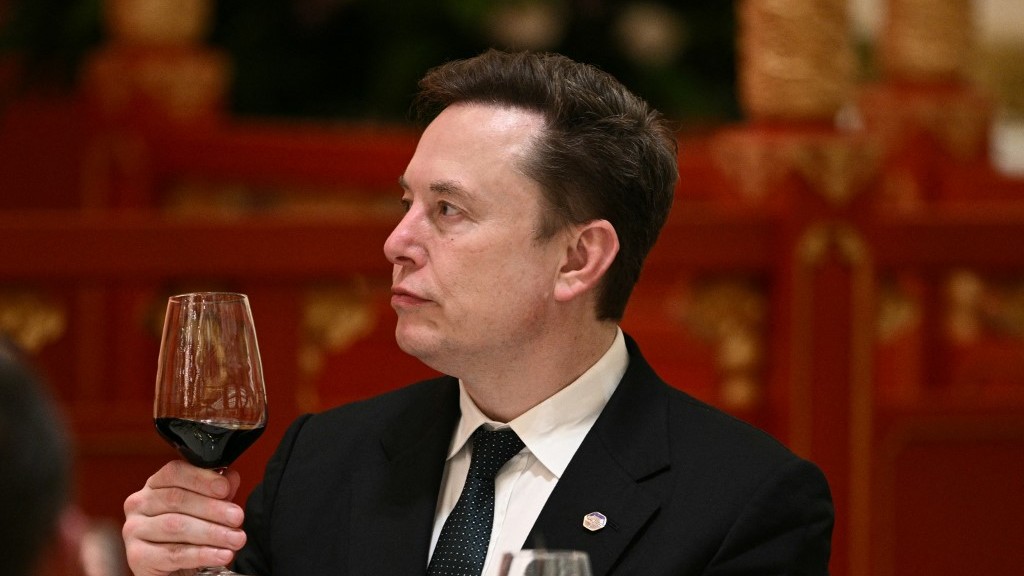
    Trump personally invited Jensen Huang, CEO of leading chipmaker Nvidia, to join him on Air Force One during a refueling stop in Alaska en route to Beijing. Huang is one of a dozen high-profile CEOs from the technology, defense, finance and agricultural sectors joining Trump’s official delegation. Other senior members of the U.S. delegation include Secretary of State Marco Rubio, Treasury Secretary Scott Bessent, Defense Secretary Pete Hegseth, as well as Trump’s son Eric Trump and daughter-in-law Lara Trump. Tesla and SpaceX CEO Elon Musk, who previously led Trump’s initiative to cut federal staffing and shrink the size of the federal government, is also part of the delegation.

    The U.S. and China reached a bilateral trade truce last year that eased tit-for-tat threats of steep new tariffs on each other’s goods. The White House says ongoing discussions have shown mutual interest in extending the agreement, though it remains unclear whether any formal announcement of an extension will come during this visit.

    Trump has said he will press Xi to grant greater market access to U.S. firms in China, saying he will urge his Chinese counterpart to “‘open up’ China so that these brilliant people can work their magic.” He is also seeking to extend an existing agreement that allows China to continue exporting rare earth minerals to the United States, a deal that has so far prevented Beijing from restricting global rare earth supplies in response to Trump’s earlier tariff threats.

    Senior U.S. officials have also confirmed that Trump will raise the proposal for a three-way nuclear arms pact between the U.S., China and Russia that would place caps on each nation’s nuclear arsenal, an idea that Beijing has previously viewed with open skepticism.

    Associated Press writer Seung Min Kim in Washington contributed reporting to this article.

  • US news reports of gloomy Iran war intel assessments anger Trump

    US news reports of gloomy Iran war intel assessments anger Trump

    A growing rift has erupted between the Trump White House and major U.S. news outlets after independent reporting revealed that classified U.S. intelligence assessments directly contradict the administration’s public claims that Iran’s military capabilities have been completely destroyed. The confrontation has sparked fresh alarms over escalating attacks on press freedom from the Trump administration, as policymakers face growing scrutiny over the trajectory of the ongoing conflict with Iran.

    The New York Times first broke the story on Tuesday, citing declassified internal assessments compiled earlier this month that draw a sharp distinction between the Trump administration’s upbeat public narrative and the confidential briefings provided to senior policymakers. According to the report, U.S. spy agencies have confirmed that Iran has rapidly reestablished operational access to the vast majority of its key missile infrastructure, including primary launch sites, mobile deployment units, and underground storage facilities that the administration claimed had been wiped out in joint U.S.-Israeli bombardment campaigns.

    Most concerning for senior national security officials, the assessments note that 30 out of Iran’s 33 active missile sites positioned along the Strait of Hormuz — one of the world’s most critical global energy chokepoints — are now fully operational once again. The reactivation of these sites puts U.S. naval vessels and commercial oil tankers transiting the strategic waterway at direct risk, the report added.

    The Times’ reporting followed a similar exclusive published one week earlier by The Washington Post, which outlined a confidential Central Intelligence Agency analysis delivered to top administration policymakers. The CIA assessment concluded that Iran’s economy could withstand a sustained U.S. naval blockade for a minimum of three to four months before encountering crippling hardship, contradicting administration claims that the blockade would force Tehran to capitulate in short order.

    The Post’s reporting also confirmed the core findings of the later New York Times assessment, noting that the broader U.S. intelligence community has determined that Iran retains the vast majority of its ballistic missile capacity despite weeks of intensive joint bombing campaigns. Citing an unnamed senior U.S. official, the outlet reported that Iran still holds roughly 75 percent of its pre-conflict inventory of mobile missile launchers and approximately 70 percent of its original stockpile of operational missiles. The official added that Iranian forces have successfully recovered and reopened nearly all of their underground weapons storage sites, repaired damaged missiles, and even completed assembly of new missiles that were near completion when the conflict began.

    Within hours of the Times’ publication, President Donald Trump took to his Truth Social platform to lash out at the reporting. Trump, who has repeatedly claimed Iran has been left with no functional military capacity, denounced the outlets’ reporting as “virtual TREASON,” arguing that the claims of intact Iranian military capabilities are false and outrageous. “They are aiding and abetting the enemy!” Trump wrote, doubling down on his original claim that “Iran has ‘no Navy, their Air Force is gone, all Technology is gone, their ‘leaders’ are no longer with us, and the Country is an Economic Disaster.”

    Beyond the divergence between public claims and classified intelligence on Iran’s capabilities, multiple independent reports have also revealed that the Trump administration has drastically understated the damage Iranian counterstrikes have inflicted on U.S. military assets across the Persian Gulf. In a report published late last month, NBC News cited three unnamed U.S. officials, two congressional aides, and an additional source familiar with the damage assessment, which found that U.S. bases and equipment suffered far more extensive damage than the administration has publicly acknowledged. The outlet added that repair costs are expected to reach into the billions of dollars.

    A subsequent Washington Post analysis of open-source satellite imagery reinforced these findings, documenting that Iranian strikes have damaged or destroyed at least 228 structures and pieces of equipment at U.S. military installations across the Middle East since the outbreak of hostilities. Targets have included aircraft hangars, troop barracks, fuel depots, fixed-wing aircraft, and critical infrastructure including radar systems, communications networks, and air defense installations — a scale of destruction vastly larger than the U.S. government has publicly admitted.

    Foreign policy analysts have already concluded that the Trump administration’s Iran strategy has suffered a major strategic failure 10 weeks into the conflict. Writing on Wednesday, Brookings Institution foreign policy scholar Phil Gordon argued that “10 weeks in, the strategic failure is undeniable” for the administration. Gordon warned that the greatest ongoing risk stems from the president’s inability to accept a setback: “The risk now is that having missed the opportunity to declare victory after the first few weeks, Trump can’t accept defeat and humiliation so will keep looking for the next quick fix, thereby likely only making things worse.”

    Top Trump administration officials have doubled down on attacks against the press for publishing the unflattering disclosures. Pentagon Secretary Pete Hegseth has already labeled U.S. media outlets “unpatriotic” and warned reporters to “think twice” before publishing classified information that contradicts the administration’s narrative. Earlier this week, The Wall Street Journal revealed that the U.S. Department of Justice issued subpoenas to the outlet’s journalists in March seeking records tied to their Iran war coverage.

    Katie Fallow, deputy litigation director at the Knight First Amendment Institute at Columbia University, called the subpoenas the latest example of the administration’s escalating campaign against press freedom. “Time and again, the administration has shown itself willing to disregard the First Amendment and long-standing limits on the use of government power to go after news outlets that publish embarrassing or critical information about the government,” Fallow said.

  • US commerce secretary details “off-putting” interaction with Epstein in testimony

    US commerce secretary details “off-putting” interaction with Epstein in testimony

    A congressional investigation into the late convicted sex offender Jeffrey Epstein has made public sworn interview transcripts from two high-profile figures: U.S. Commerce Secretary Howard Lutnick and Gateway Computers co-founder billionaire Ted Waitt. As of the release, neither man has faced any accusations of misconduct related to Epstein’s alleged criminal network from victims or investigative bodies.

    In his transcribed voluntary testimony before the House Oversight Committee on May 6, Lutnick outlined three brief encounters with Epstein, who was once his next-door neighbor in New York City. The commerce secretary, widely known as the key architect of the Trump administration’s global tariffs policy, told investigators that his first introduction to Epstein came in 2005, when he and his wife were invited to coffee at Epstein’s Manhattan home. During a tour of the residence, the couple was shown a room fitted with only a massage table and surrounded by candles. When Lutnick asked how often Epstein received massages there, the disgraced financier responded with a suggestive remark: “Every day and the right kind of massage.”

    Lutnick told the panel he found the comment deeply off-putting, and he and his wife left the property immediately after the exchange. He added that he made an explicit decision right then to cut off all personal and professional ties with Epstein, a statement he had previously given to congressional investigators. But newly released court documents from the U.S. Department of Justice’s Epstein investigation earlier this year revealed a previously undisclosed visit Lutnick made to Epstein’s private Caribbean island in 2012, years after he claimed to have severed all contact. The revelation sparked bipartisan demands for Lutnick’s resignation from the Trump Cabinet.

    During his recent testimony, Lutnick offered an explanation for the 2012 visit. He told the committee that Epstein’s staff reached out to his group unexpectedly while he was on a family vacation in St. Thomas, located just a short distance from Epstein’s private island. Lutnick said the unprompted contact left him unnerved, noting: “Without any communication for years, [how] would he inexplicably know where I’m going? It’s unsettling, actually.” The commerce secretary confirmed that he, his family, another couple and their children, plus accompanying staff, accepted the invitation for lunch. He emphasized that the group only dined outdoors on the island’s grounds and never entered any of the property’s buildings, describing the visit as unremarkable: “We sat outside, had lunch. It was boring. We left.” Lutnick also acknowledged one additional brief, casual interaction with Epstein in 2011 focused on construction scaffolding, which he described as completely meaningless and inconsequential.

    Alongside Lutnick’s transcript, the committee also released the record of its April 30 interview with Waitt, the billionaire tech entrepreneur. Waitt detailed his six-year romantic relationship with Ghislaine Maxwell, Epstein’s convicted co-conspirator, which ran from 2004 to 2010. Waitt told investigators he had very limited direct contact with Epstein and never witnessed any illegal or harmful activity during his relationship with Maxwell.

    Waitt told the panel he understood Maxwell’s role with Epstein to be that of an estate manager, responsible for overseeing the financier’s multiple properties and staff. He added that he always felt uncomfortable with the dynamic between the pair, noting that Epstein held clear sway over Maxwell, who consistently deferred to him: “He did seem to have significant influence over her, she always kind of look[ed] up to him and I was not comfortable with that.” Waitt also confirmed that their relationship overlapped with Epstein’s 2008 guilty plea in Florida to charges related to the prostitution of a minor. He said Maxwell was subpoenaed to testify in the case during that time, and that she was visibly stressed by the legal proceedings but repeatedly denied any personal involvement in Epstein’s crimes.

    Waitt stated that he and Maxwell never cohabitated, as he maintained a primary residence in California while she lived mostly in New York. He denied having any knowledge of abuse or misconduct by either Epstein or Maxwell, and said he had no awareness of Maxwell ever traveling to Epstein’s private island during their relationship. He added that Maxwell was not publicly identified as a co-conspirator in Epstein’s crimes until after their relationship ended, and he did not learn of the formal charges against her until she was arrested by federal authorities.

  • Supporters of bill to aid Ukraine and sanction Russia hit number to force House vote

    Supporters of bill to aid Ukraine and sanction Russia hit number to force House vote

    A cross-partisan coalition of Ukraine supporters in the U.S. House of Representatives crossed a critical procedural milestone on Wednesday, securing the required number of signatures to force a floor vote on a package of new Ukraine aid and Russian sanctions, bypassing top Republican leadership in the chamber. The push for a vote, led by New York Democratic Representative Gregory Meeks, will bring legislation to the House floor in the coming weeks that codifies U.S. support for Kyiv. It proposes allocating more than $1 billion in direct security assistance to Ukraine, alongside an additional $8 billion in loaned funding for the war-torn nation.

    Proponents of the measure have repeatedly pushed the Trump administration to take a harder line against Moscow and ramp up military backing for Kyiv as its war with Russia enters its fourth year. To trigger a discharge vote — the procedural mechanism that allows rank-and-file lawmakers to bypass committee gridlock and leadership opposition — backers needed 218 signatures on a discharge petition. They hit that exact threshold on Wednesday, after California Independent Representative Kevin Kiley signed on as the decisive vote.

    The petition draws broad Democratic support, with 215 House Democrats adding their names, joined by just two House Republicans: Nebraska’s Don Bacon and Pennsylvania’s Brian Fitzpatrick. In his statement explaining his support for the petition, Kiley emphasized that the legislation would reinforce Ukraine’s negotiating position to reach a lasting, sustainable peace deal. He also added that the bill sends an unambiguous warning to Moscow that Russia’s ongoing backing for Iran’s targeting of U.S. military assets in the Middle East will not go unanswered by Congress.

    Despite the procedural breakthrough, House Speaker Mike Johnson, the chamber’s top Republican leader, has raised public concerns about the timing of the vote. Johnson noted that both Russian President Vladimir Putin and former President Donald Trump have recently signaled that the war could be nearing an end, and argued that Congress should wait to see how diplomatic efforts unfold before holding a vote. “The latest news out of Russia is that it looks like the war is scaling back, scaling down, coming to a conclusion. I think Vladimir Putin said that himself in the last few days, and so this would be a good time for Congress to see how that pans out,” Johnson told reporters this week.

    Trump echoed that optimistic tone on Tuesday, telling reporters ahead of a summit in Beijing that he expects Moscow and Kyiv to finalize a peace deal in the near future. “The end of the war in Ukraine I really think is getting very close,” Trump said. Putin similarly claimed in a speech last weekend that his full-scale invasion of Ukraine could be “coming to an end.”

    Those optimistic claims have been sharply contradicted by new violence on the ground, however. On Wednesday, the same day backers locked in the final petition signature, Ukrainian President Volodymyr Zelenskyy announced that Russia launched a massive daytime drone barrage across Ukraine, deploying at least 800 drones in one of the largest single attacks of the entire war. The strike killed at least six civilians and wounded dozens more, including multiple children.

    That ongoing violence led Fitzpatrick, one of the two Republican supporters of the discharge petition, to reject the claim that the war is winding down. The GOP lawmaker stressed that he would only withdraw his backing for the bill if Russia fully withdraws all of its military forces from internationally recognized Ukrainian territory. “There’s people dying as we speak, so no, the war is not winding down,” Fitzpatrick said.

    Meeks, the lead sponsor of the effort, echoed that argument, noting that the vote will finally force every member of Congress to go on the public record with their stance on Ukraine support. “Members of Congress, some tell me that they are supportive of Ukraine. Well, we’re going to finally get a vote on the floor to make that determination,” Meeks said. He added that the House vote will build pressure on the U.S. Senate to act, and send a clear message to Trump that the American public supports standing with U.S. allies rather than aligning with the Kremlin.

    Even if the bill passes the House, its future in the Senate remains far from certain. For months, senators from both parties have debated a range of Russia sanction and Ukraine aid packages, but momentum stalled after Trump launched military strikes against Iran in late February. While most Senate Republicans have voiced nominal support for Ukraine, they have been reluctant to advance any legislation without explicit backing from the Trump administration. On Wednesday, Senate Majority Leader John Thune cast doubt on the chamber’s ability to take up Russia sanctions in the near term, noting that the Senate is already backed up with other pending legislation.

    South Carolina Republican Senator Lindsey Graham, one of the most prominent GOP advocates for Russia sanctions in the Senate, offered a mixed assessment of the House-passed package this week, saying he supports some provisions but opposes others. Lawmakers from both parties have also expressed growing frustration over the Pentagon’s failure to disburse $400 million in previously approved military aid for Ukraine that Congress allocated last year. During a congressional hearing earlier this week, Defense Secretary Pete Hegseth told lawmakers the department is currently developing a plan to release the long-delayed funds.

    Support for Ukraine has emerged as one of the most persistent points of tension between Congress and the Trump administration, after Trump pledged during his campaign to rapidly end the war within days of taking office. To date, the administration has failed to make meaningful progress toward a negotiated peace deal, and has repeatedly moved to scale back military support for Ukraine and reduce U.S. security commitments across Europe.

  • Soybeans on Beijing agenda but US farmers should temper optimism

    Soybeans on Beijing agenda but US farmers should temper optimism

    Eight years after former and current US President Donald Trump labeled China a hostile revisionist power seeking to displace American influence in Asia in his first-term National Security Strategy, his 2025 iteration of the document marks a striking departure in tone. The harsh, confrontational labels that defined the 2017 strategy have been stripped out entirely, replaced with muted, generic language that avoids direct naming even when addressing points of friction.

    The updated strategy retains core policy priorities: it commits the US to rebalancing bilateral trade relations and lists deterrence of conflict over Taiwan as a key national security goal, but frames both goals in neutral terms. Most notably, a section targeting foreign influence in the Western Hemisphere that clearly targets Chinese infrastructure investments never mentions China by name, referring only to vague “non-hemispheric competitors” and foreign firms operating in the region.

    This shift in language corresponds to measurable softening in policy, even as the Trump administration maintains pressure on China across multiple fronts. The White House has rolled back some of the steep tariffs imposed during earlier trade wars and relaxed restrictions on sales of US high-end semiconductors to Chinese buyers—a change that has spurred sharp criticism from longstanding China hawks within Republican policy circles.
    Matt Pottinger, who served as deputy national security advisor during Trump’s first term and helped craft the administration’s original hardline China approach, used January congressional testimony to push back against the semiconductor sales, warning that the relaxed rules would accelerate China’s military modernization efforts.

    The trade war that defined Trump’s first term and returned in his second has hit American agricultural producers hardest of all, a reality that has shaped the administration’s shifting approach. During 2025’s trade escalation, China halted all purchases of American soybeans for several months in retaliation for new 100% tariffs on Chinese imports. A recent analysis from *The Economist* confirmed that the US agriculture sector has suffered greater damage from reciprocal Chinese tariffs than any other American industry.

    A tentative truce was reached last fall: China agreed to resume soybean purchases, and Trump agreed to cut existing tariffs on Chinese goods. But both sides remain skeptical that the fragile agreement will hold long-term, framing the deal as a temporary pause in hostilities rather than a permanent resolution of trade tensions.

    That makes the upcoming summit between President Trump and Chinese President Xi Jinping, scheduled for May 14 and 15 in Beijing, a critical test for the bilateral relationship. Soybean trade will top the agenda, but it is far from the only issue on the table. China is pushing for further cuts to remaining US tariffs and diplomatic action to reopen the Strait of Hormuz, which has faced disruptive tensions. Washington’s priorities include securing more reliable access to rare earth minerals and cracking down on the flow of fentanyl precursors out of China.

    For Trump, securing a commitment for continued Chinese soybean purchases is a key political and economic priority, and analysts widely expect Xi to allow Trump to claim a diplomatic win ahead of any future electoral cycles. But even a cordial summit with a positive closing statement will not resolve the deep structural tensions between the two powers. Both sides have proven they can inflict significant economic pain on one another, and both have shown willingness to use that leverage to advance their negotiating positions.

    In the weeks leading up to the summit, China has already demonstrated its willingness to push back against US actions twice. First, Chinese regulators ordered Meta Platforms to unwind its $2 billion acquisition of domestic Chinese AI startup Manus. Second, after the US Treasury sanctioned five small Chinese refiners for purchasing Iranian crude oil, Beijing retaliated by activating its anti-sanctions blocking rules for the first time, allowing the targeted firms to sue any financial or insurance entity that complies with the US sanctions in Chinese courts.

    Lingling Wei, a veteran Wall Street Journal China correspondent with deep access to Chinese leadership circles, reports that top Chinese officials believe they have developed a framework for managing US-China relations with Trump at the helm: “The U.S. president can be exhausted and outwaited, and calibrated escalation resets the bargaining floor instead of blowing up the relationship.”

    The question remains whether Beijing is overestimating its ability to influence Trump. While Trump is invested in making the summit appear a success, he has little incentive to be seen as easily manipulated. Analysts say it would not be surprising to see a new show of force from Washington after the summit to remind Beijing of American leverage.

    For the moment, the status quo is an uneasy truce, not a permanent peace. With luck, the temporary pause will hold, allowing bilateral trade including soybean exports to continue flowing. But China has already begun long-term preparations for a future breakdown in trade, working aggressively to reduce its dependence on American soybeans. Beijing has ramped up purchases of Brazilian soybeans and invested in Brazilian infrastructure to speed export logistics, while also developing alternative fermented pig feed to reduce overall domestic soybean consumption.

    That reality leaves American soybean producers with a clear lesson, analysts say: they too must prepare for the worst. While some level of exports to China will likely continue even if the truce holds, farmers need to aggressively expand sales to other domestic and international markets to insulate themselves from future disruptions. Just as China seeks to end its reliance on American agriculture, American farmers must end their reliance on the Chinese market.

  • Mass sex abuse allegations force closure of boarding school in Indonesia

    Mass sex abuse allegations force closure of boarding school in Indonesia

    On May 2, hundreds of angry demonstrators gathered at the Ndholo Kusumo Islamic girls’ boarding school in Tlogosari village, Central Java, to confront the institution’s 58-year-old founder and caretaker Kiai Ashari. Brandishing banners with slogans including “Women are not sexual objects” and “The Predator,” the crowd shouted insults at Ashari as local police escorted him off the property. The longtime school leader stands accused of years of sexual abuse against dozens of his female students, most of whom are low-income orphans.

    This shocking allegation is not an isolated incident in Indonesia. It has sparked nationwide public outrage and pulled back the curtain on deep-rooted systemic gaps that allow sexual abuse to thrive in the country’s network of independent Islamic boarding schools. Though most witnesses who initially spoke out against Ashari have since retracted their statements, one survivor has formally filed a police complaint, and her legal team says as many as 50 other girls may have been victimized.

    “Based on the victim’s account, the number of victims ranges from 30 to 50 children,” Ali Yusron, the attorney representing the complainant, told the BBC. “I am representing one victim, but the unfolding legal process confirms many more were harmed. One survivor’s courage has brought the full scope of these abuses to light.”

    Authorities first named Ashari as a suspect on April 28. Police initially claimed on May 4 that he had not yet been taken into custody but assured the public he would not attempt to flee. Ashari contradicted that assurance hours later, slipping out of the Pati regency and traveling across Java to Bogor, Jakarta, and Solo before law enforcement intercepted him on the night of May 6 at a mosque in Wonogiri, Central Java.

    Pati Police Chief Jaka Wahyudi confirmed the allegations against Ashari on May 7, detailing that the surviving complainant was abused 10 times across different locations between February 2020 and January 2024. According to the official account, Ashari would enter the victim’s dorm room under the pretense of requesting a massage, then coerce her to remove her clothing and commit multiple indecent sexual acts, including unwanted touching, squeezing, and kissing. After the 10th assault, the victim finally disclosed the abuse to her father, who filed an official police report.

    This is far from the first time Ashari has faced credible accusations of sexual abuse against his students. Court records and police investigations show the first allegations against him date back to 2022. “The victims are all female students, mostly attending intermediate religious school (MTs),” Ali explained. “Over three consecutive years, new victims were targeted as he cycled through students.”

    In early 2024, Pati Police’s Women and Children’s Services Unit received new reports of sexual offenses against underage teenage students at the school, but many of those initial claims were later dropped after witnesses withdrew their statements. Chief Jaka told the BBC that the 2024 investigation faced significant roadblocks, with four separate victims choosing to retract their testimonies.

    Chief Jaka explained: “The victims and their families said they wanted to resolve the matter privately and amicably. Many witnesses withdrew their statements out of concern for their children’s future safety and prospects in the community.” The case lay dormant for two years before investigators finally formally named Ashari as a suspect last month, and authorities are still working to identify and interview all potential victims.

    Beyond the individual accusations against Ashari, the case has exposed a repeating pattern of abuse enabled by problematic teachings and weak oversight. Many perpetrators in these boarding schools manipulate students through false religious doctrine: Ashari, for example, convinced his female students he was a saint with supernatural powers, and a descendant of the Prophet Muhammad who deserved unquestioned obedience.

    Imam Nahe’i, a member of the Nahdlatul Ulama (PBNU) Anti-Sexual Violence Unit (SAKA) and a former commissioner of Indonesia’s National Commission on Violence Against Women, told the BBC that most sexual abuse cases in Islamic boarding schools follow this same manipulative template. “Caretakers often spread teachings rooted in shamanism and mysticism, rather than rational religious doctrine,” he said. “Many claim to be spiritual guardians, and tell students if they disobey them, they will go to hell.”

    Worse, Imam Nahe’i added, many boarding schools normalize inappropriate physical contact with students – including touching, hugging, and kissing – creating a culture that tolerates escalating sexual violence. He cited an ongoing case in Sumenep where abuse continued unchecked from 2017 until it was exposed only recently, proof that surrounding communities and school leaders have long turned a blind eye to harm. A longtime educator at a large Islamic boarding school himself, Imam Nahe’i said he found most of his fellow teachers do not even correctly understand what constitutes sexual violence.

    “Many of them think sexual violence only counts if it involves penetration,” he explained. “If it doesn’t reach that point, they don’t see it as sexual violence – they just write it off as a sin, not a serious crime.”

    The broader systemic failure also stems from a profound lack of government oversight. While Indonesia’s Ministry of Religious Affairs passed formal regulations in 2022 to address sexual violence in educational settings, most Islamic boarding schools are privately founded by independent religious leaders rather than operated by the state, making them far harder to regulate. Many fall through the cracks of existing oversight frameworks, creating barriers to reporting abuse and protecting vulnerable students. As Imam Nahe’i put it, existing national regulations simply do not have jurisdiction to enforce standards at these independent institutions.

    “To create clear binding regulations and dedicated task forces for Islamic boarding schools, the Ministry of Religion needs to prioritize this issue urgently,” he said. “On top of that, supervision of newly established private boarding schools from both the ministry and local communities needs to be far stricter.”

    In response to the latest scandal, authorities have taken immediate action against Ndholo Kusumo, which first received its operating permit in 2021 and hosted 252 enrolled students before the allegations broke. The school has been shut down, all students have been sent to temporary housing or to their families, and the Ministry of Religious Affairs has permanently revoked the institution’s operating license. The ministry has confirmed that displaced students – particularly the orphaned students who make up a large share of Ashari’s alleged victims – will be able to continue their education via online learning or transfer to other accredited boarding schools.

    Basnang Said, Director of Islamic Boarding Schools at the Ministry of Religious Affairs, explained that the immediate closure was intended to let authorities prioritize the criminal investigation while protecting students and maintaining public order. New student admissions at the school are suspended indefinitely until all institutional reforms to child protection, student care, and governance are completed and independently audited. If the school fails to meet mandatory safety standards, its deactivation will become permanent.

    The ministry has also issued new nationwide guidance calling for any boarding school caretaker or educator accused of sexual abuse to be immediately removed from their post and evicted from school grounds. All Islamic boarding schools across Indonesia have been ordered to hire new teaching and care staff that meet strict standards of moral integrity, and are prepared to provide 24-hour supervised care for all enrolled students.

  • ‘Watermelon deaths’ in Mumbai puzzle investigators

    ‘Watermelon deaths’ in Mumbai puzzle investigators

    It has been nearly three weeks since a family of four was discovered dead in their cramped Mumbai apartment, yet investigators have still not uncovered how the tragedy unfolded. The Dokadia family — 46-year-old Abdullah, his 42-year-old wife Nasreen, and their teenage daughters Ayesha, 16, and Zainab, 13 — were found unresponsive at their first-floor residence in the crowded Pydhonie neighborhood of south Mumbai on April 25, a case that has gripped India’s national media from the first hours of the tragedy.

    When news of the deaths first broke, local media immediately coined the haunting nickname the ‘watermelon deaths’, referencing the last meal the family consumed before falling fatally ill. Unsubstantiated early reports spread rapidly across news outlets and social media claiming the fruit had been intentionally poisoned or adulterated with toxic chemicals to extend its shelf life. Widespread public panic followed, sending demand for watermelon — one of India’s most beloved and widely consumed summer treats — plummeting and dragging local market prices down by nearly 40% in less than a week.

    Initial accounts from first responders show that on the night of the deaths, the Dokadias hosted extended family for dinner, serving the traditional spiced rice dish biryani. Guests left the apartment around 10:30 p.m., and a few hours later, the family ate a sliced watermelon as a late-night snack. Minutes after finishing the fruit, all four began suffering from severe vomiting and diarrhea. Neighbors, alerted by frantic calls, rushed to the apartment, where fourth-floor resident and doctor Zaid Qureshi immediately administered CPR to 13-year-old Zainab, who was struggling to breathe.

    “I did everything I could to stabilize her, but her condition just kept worsening,” Dr. Qureshi told BBC Marathi. All four family members were rushed first to a nearby local hospital, before being transferred to Mumbai’s larger JJ Hospital, where they were pronounced dead within hours.

    For weeks, investigative focus centered exclusively on the watermelon, as it was the final food the family consumed before becoming ill. Police seized all leftover food from the apartment, including the watermelon rind and leftover biryani, and sent samples to Mumbai’s Forensic Science Laboratory (FSL) for toxicology testing.

    Last week, FSL officials released a breakthrough finding: the deadly agent that killed the Dokadias was zinc phosphide, a highly potent rodenticide commonly used across India to control rat populations. FSL director Dr Vijay Thakare confirmed that the chemical was detected in tissue samples taken from the victims’ organs — including their livers, kidneys and spleens — as well as in their stomach contents, bile and abdominal fat. Critically, zinc phosphide was also found in the leftover watermelon samples, but not detected in any other food items from the meal, including the biryani.

    Local health experts explain that even small amounts of zinc phosphide can kill a human within hours. When the chemical comes into contact with moisture in the digestive tract, it releases phosphine gas, which blocks cells from absorbing oxygen, causing rapid organ failure. Mumbai-based physician Dr Bhushan Rokade notes that the symptoms reported by neighbors match a classic zinc phosphide poisoning: vomiting, chest tightness, severe respiratory distress, and catastrophic shock.

    The Dokadia’s apartment building has long struggled with a widespread rodent infestation, according to local reports, with many residents relying on zinc phosphide-based poison pellets to kill rats. But despite this context, the case remains frustratingly open, with investigators still no closer to answering the two biggest questions: how did the rat poison end up in the family’s watermelon, and what was the motive if foul play was involved?

    On Wednesday, senior Mumbai police sources told the BBC that all possible scenarios are still on the table, and none have been ruled out. “We are still collecting evidence and examining every potential angle,” a senior investigating officer said. “We have not eliminated homicide, accidental poisoning, or even collective suicide as possibilities.” So far, investigators have interviewed more than 40 to 50 people, including relatives, neighbors, friends, and Abdullah Dokadia’s work colleagues, and multiple investigative teams have been assigned to untangle the case.

    Three weeks after the tragedy shook the neighborhood, the family’s building remains quiet, and the Mumbai watermelon market has only just begun to recover from the demand crash. But for investigators, the core mystery of how four healthy people ended up dead from zinc phosphide poisoning remains unsolved. “We will keep working until we find the answers,” the senior officer said.

  • Jury convicts man accused of running secret Chinese spy outpost in New York City

    Jury convicts man accused of running secret Chinese spy outpost in New York City

    NEW YORK – After a high-profile federal trial that underscores escalating U.S. tensions over transnational Chinese surveillance operations on American soil, a 64-year-old Chinese-American man has been found guilty of acting as an unregistered illegal foreign agent and deleting communications tied to a Chinese government contact. Lu Jianwang, who also goes by Harry Lu, was acquitted of a separate conspiracy charge, delivering a mixed outcome to a case that has highlighted deep divides over how U.S. law enforcement addresses China’s global transnational repression efforts.

    Federal prosecutors allege that Lu and co-defendant Chen Jinping founded the secret outpost in Manhattan’s Chinatown in 2022, shortly after Lu attended an official ceremony in China’s Fujian province where China’s Ministry of Public Security unveiled a global network of 30 so-called “overseas police stations.” The Chinese government has publicly acknowledged operating these outposts to monitor and target individuals it labels as opponents to its interests, including pro-democracy dissidents living abroad.

    The Manhattan outpost operated out of shared office space with the America ChangLe Association, a community group co-run by Lu – a U.S. citizen for decades – and his brother Jimmy. The organization characterizes itself as a social hub for Fujianese immigrants in the city, a framing the defense has leaned into heavily throughout the legal proceedings. During the trial, Lu’s legal team argued the space was never a covert spy hub, but rather a legitimate community resource that helped overseas Chinese renew their Chinese driver’s licenses remotely when COVID-19 border restrictions shut down cross-border travel, alongside serving as a gathering spot for locals to play mahjong and ping-pong. Defense attorney John Carman has repeatedly dismissed the prosecution’s case as an overreach, claiming prosecutors twisted an innocent bureaucratic misstep by a well-meaning community leader into a fabricated espionage narrative, dressing up a routine paperwork violation with baseless claims of intelligence gathering.

    Prosecutors pushed back on that narrative, noting that even if Lu’s only official activity was facilitating driver’s license renewals on behalf of the Chinese government, that still violates U.S. laws requiring foreign agents to formally register their activities with U.S. authorities. Jurors were presented with direct evidence during the trial, including a large banner hung at the Chinatown location explicitly labeling the space the “Fuzhou Police Overseas Service Station, New York USA.”

    The case traces back to an FBI raid conducted in October 2022, launched after investigators received a tip from a watchdog organization that tracks transnational repression by Chinese authorities. During the raid, agents seized digital devices including a computer and multiple cellphones, rummaged through documents, and accessed locked storage cabinets and a safe on the property. The day after the search, prosecutors confirm Lu admitted to FBI agents that he had launched the outpost, communicated with his Chinese government handler via the messaging platform WeChat, and deliberately deleted all of those conversations ahead of the raid.

    Lu spoke briefly to supporters as he exited Brooklyn Federal Court following the verdict, but declined to respond to questions from assembled reporters. He remains free on bail as he awaits sentencing, which has not yet been scheduled. His co-defendant Chen Jinping accepted a guilty plea in December 2024 to one count of conspiracy to act as an unregistered foreign agent, resolving her part of the case ahead of Lu’s trial.

    The conviction comes amid growing bipartisan concern in the U.S. over China’s widespread campaign of transnational repression, which has targeted dissidents, activists, and minority groups living in countries across the globe. The verdict is expected to add fuel to ongoing debates over how U.S. law enforcement should balance national security concerns with protecting the rights of Chinese-American communities.