作者: admin

  • China to boost extreme weather forecasting capabilities in 2026

    China to boost extreme weather forecasting capabilities in 2026

    China has announced ambitious plans to revolutionize its meteorological capabilities by deploying advanced artificial intelligence systems to predict extreme weather phenomena. The initiative, unveiled at the National Meteorological Work Conference in Beijing, represents a significant technological leap in climate resilience planning.

    The China Meteorological Administration (CMA) will pilot a groundbreaking imminent warning system in 2026 that integrates machine learning algorithms to enhance typhoon trajectory projections and heavy rainfall forecasting accuracy. Under the leadership of Administrator Chen Zhenlin, the program will develop specialized prediction products specifically designed for extreme climate scenarios.

    This technological advancement builds upon recent achievements in disaster response, where China successfully minimized typhoon tracking errors and provided crucial early warnings during flood seasons. The meteorological authority has strengthened interdepartmental coordination mechanisms, creating more efficient resource allocation protocols and disaster preparedness frameworks.

    The 2026 roadmap additionally includes developing specialized agricultural meteorological services and conducting comprehensive surveys of agricultural climate resources. This dual approach addresses both immediate safety concerns and long-term food security considerations in the face of changing climate patterns.

    The new forecasting system represents China’s commitment to technological innovation in public safety, potentially establishing new global standards in meteorological science while protecting vulnerable communities from climate-related disasters.

  • Watch: Hail, rain hit RAK, Dubai during cold winter spell

    Watch: Hail, rain hit RAK, Dubai during cold winter spell

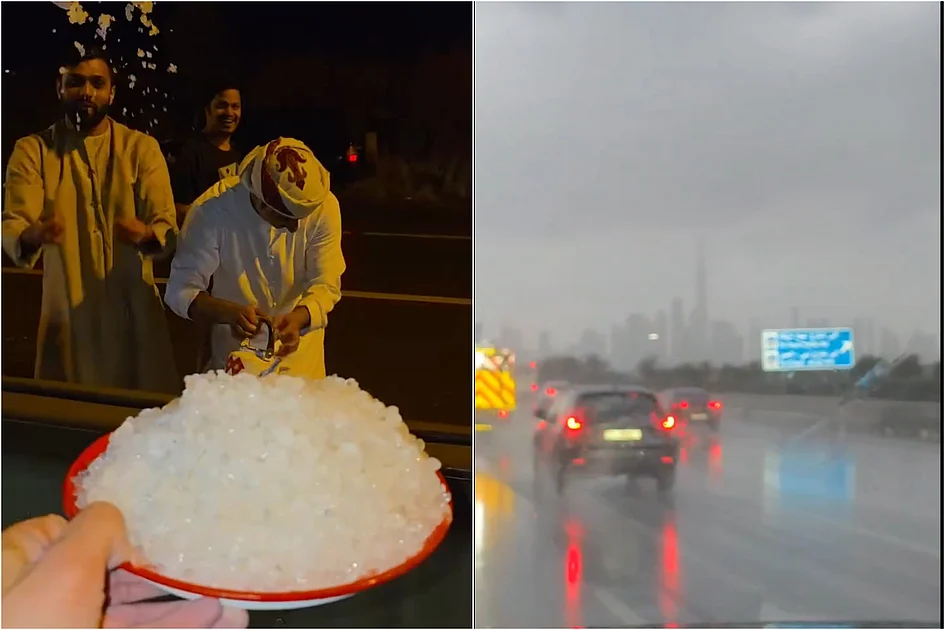
    An extraordinary winter weather phenomenon captivated residents across the United Arab Emirates on Monday morning as rare hailstorms and rainfall transformed the typically arid landscape. The northern emirate of Ras Al Khaimah became the epicenter of this meteorological event, with social media platforms flooded with videos showing steady hailstones descending upon the region. In one particularly joyful clip, groups of men were seen embracing the unexpected weather, laughing and playfully engaging in hail-throwing exchanges.

    The National Centre of Meteorology (NCM) had previously forecast light precipitation around January 25th, but the intensity and nature of Monday’s weather surpassed expectations. While winter rainfall occurs periodically in the UAE, hailstorms remain exceptionally uncommon, particularly in coastal and low-lying areas. The mountainous terrain of Ras Al Khaimah, with its higher elevations and lower temperatures, created ideal conditions for this rare convective cloud activity.

    Simultaneously, Dubai experienced its own winter transformation with steady rainfall, overcast skies, and brisk winds. Instagram footage from StormCentre.ae captured the precipitation streaming across vehicle windshields as traffic navigated the newly soaked roadways. The morning’s lowest temperature registered at 4.7°C on Jais Mountain in Ras Al Khaimah at 6:30 AM, contributing to the distinctly wintery atmosphere.

    Meteorological authorities have advised residents to exercise caution during these unstable weather conditions, emphasizing potential hazards from wet roads and reduced visibility. Dr. Mohamed Al Ebri, Director of Meteorology at NCM, previously explained to Khaleej Times that these temperature fluctuations represent normal winter patterns, with alternating cold spells and moderate warm periods expected throughout the season.

    Notably, Dr. Al Ebri contextualized the current cold spell within broader global climate dynamics, specifically referencing the La Niña phenomenon. This climate pattern, characterized by cooler-than-normal sea surface temperatures in the Pacific Ocean, continues to influence weather systems worldwide, including the Arabian Peninsula.

    The unexpected hailstorm provided residents with a memorable break from the region’s typically mild winter weather, creating moments of shared wonder and digital documentation across social media platforms.

  • Bahrain: 23-year-old dies in highway accident; one injured

    Bahrain: 23-year-old dies in highway accident; one injured

    A fatal traffic incident on Bahrain’s Sheikh Isa bin Salman highway resulted in the death of a young individual and left another person wounded during the early hours of January 26, 2026. The country’s Ministry of Interior has officially confirmed the tragic event, which occurred in the vicinity leading toward the King Fahd Bridge.

    Emergency response teams and relevant authorities were immediately dispatched to the accident site to provide necessary assistance and conduct preliminary investigations. The Ministry’s prompt announcement underscores the seriousness with which Bahraini officials are treating this roadway tragedy.

    While specific details regarding the circumstances leading to the collision remain under investigation by authorities, the incident highlights ongoing concerns about road safety in the region. The identity of the deceased 23-year-old victim has not been publicly disclosed pending notification of family members.

    This unfortunate event marks another addition to traffic-related fatalities in the Gulf region, where highway safety continues to be a priority for government agencies. The Ministry of Interior has not released additional information about the condition of the injured individual or the vehicles involved in the accident.

  • Perth plaza evacuated after man throws device into crowd

    Perth plaza evacuated after man throws device into crowd

    Australian authorities have apprehended a 31-year-old male suspect following an attempted attack during a contentious national holiday observance in Perth. The incident unfolded at approximately 12:30 PM local time on Monday in Forrest Place, a pedestrian square where thousands had gathered for an Invasion Day rally advocating for Indigenous rights.

    According to Western Australia Police Commissioner Col Blanch, the suspect threw a rudimentary explosive device toward a stage area where speakers were addressing the crowd. The mechanism, approximately the size of a medium coffee cup, contained ball bearings and screws wrapped around an unidentified liquid within a glass container. Forensic experts are currently analyzing the substance while the suspect remains in custody.

    Commissioner Blanch confirmed the device failed to detonate and no injuries were reported. He stated authorities “do not believe there is any ongoing threat to the community” despite the seriousness of the incident.

    The attack occurred on Australia Day, a national holiday marking the 1788 arrival of Britain’s First Fleet that many Indigenous Australians and supporters commemorate as Invasion Day due to its association with colonization. These annual protests typically draw significant crowds across major cities and frequently generate heated public discourse.

    Western Australia Premier Roger Cook condemned the act as “completely unacceptable,” emphasizing that “We can’t let hate win” and highlighting the importance of respecting diverse viewpoints in Australian society.

    This security scare follows closely on the heels of December’s Bondi Beach attack that killed 15 people during a Jewish festival. Australia’s national terror threat level currently remains at “probable,” the third-highest classification on the country’s five-point scale.

    Several Australia Day events were modified or canceled this year due to extreme heat conditions exceeding 40°C in some regions, adding another layer of complexity to the already tense national observance.

  • Pegula dethrones Keys to reach Australian Open quarterfinals

    Pegula dethrones Keys to reach Australian Open quarterfinals

    Melbourne witnessed a day of stunning upsets and masterful performances at the Australian Open on Monday, as two American contenders experienced vastly different fates. Sixth seed Jessica Pegula delivered a commanding performance to dethrone defending champion and compatriot Madison Keys with a decisive 6-3, 6-4 victory on Rod Laver Arena.

    The match between the close friends and podcast co-hosts began with Pegula’s blistering intensity, establishing an immediate 3-0 lead and securing the opening set in just 31 minutes. Despite Keys’ aggressive comeback attempt in the second set, Pegula maintained her composure, leveraging strategic serve variations and tactical awareness to overcome the challenging sun conditions that briefly affected her service game.

    Keys, the ninth seed, struggled with consistency throughout the match, committing 28 unforced errors and six double faults that ultimately hampered her defense of the title. Pegula’s victory marks her fourth appearance in the Australian Open quarterfinals, where she will face either fourth seed Amanda Anisimova or Chinese dark horse Wang Xinyu.

    In simultaneous action, Italian sensation Lorenzo Musetti produced a spectacular display of tennis artistry to dismantle American Taylor Fritz 6-2, 7-5, 6-4. The fifth seed demonstrated remarkable recovery from his previous five-set battle, breaking Fritz’s powerful serve twice in the opening set and maintaining authority throughout the contest.

    Musetti’s victory propels him into his first Australian Open quarterfinal, where he will face the ultimate challenge against ten-time champion Novak Djokovic. The Italian credited his transformed mentality and aggressive forehand strategy for his breakthrough performance, acknowledging his coach’s persistent emphasis on taking control of rallies.

    Both matches highlighted the evolving dynamics of professional tennis, with established champions making way for a new generation of contenders ready to claim their place in Grand Slam history.

  • China hits 469m motor vehicles in 2025 amid drop in dangerous driving cases

    China hits 469m motor vehicles in 2025 amid drop in dangerous driving cases

    China’s transportation landscape reached a significant milestone in 2025 with the national motor vehicle fleet expanding to 469 million units, according to official data released by the Ministry of Public Security. This substantial inventory includes 366 million automobiles, reflecting the continued growth of personal and commercial transportation across the nation.

    The corresponding driver population similarly swelled to 559 million licensed operators, with automobile drivers constituting 525 million of this total. The licensing authorities remained active throughout the year, issuing approximately 20.51 million new driving credentials to accommodate the growing mobility demands.

    Vehicle registration statistics revealed 35.35 million new motor vehicles were formally registered nationwide in 2025, maintaining an eleven-year streak of annual registration figures surpassing the 30 million mark. Automobiles accounted for 26.19 million of these new registrations, demonstrating sustained growth in personal transportation despite market maturation.

    In a parallel development, judicial data from the Supreme People’s Procuratorate indicated substantial progress in road safety enforcement. Between January and November 2025, Chinese procuratorial organs processed 236,000 dangerous driving cases referred by public security authorities—representing a notable 22.1 percent reduction compared to the previous year. Prosecutions for dangerous driving offenses similarly declined by 17.2 percent year-on-year, with 211,000 individuals formally charged.

    Despite this encouraging downward trend, dangerous driving violations continue to represent the most prevalent category of criminal cases handled by prosecutors, comprising 14.4 percent of all criminal matters accepted by judicial authorities. This persistent pattern highlights both the scale of enforcement efforts and the ongoing challenges in promoting comprehensive road safety awareness.

  • Britain’s Conservative Party loses another high-profile lawmaker to hard-right Reform

    Britain’s Conservative Party loses another high-profile lawmaker to hard-right Reform

    In a significant political realignment, former UK Home Secretary Suella Braverman has abandoned the Conservative Party after three decades to join the hard-right Reform UK party. The prominent anti-immigration lawmaker, who represented a southern England constituency, announced her defection on Monday, marking another high-profile departure from the Conservatives.

    Braverman, dismissed from her interior minister position in 2023 for repeatedly contradicting government policy, declared her decision stemmed from fundamental disagreements with the party’s direction. ‘We can either continue down this route of managed decline to weakness and surrender,’ Braverman stated, ‘or we can fix our country, reclaim our power, rediscover our strength. I believe that a better Britain is possible.’

    Her move follows recent defections including Robert Jenrick’s, bringing Reform UK’s parliamentary representation to eight seats in the 650-member House of Commons. Despite holding minimal parliamentary seats, Reform UK has demonstrated surprising strength in opinion polls, currently leading both the governing Labour Party and Conservatives ahead of critical local elections in May.

    The 45-year-old lawyer’s controversial tenure as home secretary included characterizing migration as a ‘hurricane’ heading for Britain, describing homelessness as a ‘lifestyle choice,’ and accusing police of excessive leniency toward pro-Palestinian protesters. Critics attributed her inflammatory rhetoric to escalating tensions that culminated in clashes between far-right demonstrators and police during large-scale protests.

    Braverman, known for criticizing liberal social values and what she termed the ‘tofu-eating wokerati,’ had previously advocated for Reform UK leader Nigel Farage’s integration into Conservative ranks following their devastating July 2024 election defeat. After colleagues rejected her proposals and dismissed her as ‘mad, bad and dangerous,’ she has now joined Farage’s expanding political movement that argues Britain is broken and overwhelmed by migration issues.

  • Why copper’s moment is far from over and what’s driving the next phase

    Why copper’s moment is far from over and what’s driving the next phase

    Copper continues to defy market expectations, establishing unprecedented price levels despite near-term volatility. The industrial metal’s remarkable 40% surge throughout 2025 has extended into 2026, with London Metal Exchange benchmarks breaching the $13,000/tonne threshold for the first time in January. This sustained appreciation reflects a complex convergence of supply constraints, evolving demand dynamics, and macroeconomic influences reshaping the global commodities landscape.

    Supply-side challenges have emerged as the dominant market driver, with significant production disruptions at major mining operations worldwide. The prolonged outage at Indonesia’s Grasberg facility – the planet’s second-largest copper mine – continues to constrain output, with normal operations not anticipated before 2027. Concurrently, labor strikes at Chile’s Mantoverde mine further tightened global supplies during early 2026, exacerbating the structural deficit.

    Market analysts identify multiple reinforcing factors behind copper’s ascent. Federal Reserve monetary policy expectations, geopolitical uncertainties, and potential US tariffs on refined copper have collectively created what Standard Chartered’s Sudakshina Unnikrishnan describes as ‘a perfect storm’ of supportive conditions. The traditional inverse correlation between copper and the US dollar positions the metal favorably amid anticipated interest rate reductions, while speculative activity has amplified recent price movements.

    Despite near-term overbought conditions prompting predictions of corrections to $11,000/tonne, the long-term outlook remains fundamentally bullish. S&P Global projections indicate copper demand will reach 42 million metric tonnes by 2040 – a 50% increase from current consumption levels – driven primarily by electrification initiatives, artificial intelligence infrastructure, and defense manufacturing. Vice Chairman Daniel Yergin emphasizes that ‘new vectors of demand that didn’t exist 10 years ago’ now permanently alter market dynamics, with electric vehicles consuming 2.9 times more copper than conventional automobiles and data centers requiring substantial electrical components.

    The critical supply-demand imbalance appears structural rather than cyclical. With new mining projects requiring approximately 17 years from discovery to production, S&P Global anticipates supply will peak at 33 million metric tonnes by 2030, potentially creating a 10-million-tonne deficit within fifteen years. This outlook has attracted diversified investment interest, including sovereign wealth funds and institutional investors increasing commodity allocations beyond traditional stock-bond portfolios.

    Market participants can access copper exposure through physical metal ownership, exchange-traded products tracking futures contracts, or equity positions in mining corporations. While price consolidation may occur pending US tariff policy clarification in June, the metal’s fundamental supply constraints and expanding demand applications suggest sustained long-term appreciation potential despite interim volatility.

  • US storm leaves 1 million without power, forces 10,000 flight cancellations

    US storm leaves 1 million without power, forces 10,000 flight cancellations

    A catastrophic winter storm has plunged the eastern United States into a state of emergency, triggering what officials are calling historic disruptions to power infrastructure and transportation networks. The massive weather system, delivering a dangerous combination of snow, sleet, and freezing rain across two-thirds of the nation, has left more than one million customers without electricity and forced the cancellation of over 10,000 flights.

    PowerOutage.us data revealed extensive blackouts stretching from the Southeast to the Southwest, with Tennessee experiencing the most severe impact at approximately 330,000 customers without power. Mississippi and Louisiana each reported over 100,000 outages, while Texas, Kentucky, Georgia, West Virginia, and Alabama faced significant electrical infrastructure failures.

    The aviation sector experienced unprecedented disruptions, with FlightAware reporting more than 10,800 cancelled flights on Sunday alone. Major airports including New York’s metropolitan facilities, Philadelphia International, and Charlotte Douglas International saw cancellation rates exceeding 80%. Washington’s Ronald Reagan National Airport suspended all operations entirely.

    Delta Air Lines implemented emergency measures, operating a reduced schedule and deploying cold-weather experts from northern hubs to assist with de-icing operations at southern airports. The airline cited ‘real-time frozen precipitation and afternoon storm conditions’ as continuing challenges.

    The National Weather Service issued grave warnings of ‘bitterly cold temperatures and dangerously cold wind chills’ extending from the Southern Plains to the Northeast. Forecasters predicted accumulation of up to 18 inches of snow in New England regions, with freezing rain expected across much of the Southeast and Mid-Atlantic.

    Federal and state authorities mobilized emergency responses, with President Donald Trump approving federal disaster declarations for twelve states. The Department of Homeland Security confirmed seventeen states and the District of Columbia had declared weather emergencies.

    Energy Secretary officials authorized emergency measures for grid operators, allowing bypass of environmental restrictions to maintain critical power supply. Homeland Security Secretary Kristi Noem warned of particular vulnerability to power lines due to accumulating ice, noting ‘this ice that has fallen will keep those lines heavy, even if they haven’t gone down immediately.’

    Dominion Energy, which operates Virginia’s extensive data center network, indicated the storm could rank among the most significant winter events in the company’s history if current ice accumulation forecasts prove accurate.

  • Dubai gears up for largest edition of Gulfood; commute, parking explained

    Dubai gears up for largest edition of Gulfood; commute, parking explained

    Dubai is poised to host the most expansive iteration of Gulfood in its history, marking a significant milestone by simultaneously utilizing two premier venues for the first time. The 2026 edition of this globally recognized food and beverage sourcing exhibition will unfold across both the Dubai Exhibition Centre (DEC) at Expo City and the Dubai World Trade Centre (DWTC) from January 26 to 30.

    This strategic expansion facilitates an unprecedented scale, featuring over 8,500 exhibitors from 195 countries presenting more than 1.5 million products. The event introduces several innovative programs, including curated discovery tours designed to connect investors with buyers. Prestigious competitions, such as the Gulfood Innovation Awards and the World Agri Food-tech Startup Challenge, will spotlight groundbreaking products and services within the industry.

    Attendees are advised on logistical arrangements to navigate the dual-venue format. The Dubai Metro is highly recommended for access to both locations, complemented by a complimentary shuttle bus service operating between DEC and DWTC. Paid parking is available at DWTC facilities, starting at Dh100 for the first hour, while DEC offers entirely free visitor parking. Organizers have implemented enhanced security protocols at both sites, including bag checks and screenings, and encourage pre-printing of badges and use of the official event app to streamline entry and improve the visitor experience.

    The event programming is strategically divided between the two venues. DWTC will host exhibitors from core categories like beverages, meat, seafood, and dairy, alongside the Future Food 500, NXT stage, and startup investor lounges. The Dubai World Cuisine program will feature culinary demonstrations from seven Michelin-starred chefs and 80 masterclasses. Conversely, DEC will serve as the global hub for international country pavilions and multi-commodity suppliers, housing the Gulfood Fresh exhibit, a new dedicated Grocery Trade sector, and the pivotal Gulfood World Economy summit.