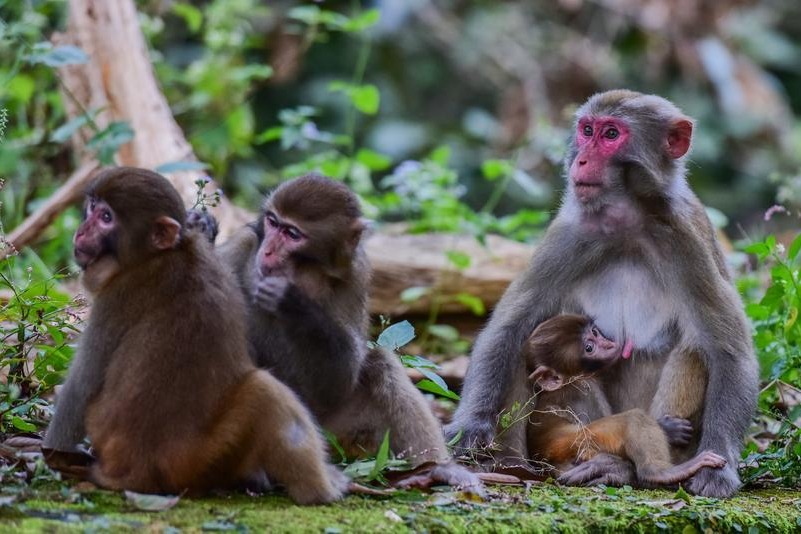
China’s endangered golden snub-nosed monkeys, known for their striking orange manes and pale blue faces, have embarked on a historic journey to Europe as part of a diplomatic initiative. These rare primates, native to the frigid mountains of central China, have joined the ranks of the country’s iconic pandas as animal ambassadors. Six monkeys have been loaned to zoos in France and Belgium for a decade, marking the first time these species have been showcased outside Asia. The initiative aims to foster scientific collaboration and conservation efforts while celebrating 60 years of diplomatic relations between China and France. The monkeys, after a monthlong quarantine, have made their public debut and are reportedly adapting well to their new environments. Their enclosures feature traditional Chinese architecture, blending cultural elements with their natural habitats. While some experts praise the potential for conservation and research, others express concerns about the welfare of these individual animals during international transport. The golden snub-nosed monkey, deeply rooted in Chinese art and culture, joins the panda as a symbol of China’s soft power. However, unlike pandas, which have long been global icons, these monkeys are yet to achieve similar recognition. The initiative reflects China’s ongoing efforts to leverage its unique wildlife for diplomatic and conservation purposes, though debates about the ethical implications of such practices persist.
作者: admin
-

The new shepherds of Spain: African migrants take up a neglected rural trade
In the sun-drenched plains of Castile-La Mancha, Spain, Osam Abdulmumen, a 25-year-old migrant from Sudan, herds 400 sheep on a centuries-old farm in the village of Los Cortijos. This pastoral scene, reminiscent of the region’s literary fame in “Don Quixote,” masks a deeper crisis: rural depopulation has left traditional shepherding jobs unfilled, a role Spaniards increasingly shun. To address this, a government program is training migrants like Abdulmumen—many from Africa, Venezuela, and Afghanistan—to sustain the region’s prized sheep’s milk cheese industry.
Abdulmumen, who fled violence in Sudan, now lives in a modest apartment in Los Cortijos, dreaming of sending money home to his family. His journey to Spain was arduous, spanning Egypt, Tunisia, Morocco, and finally Ceuta, a Spanish enclave, where he sought asylum. Today, he finds solace in the tranquility of rural life, earning €1,300 monthly, slightly above Spain’s minimum wage.
The program, funded by the regional government, has trained 460 migrants since 2022, with 51 now employed as shepherds. Sharifa Issah, a 27-year-old from Ghana, is among them, drawn to the work due to her experience with animals back home. The training, held near Toledo, covers the basics of shepherding over five days, preparing migrants for roles on farms, slaughterhouses, and olive groves.
Álvaro Esteban, a fifth-generation farmer, returned to Los Cortijos after years away, modernizing his family’s farm with drones and cheese production. He acknowledges that without migrant labor, many farms would face closure within a decade. “Most businesses won’t have successors,” he laments, highlighting the sector’s neglect.
Abdulmumen’s story is emblematic of a broader trend: migrants filling critical gaps in Spain’s rural economy, ensuring the survival of traditions and livelihoods in a region grappling with an aging population and urban migration.
-

Sharma and Kohli deny Australia a whitewash in ODI series as India wins by 9 wickets
In a thrilling conclusion to their three-match ODI series, India delivered a dominant performance to secure a nine-wicket victory against Australia at the Sydney Cricket Ground on Saturday. Rohit Sharma led the charge with an unbeaten 121 off 125 balls, marking his 33rd ODI century, while Virat Kohli rebounded from consecutive ducks with a composed 74 not out. The duo’s 168-run partnership, their first century stand since January 2020, guided India to chase down Australia’s total of 236 with more than 11 overs to spare. This victory prevented a series whitewash after Australia had clinched the first two matches in Adelaide and Perth. India’s bowlers also played a crucial role, with Harshit Rana claiming a career-best 4-39 as Australia collapsed from a promising 183-3 to be bowled out in 46.4 overs. Captain Shubman Gill praised the team’s near-perfect performance, highlighting the brilliance of Sharma and Kohli. The match, attended by nearly 40,000 fans, could mark the last international innings for the Indian stars in Australia. India’s tour continues with a five-match T20 series starting next Wednesday, while Australia prepares for the upcoming Ashes series against England.
-

Gift to Palestinians from Scottish firefighters seized by Israel, may be sent back to UK: Report
A humanitarian gesture by Scottish firefighters has sparked a diplomatic standoff, as a fire engine donated to their counterparts in the occupied West Bank remains impounded by Israeli authorities. The Guardian reported on Friday that the fire engine, equipped with essential medical supplies and firefighting gear, was sent to Nablus last summer but has been held at the Port of Ashdod since July 2024. Israeli officials have imposed $21,271 in fees on the Nablus governorate, citing the vehicle’s right-hand drive configuration as non-compliant with local regulations. Despite documented clearance, the fire engine has not been released, prompting Scottish firefighters to seek intervention from the UK government to repatriate the donation and avoid further financial burdens on Nablus. The Fire Brigades Union (FBU) has escalated efforts to resolve the issue, including presenting an early day motion in UK Parliament, lobbying the Israeli ambassador, and organizing protests outside the Israeli embassy in London. FBU General Secretary Matt Wrack emphasized the dire conditions faced by Palestinian firefighters, stating, ‘It is appalling that life-saving equipment donated by our members is being held by Israeli customs while Palestinian firefighters are in desperate need of resources.’ The UK Foreign, Commonwealth and Development Office (FCDO) has also engaged with Israeli authorities, urging increased humanitarian aid access to the Palestinian territories. The donation, which includes fire helmets, protective equipment, and medical supplies, underscores a decades-long partnership between Dundee and Nablus, twinned since 1980. However, the impasse highlights ongoing challenges in delivering aid to the West Bank, where firefighters face chronic shortages of essential equipment.
-

‘Journey of ambition’: Sheikh Hamdan lauds Emirates on first flight anniversary
Dubai Crown Prince Sheikh Hamdan bin Mohammed bin Rashid Al Maktoum commemorated the 40th anniversary of Emirates’ inaugural flight, praising the airline’s transformative journey and its role in shaping Dubai into a global hub. In a heartfelt message shared on October 25, 2025, Sheikh Hamdan reflected on the historic moment in 1985 when Emirates took its first flight from Dubai, marking the beginning of an ambitious venture that continues to soar. He lauded the airline’s team, led by Chairman and CEO Sheikh Ahmed bin Saeed Al Maktoum, for their unwavering dedication and vision, which have propelled Emirates to become a world leader in aviation. Earlier that day, Dubai Ruler Sheikh Mohammed bin Rashid Al Maktoum also celebrated the milestone, describing Emirates as a ‘national pride’ that has transported over 860 million passengers worldwide. Starting with a modest $10 million investment and two leased aircraft, Emirates has grown into a global powerhouse with a modern fleet of Boeing 777, Airbus A380, and Airbus A350 aircraft, and over 300 planes on order. To mark the occasion, Emirates released a video showcasing the evolution of its fleet since 1985, highlighting its commitment to innovation and excellence in aviation.
-

Palestinian factions start ‘national dialogue’, US appoints diplomat to monitor ceasefire
In a significant development, Palestinian factions convened in Cairo on Friday to initiate a ‘national dialogue’ aimed at addressing the governance and future of Gaza as part of a broader Palestinian state. A joint statement issued after the meeting highlighted the factions’ commitment to unifying their visions and positions to confront the challenges facing the Palestinian cause. The factions also called for an urgent meeting of all Palestinian forces and factions to agree on a national strategy and to reactivate the Palestine Liberation Organization (PLO), recognized as the sole legitimate representative of the Palestinian people. While Hamas was present at the meeting, the participation of other factions remains unclear. The statement emphasized the need for a unified national position, rejecting all forms of annexation and displacement in Gaza, the West Bank, and Jerusalem. Additionally, the factions urged an end to torture and violations against prisoners in Israeli prisons and called for measures to ensure security and stability in Gaza. Notably, the factions agreed to form a temporary committee of independent Palestinian technocrats from Gaza to manage daily life and provide basic services, signaling a willingness to cede power to this group. However, the issue of disarmament, a contentious demand from the US and Israel, was not addressed. Instead, the factions proposed a UN force to monitor the ceasefire. The meeting comes as 157 out of 193 UN member states recognize Palestine, including most G7 nations. Interestingly, recent polling in the US shows that 41% of Republican voters and a majority of Democrats support Palestinian statehood, marking a shift in public opinion. The Trump administration, historically critical of the UN, has appointed Ambassador Steven Fagin to lead the Civil-Military Coordination Center in southern Israel, tasked with monitoring the Gaza ceasefire. Secretary of State Marco Rubio, who toured the facility on Friday, expressed cautious optimism about the progress of the Trump administration’s 20-point peace plan for Gaza.
-

India: Police foil major terrorist plot in Delhi, accused planned Diwali blasts
In a significant counter-terrorism operation, Delhi Police have successfully foiled a major terrorist plot aimed at disrupting Diwali festivities in the Indian capital. The police arrested two individuals, both named Adnan, who were allegedly planning to carry out explosions in crowded areas, including a prominent mall and a public park. Preliminary investigations reveal that the suspects were using multiple Instagram accounts to disseminate extremist content and maintain communication with foreign handlers, suspected to be based near the Syria-Turkey border. During the arrests, authorities seized incriminating evidence, including a laptop, pen drives, Daesh propaganda material, electronic components, and a wristwatch believed to be intended for constructing an Improvised Explosive Device (IED). One of the suspects had previously been arrested in June 2024 by the Uttar Pradesh Anti-Terrorist Squad for issuing online threats. The second suspect, whose father is a government employee, was apprehended on October 16. The Special Cell, led by Inspector Sunil and Inspector Dhiraj, had been monitoring the suspects for months, with parallel investigations in Delhi and Bhopal. Interrogations are ongoing to uncover potential network members, and searches are being conducted at multiple locations linked to the duo. This operation highlights the persistent threat of terrorism during festive seasons and the vigilance of Indian security forces in safeguarding public safety.
-

Trump’s Asia return and East Timor’s entry take spotlight in landmark ASEAN summit
The 2023 ASEAN Summit in Kuala Lumpur, Malaysia, has commenced with significant developments on multiple fronts. The event marks the formal inclusion of East Timor as the 11th member of the Association of Southeast Asian Nations (ASEAN), the first expansion in 26 years. This milestone underscores ASEAN’s commitment to regional inclusivity, offering East Timor access to free trade agreements, investment opportunities, and a broader market to diversify its oil-dependent economy.
The summit also highlights the return of U.S. President Donald Trump to Asia for the first time since his re-election. Trump’s presence signals renewed U.S. engagement in the Indo-Pacific region, with expectations of new trade deals and his involvement in brokering an expanded ceasefire between Thailand and Cambodia. However, his visit has sparked protests in Kuala Lumpur, particularly over his administration’s stance on the Palestinian issue, despite Malaysia’s acknowledgment of his role in facilitating a Gaza ceasefire.
Regional security and economic resilience dominate the agenda, with discussions on the South China Sea disputes, Myanmar’s civil war, and the proliferation of cross-border scam networks. ASEAN is set to sign an upgraded free trade pact with China and continue negotiations on a code of conduct for the contested waterway. Meanwhile, Myanmar’s military government, barred from summits since the 2021 coup, faces scrutiny over its planned elections in December, which critics deem neither free nor fair.
The summit also features the revival of the Regional Comprehensive Economic Partnership (RCEP), the world’s largest trade bloc, as regional economies seek stability amid U.S. tariff measures and shifting global trade patterns. Leaders from China, Japan, India, Australia, and other key partners are attending, alongside Brazilian President Luiz Inácio Lula da Silva and South African President Cyril Ramaphosa, reflecting ASEAN’s efforts to deepen ties with Africa and Latin America.
-

Three-way tie at the top as Skaik leads UAE bid at Asia-Pacific Amateur Championship
The 16th Asia-Pacific Amateur Championship (AAC) at Emirates Golf Club is heating up with a thrilling three-way tie at the top of the leaderboard. Japan’s Rintaro Nakano, Vietnam’s Khanh Hung Le, and Australia’s Harry Takis are all tied at 11-under-par, setting the stage for a competitive final weekend. Meanwhile, UAE’s Ahmad Skaik has emerged as a local hero, showcasing resilience and skill to remain in contention. Despite a challenging round on Friday, Skaik fought back to finish level-par, leaving him tied for 10th at four-under 140, just seven shots behind the leaders. Skaik’s performance has ignited local enthusiasm, with compatriots Sam Mullane and Rayan Ahmed also advancing past the cut, ensuring a strong Emirati presence in the tournament. Lebanon’s Geoffrey Laklak made history by becoming the first player from his country to make the AAC cut, adding another layer of excitement to the event. Nakano, Le, and Takis each delivered standout performances, with Nakano matching the day’s best score of 66. The tournament’s depth is evident, with 62 players progressing to the weekend rounds and 22 breaking par after two days. As the competition intensifies, all eyes are on the final 36 holes, where the winner will secure a coveted spot at The Masters. Round three begins on Saturday, with the leaders teeing off at 10:06 a.m. For live updates and scores, visit www.aacgolf.com.
-

Beijing looking to exert tighter control over Chinese Christians
In a significant move, Chinese authorities detained Ezra Jin, the leader of the Zion Church, along with over 30 church staff, including pastors, on October 10. This marks one of the largest crackdowns on Christian churches in recent years, shedding light on Beijing’s ongoing efforts to regulate religious activities. The Zion Church, a prominent unregistered Christian congregation with widespread presence across China, has long been under government scrutiny. The timing of this crackdown is particularly notable, as it coincides with escalating tensions between China and the United States, suggesting that both domestic religious policies and international relations are influencing Beijing’s actions. China officially recognizes five religions—Buddhism, Daoism, Islam, Catholicism, and Protestantism—with Buddhism and Daoism considered indigenous and central to Han Chinese culture. Christianity, introduced to China centuries ago, has faced periods of tolerance and persecution. The 19th century saw significant growth in Chinese Christianity, fueled by Western missionaries, but this also led to xenophobic movements that contributed to the fall of the empire. After the establishment of the People’s Republic of China in 1949, foreign Christians were expelled, and state-controlled religious bodies were created. Dissatisfaction with these bodies led to the rise of unregistered churches, which have operated outside state control ever since. The Cultural Revolution (1966–1976) brought severe persecution of all religious practices, but Christianity persisted and experienced a resurgence in the more liberal 1980s. However, under President Xi Jinping’s leadership since 2013, China has adopted a stricter stance on religion, emphasizing the ‘Sinicization’ of faiths to align them with state ideology. Recent regulations have tightened control over religious sites, finances, and charitable activities, while the forcible removal of crosses and the imprisonment of prominent church leaders like Wang Yi underscore the severity of the crackdown. The close ties between some unregistered churches and U.S.-based evangelical groups have further complicated the situation, with repressive measures often intensifying during periods of strained U.S.-China relations. The recent crackdown on the Zion Church, whose founder’s daughter is a U.S. Senate staffer, appears to be a strategic signal to Washington. Unless bilateral relations improve, Chinese Christians may face continued repression.