
Luis Domingos, a 27-year-old wheelchair athlete, has made an extraordinary transition from wheelchair basketball to wheelchair rugby league, earning a spot in England’s 10-man squad for the upcoming Ashes series against Australia. Born in Setubal, Portugal, of Angolan descent, Domingos became a wheelchair user after contracting polio as a child. His journey began in Leeds, where he initially played wheelchair basketball for fun before switching to rugby league to improve his fitness. Domingos’ talent in basketball led him to professional leagues in Italy, Spain, and Portugal, where he represented his birth country internationally. However, his desire to pursue a business management degree at the University of Huddersfield brought him back to England. While studying, Domingos continued to play wheelchair basketball and eventually joined Castleford Tigers’ wheelchair rugby league team, where he quickly made an impact. His performances earned him a call-up to England’s national squad, and he recently helped Castleford win the Wheelchair Championship Grand Final. Domingos attributes his success to his diverse experiences and the support of his teammates. ‘England is a family,’ he said. ‘I feel privileged to be part of this.’ The Ashes series will see England play four matches in Australia, starting on October 24. Domingos is optimistic about the challenges ahead, drawing on his professional background to handle the pressure. ‘Everything happens for a reason,’ he reflected. ‘I’m living today and enjoying this moment.’
作者: admin
-
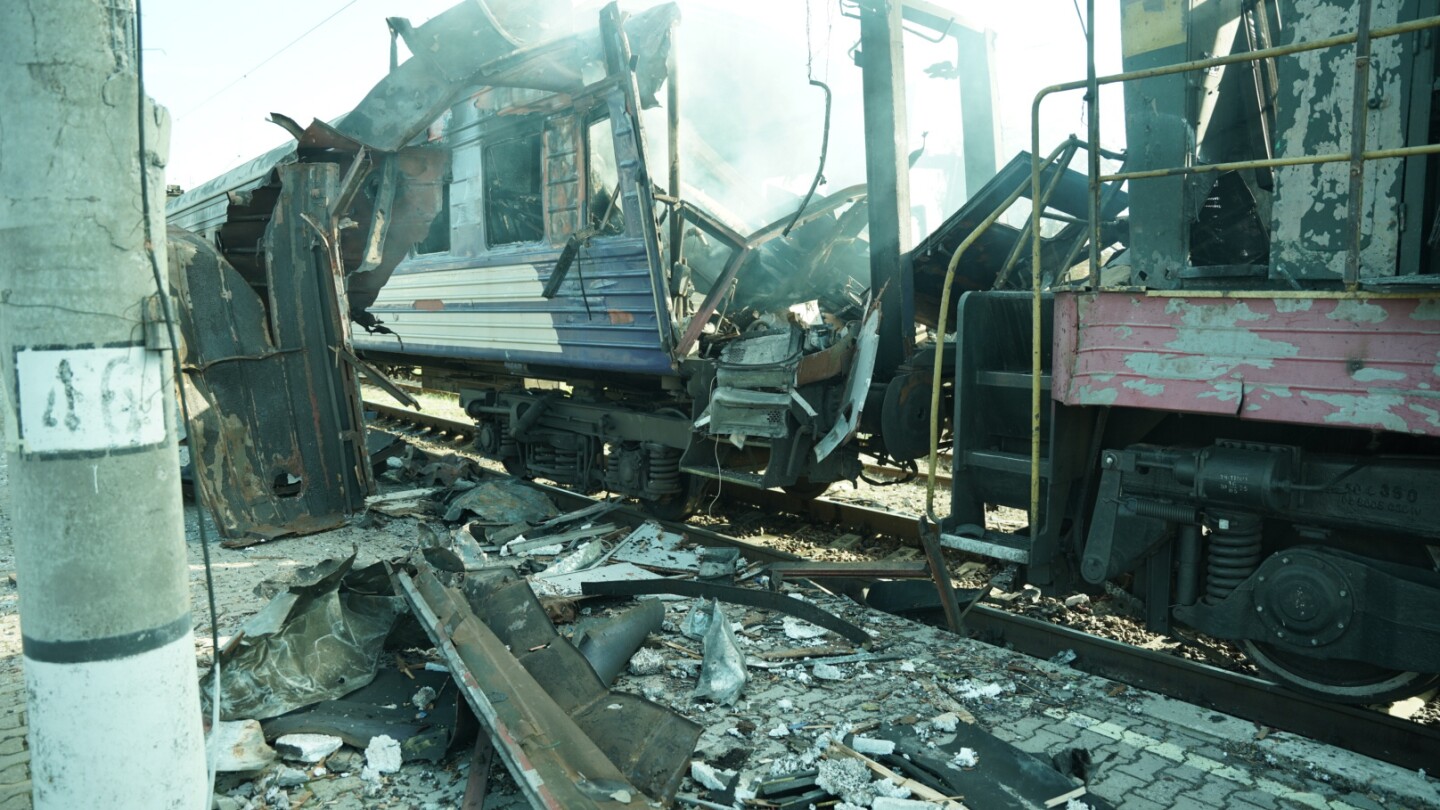
Russia makes more precise drones and is using them to attack Ukraine’s vital rail network
In a recent escalation of hostilities, Russian drones targeted the Shostka train station in northeastern Ukraine, resulting in the death of a 71-year-old man and injuring at least eight others. The attack left train cars severely damaged by fire and shrapnel, highlighting a surge in assaults on Ukraine’s railway system since mid-summer. Ukrainian officials report that these strikes are part of a broader Russian strategy to disrupt commercial and military logistics by targeting critical infrastructure with increasingly precise long-range drone technology. Oleksandr Pertsovskyi, CEO of the Ukrainian state railway, emphasized that the attacks aim to sow unrest in border regions by severing rail connections. Since August alone, there have been approximately 300 attacks on railway infrastructure, averaging about 10 per week. Ukraine’s rail network, which handles over 63% of the country’s freight and 37% of passenger traffic, is vital for transporting grain, metal exports, and military aid. Russian forces have enhanced their drone capabilities by equipping them with cameras and radio modems, allowing real-time adjustments to flight paths and significantly increasing precision. Ukrainian repair crews have been working tirelessly to restore services swiftly, with track repairs often completed within hours. Despite the relentless attacks, Ukrainian officials remain determined to keep the trains running, viewing their resilience as a defiance against Russian aggression.
-
US soybean farmers are dangerously overdependent on China
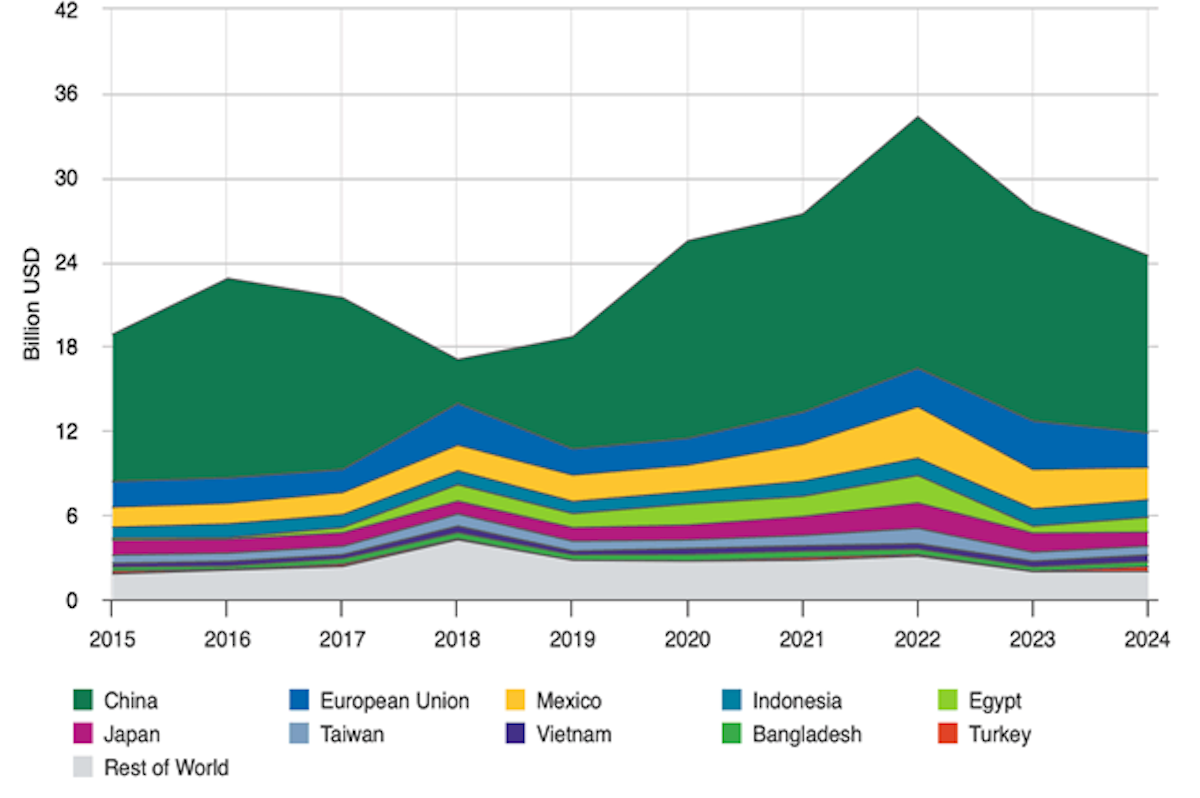
In 2003, during my early days at DTN/The Progressive Farmer, I was invited to speak about China at a farmers’ meeting in Iowa. Though not an expert on Chinese agriculture, my 17 years living and working in Tokyo and Hong Kong allowed me to witness China’s extraordinary economic growth. I confidently declared, ‘China is the difference between $5 soybeans and $10 soybeans.’ This prediction proved accurate, as US soybean exports to China doubled in the following years, with prices soaring to $9–$15 per bushel. For decades, China has been the largest overseas buyer of US soybeans, accounting for over half of American exports in 2024, far surpassing the European Union’s 10% share. However, the trade war initiated by President Donald Trump in 2018 disrupted this relationship, prompting China to increasingly turn to Brazil as its primary supplier. Despite this shift, China continued to purchase significant quantities of US soybeans—until 2024. This year, China has drastically reduced its imports, buying only 200 million bushels in the first eight months, compared to 1 billion during the same period in 2023. In recent months, imports have dropped to zero. The American Soybean Association’s president, Caleb Ragland, expressed concern, stating, ‘The farm economy is suffering while our competitors supplant the United States in the biggest soybean import market in the world.’ While some analysts predict a potential rebound in Chinese purchases, the ongoing trade tensions, including Trump’s imposition of 100% tariffs on Chinese goods, cast doubt on this possibility. The situation underscores the urgent need for US farmers to diversify their markets and reduce reliance on China. Meanwhile, China is actively expanding its domestic soybean production and investing in alternative suppliers like Brazil and Russia. For US farmers, the loss of China as a major buyer is a stark reminder of the risks of overdependence on a single market. Developing new domestic and international markets is essential to ensure long-term stability and growth in the soybean industry.
-

Ecuador and Mexico draw 1-1 in a World Cup warmup
In a tightly contested warmup match for the 2026 FIFA World Cup, Ecuador managed to secure a 1-1 draw against Mexico on Tuesday in Guadalajara. The game saw early action as Germán Berterame put Mexico ahead in the third minute with a swift strike. However, Ecuador responded with determination, and Jordy Alcívar leveled the score in the 20th minute through a well-executed penalty kick. This result extended Mexico’s winless streak to four matches, following a disappointing 4-0 loss to Colombia last Saturday. Mexico’s last victory dates back to July 6, when they defeated an alternate United States squad in the Gold Cup final. The team will now look to break this streak in November when they face Uruguay. Meanwhile, Ecuador, which finished second in South America’s World Cup qualifiers behind Argentina, continues to build momentum after a 1-1 draw against the United States last Friday. Both teams are using these matches to fine-tune their strategies ahead of the 2026 World Cup, where Mexico will co-host with Canada and the United States.
-

Watch: Moment house drifts away from land as typhoon hits Alaska
In a harrowing incident during a severe typhoon in Alaska, the U.S. Coast Guard executed a critical rescue operation, saving 24 individuals whose homes were swept away by the storm. The event unfolded as powerful winds and surging waters detached several houses from their foundations, causing them to drift perilously away from the shore. The Coast Guard responded swiftly, deploying rescue teams to locate and evacuate the stranded residents. This incident highlights the increasing vulnerability of coastal communities to extreme weather events, exacerbated by climate change. Authorities have urged residents in vulnerable areas to remain vigilant and adhere to evacuation protocols during such emergencies.
-
Chinese airlines protest US plan to ban their flights over Russian airspace
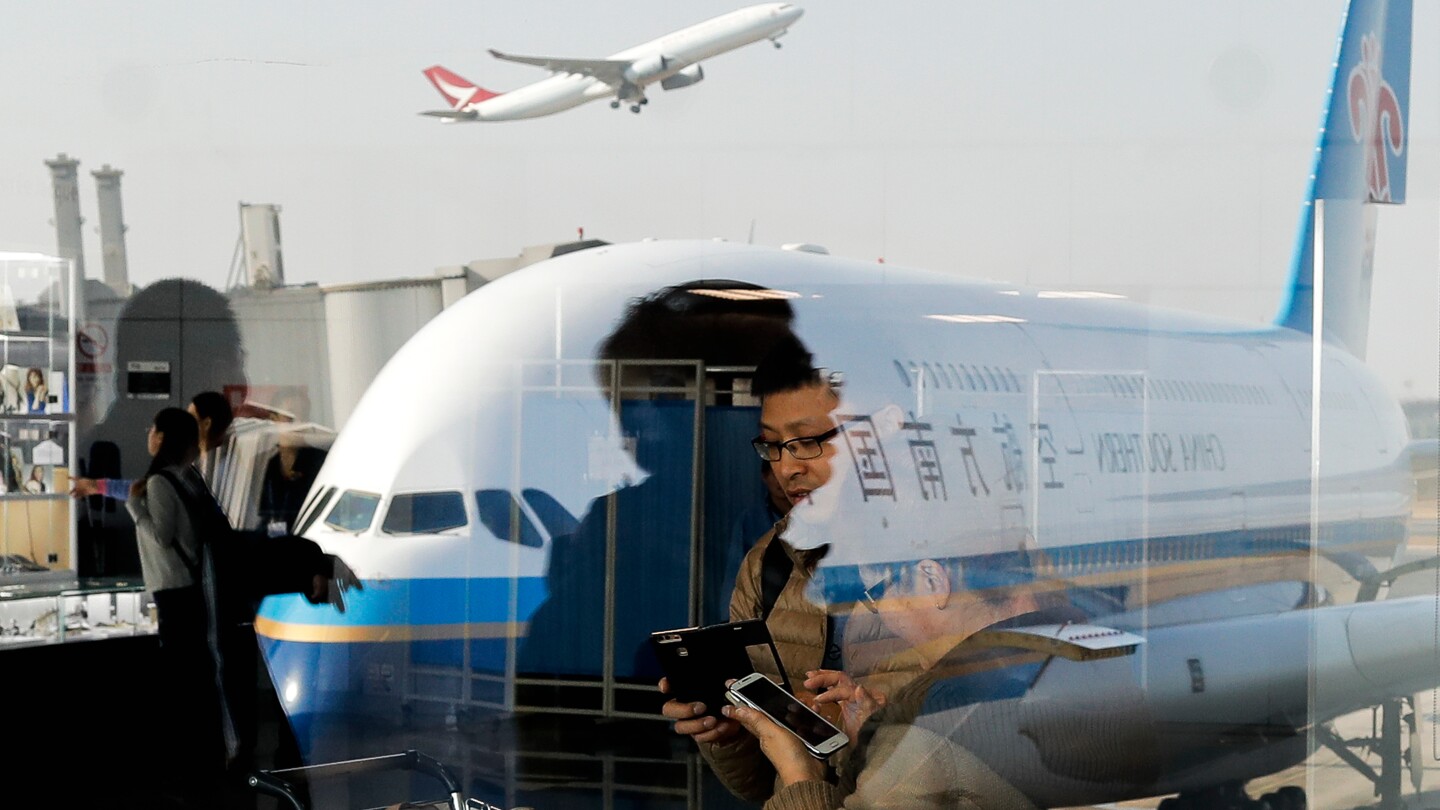
Major Chinese state-owned airlines have strongly opposed a U.S. proposal to prohibit them from flying over Russian airspace on routes to and from the United States. The U.S. argues that this restriction would level the playing field, as American carriers are barred from Russian airspace due to sanctions imposed after Russia’s invasion of Ukraine in 2022. Air China, China Eastern, and China Southern are among six carriers that have filed formal complaints against the proposed ban, warning of significant disruptions to travelers and increased costs. China Eastern emphasized that the ban would harm public interest and inconvenience passengers, leading to longer flight times, higher fuel consumption, and elevated airfares. China Southern highlighted the potential impact on thousands of travelers, while Air China estimated that over 4,400 passengers could be affected during the upcoming holiday season. The Chinese Foreign Ministry also criticized the proposal, labeling it as punitive to global passengers. Aviation expert David Yu noted that U.S. carriers face increased costs due to longer flight paths, while Chinese airlines benefit from cost savings by using Russian airspace. Despite these advantages, Chinese carriers have faced financial challenges, particularly since the COVID-19 pandemic. The U.S. Department of Transportation defended the proposal, citing ‘competitive imbalances’ caused by Chinese airlines’ access to more efficient routes. European carriers, including Air France-KLM, have also expressed concerns, while United Airlines urged that Cathay Pacific, Hong Kong’s flagship carrier, be excluded from the ban.
-

An ancient tradition is helping girls in Zimbabwe fight child marriages
In the rural landscapes of northeastern Zimbabwe, a group of girls gathers inside a white tent with a wooden fireplace at its center. They remove their shoes, sit on mattresses, and prepare to engage in open discussions about sexuality, child marriage, teen pregnancy, gender bias, education, economic empowerment, and the law. This gathering is a modern revival of Nhanga, an ancient tradition once used to prepare adolescent girls for marriage. Today, it has been reimagined as a peer-led movement to resist child marriage, a pervasive issue in Zimbabwe and across Africa.
Nhanga, traditionally a female-only space in round thatched huts, was historically a place where girls were taught obedience, marital duties, and moral education, reinforcing patriarchal norms. However, the new Nhanga is a cultural innovation addressing contemporary challenges. ‘The new Nhanga is a safe space where girls can candidly discuss sensitive topics,’ said Nokutenda Magama, a programs officer with the Rozaria Memorial Trust, a nonprofit driving this revival.
The sessions, organized by age groups ranging from five-year-olds to women over 35, include practical skills like poultry raising, farming, and soap making. Elders and senior government officials are sometimes invited to provide mentorship. This initiative comes amid alarming statistics: one in three girls in Zimbabwe marries before 18, a situation mirrored across East and southern Africa. Despite laws outlawing child marriage, poverty, weak enforcement, and cultural practices perpetuate the problem.
For Samantha Chidodo, 26, the Nhanga revival offered a lifeline. Forced into an abusive marriage at 17, she escaped and, with support from the Rozaria Memorial Trust, returned to school and became a pioneer of the modern Nhanga. ‘Initially, we were only about 20 girls. Now, over 200 in my village participate,’ she said. The movement has spread to Zambia and Sierra Leone and gained recognition at African Union and United Nations forums.
To address the cultural roots of child marriage, girls have sought the support of chiefs and village heads. Xmas Savanhu, a local village headman, explained that offenders now face fines, such as paying a cow, which is held in trust for the girl’s education. Despite progress, poverty and entrenched attitudes remain challenges. ‘The gap lies with the adults,’ said Enet Tini, a teacher and mentor, emphasizing the need for girls-led initiatives to shift societal norms.
Nyaradzai Gumbonzvanda, deputy executive director at U.N. Women and founder of the Rozaria Memorial Trust, called child marriage ‘essentially rape and sexual exploitation,’ stressing that solutions must involve girls themselves, policymakers, and traditional leaders. ‘If we can pressure each other into behaving badly, then we can also influence each other to act positively,’ said Anita Razo, an 18-year-old mentor.
This grassroots movement demonstrates how ancient traditions can be reimagined to address modern challenges, empowering girls to shape their futures and challenge societal norms.
-

Most US stocks rise after swinging through another erratic day
Wall Street experienced another day of erratic trading on Wednesday, with major indices showing mixed results. The S&P 500 gained 0.4%, recovering from earlier fluctuations that saw it nearly erase a significant morning rally. The Nasdaq composite rose 0.7%, bouncing between a 0.4% drop and a 1.4% surge, while the Dow Jones Industrial Average dipped slightly by 17 points, or less than 0.1%. This volatility follows a turbulent Tuesday, where the Dow swung between a 615-point loss and a 455-point gain, reflecting ongoing market uncertainty. The recent instability traces back to President Donald Trump’s threat of higher tariffs on China, which disrupted a period of relative calm in the markets. Technology stocks led the charge on Wednesday, buoyed by a strong earnings report from ASML, a key player in the semiconductor industry. ASML projected a 15% revenue increase by 2025, with next year’s earnings expected to match or exceed this year’s. CEO Christophe Fouquet highlighted the growing momentum in AI investments, countering concerns of a potential bubble akin to the dot-com frenzy of 2000. Financial institutions also contributed to the market’s upward movement, with Bank of America and Morgan Stanley posting better-than-expected profits. However, PNC Financial and Abbott Laboratories faced declines due to underwhelming forecasts and revenue shortfalls. Corporate earnings are under heightened scrutiny as investors seek clarity on the U.S. economy’s health, especially with delayed government reports on inflation and other key indicators. The Federal Reserve’s recent rate cut and hints of further reductions add another layer of complexity, as policymakers balance inflation concerns with a slowing job market. In the bond market, the 10-year Treasury yield held steady at 4.03%, while gold prices surged 0.9% to over $4,200 per ounce, driven by global economic uncertainties. Overseas, Asian markets saw strong gains, with South Korea’s Kospi jumping 2.7%, while European indices showed mixed results.
-

Red Cross en route to collect bodies of Israeli hostages from Hamas, Israel says
In a significant development within the ongoing ceasefire agreement between Israel and Hamas, Red Cross vehicles have been deployed to collect the bodies of Israeli hostages held in Gaza. The operation, which took place on October 14, 2025, in Gaza City, is part of a broader hostages-prisoners exchange deal initiated after the deadly October 7, 2023, attack. The Israeli military and Shin Bet security agency confirmed that the Red Cross was en route to a designated meeting point in the northern Gaza Strip to receive several coffins containing the remains of deceased hostages. Hamas had earlier communicated to mediators its intention to transfer four bodies, with a senior Hamas official revealing plans to hand over an additional four bodies later in the evening. The official emphasized the challenges in locating more bodies due to the extensive destruction caused by the conflict, which has severely hampered search and recovery efforts. This move comes as Israel has tightened restrictions on humanitarian aid to Gaza, including the closure of the Rafah crossing, in an effort to pressure Hamas to release the remaining 24 bodies. Despite the ceasefire, tensions persist, with both sides accusing each other of violations. Israeli fire reportedly killed at least six people in Gaza, while Hamas has yet to return all the remaining bodies. The fragile truce, now in its fifth day, remains a critical yet precarious step toward de-escalation.
-

Messi gets two assists, Argentina beats Puerto Rico 6-0 in relocated soccer friendly
In a commanding display of skill and teamwork, Lionel Messi led Argentina to a resounding 6-0 victory over Puerto Rico in an international friendly match held in Fort Lauderdale, Florida. The game, originally slated for Chicago, was relocated due to low ticket sales and concerns over an ongoing immigration crackdown in the area. Messi, playing on familiar turf as a member of Inter Miami, showcased his brilliance with two assists and a pivotal role in setting up another goal. His first-half lob set up Gonzalo Montiel’s opener, while a clever back pass in the 83rd minute facilitated Lautaro Martínez’s second goal of the night. Alexis Mac Allister contributed with a brace, and an own goal further cemented Argentina’s dominance. Despite the lopsided matchup between FIFA’s third-ranked team and 155th-ranked Puerto Rico, the latter’s goalkeeper, Sebastian Cutler, made notable saves against Messi. The match, part of Argentina’s World Cup preparations, drew a modest crowd initially but filled up as the game progressed. The relocation controversy and the stark contrast in team rankings added layers of intrigue to the event.