
In a significant development, an Australian coroner has called for renewed police scrutiny into the mysterious death of Simone Strobel, a German backpacker whose body was discovered concealed in a park two decades ago. Coroner Teresa O’Sullivan, who presided over a second inquest into the case, concluded that further investigation is warranted to uncover the truth behind the tragic incident. Strobel, a 25-year-old kindergarten teacher from Bavaria, was found naked under palm fronds in Lismore, New South Wales, on February 17, 2005, just 100 meters from the trailer where she had been staying with her boyfriend Tobias Suckfuell (now known as Tobias Moran), his sister Katrin Suckfuell, and friend Jens Martin. Her body was discovered six days after she was reported missing. Despite Moran being charged with her murder and obstruction of justice in 2022, the charges were subsequently dropped without explanation. O’Sullivan noted that while Moran’s legal team argued his involvement was ‘very unlikely,’ she could not definitively rule out his participation. The coroner also dismissed the likelihood of Moran’s sister or Martin being involved, emphasizing that Moran could not have acted alone in the alleged crime. However, O’Sullivan stopped short of assigning responsibility, stating that the cause of Strobel’s death remains unclear. This echoes the findings of the initial 2007 inquest, which also cited insufficient evidence to recommend charges. In 2020, police offered a AUD 1 million reward for information, and Moran has since expressed hope that the case will receive a ‘fair and unbiased investigation’ following the coroner’s recommendation to refer the matter to the New South Wales Unsolved Homicide Team for further DNA analysis. Strobel and Moran had arrived in Australia as backpackers in 2004, with Moran changing his name in 2012 after marrying his Australian wife.
作者: admin
-

China’s vision expected to benefit Africa
China’s Global Governance Initiative (GGI), launched in September 2025 at the ‘Shanghai Cooperation Organization Plus’ Meeting in Tianjin, is poised to reshape Africa’s role in the global landscape. Rooted in principles of sovereignty, equality, and multilateralism, the GGI seeks to reform global governance systems, particularly in climate, technology, and institutional representation. Experts believe this initiative offers African nations unprecedented opportunities to assert their independence and foster sustainable development. Warwick Powell, an adjunct professor at Australia’s Queensland University of Technology, emphasized that the GGI moves beyond the hierarchical structures of the post-war Western-dominated order, enabling African countries to advocate for reforms in global institutions like the United Nations, IMF, and World Bank. Powell highlighted key areas of focus, including energy sovereignty, data sovereignty, and financial independence, urging African nations to invest in local infrastructure and adopt mechanisms like currency swaps with China’s central bank. James Shikwati, director of the Inter Region Economic Network, noted that the GGI aligns with Africa’s long-standing aspirations to reshape international finance and governance. Thomas Namwambah, a senior lecturer at Kenya’s Kenyatta University, praised China’s approach for its emphasis on equality and justice. As Africa navigates the challenges of colonial legacies and external pressures, the GGI provides a framework for collective security, regional cooperation, and shared prosperity, positioning the continent to seize its moment on the global stage.
-

US and European energy leaders in Greece to talk ways to better supply Ukraine
ATHENS, Greece — Energy ministers from the United States and European nations convened in Athens on Thursday to strategize on leveraging a newly enhanced regional pipeline network to bolster gas supplies to war-torn Ukraine. The meeting, hosted by the Atlantic Council, a Washington-based think tank, saw the participation of U.S. Energy Secretary Chris Wright, Interior Secretary Doug Burgum, over 80 U.S. officials, EU energy ministers, and executives from leading American liquefied natural gas (LNG) companies.
President Donald Trump aims to capitalize on the United States’ status as the world’s leading LNG exporter to persuade the EU to increase its purchases of U.S. gas. This initiative is part of broader trade negotiations, with Europe already being the largest market for American LNG. The EU is also committed to eliminating all Russian gas supplies within the next two years, shifting focus to the Vertical Corridor, a north-south gas route connecting Greece with Bulgaria and Romania.
Greek Prime Minister Kyriakos Mitsotakis emphasized Greece’s strategic geographic position as the natural entry point for American LNG into Europe. ‘The Vertical Corridor is a project of great geopolitical and economic importance to us,’ Mitsotakis stated during talks with U.S. officials. ‘We’re happy that it’s becoming a reality.’
-

People from South Sudan will lose temporary US legal status
The United States has announced the termination of South Sudan’s Temporary Protected Status (TPS), a program that has allowed South Sudanese nationals to legally reside in the U.S. and escape ongoing armed conflict in their homeland. The decision, effective January 5, was confirmed by the Department of Homeland Security (DHS) in a recent statement. Secretary of Homeland Security Kristi Noem concluded that South Sudan no longer meets the statutory requirements for TPS after consultations with interagency partners. South Sudanese nationals who voluntarily depart the U.S. using the Customs and Border Protection mobile app may receive a complimentary plane ticket, a $1,000 exit bonus, and potential future legal immigration opportunities. This policy shift is a significant setback for South Sudanese refugees, as the country remains politically unstable and continues to produce a large number of displaced individuals seeking safety abroad. Edmund Yakani, a prominent South Sudanese civic leader, suggested that the decision reflects deteriorating U.S.-South Sudan relations, particularly regarding the deportation of foreign nationals. South Sudan has resisted accepting a second phase of U.S. deportees, which reportedly angered the Trump administration. The TPS designation, initially granted in 2011 following South Sudan’s independence from Sudan, has been renewed in 18-month increments. However, the Trump administration has consistently sought to withdraw protections for immigrants, including ending TPS for hundreds of thousands of Venezuelans and Haitians. South Sudan’s government, already struggling to provide basic services, faces additional challenges due to U.S. cuts in foreign aid. The country’s fragile peace deal, signed in 2018 to end conflict between President Salva Kiir and former deputy Riek Machar, is under strain following Machar’s arrest on criminal charges earlier this year.
-

Nasa Hataoka and Miyu Yamashita atop LPGA leaderboard after first round in Japan
Japanese golfers Nasa Hataoka and Miyu Yamashita delivered stellar performances on Thursday, both carding 7-under 65 to share the lead after the opening round of the LPGA’s Toto Japan Classic. Held at the Seta Golf Club in western Japan, the event showcased a competitive field with several players in close contention. Hataoka, aiming for her seventh LPGA Tour victory, and Yamashita, seeking her third title, set the tone for an exciting tournament. South Korea’s Shin Ji-yai trailed by just one stroke, while Japanese twins Chisato Iwai and Akie Iwai, along with Minami Katsu, were two shots behind. The leaderboard remained tight, with eight players, including Australia’s Minjee Lee, a three-time major champion, just three strokes off the pace. Defending champion Rio Takeda struggled, finishing with a 1-over 73 and trailing by eight strokes. The tournament promises intense competition as players vie for the coveted title.
-
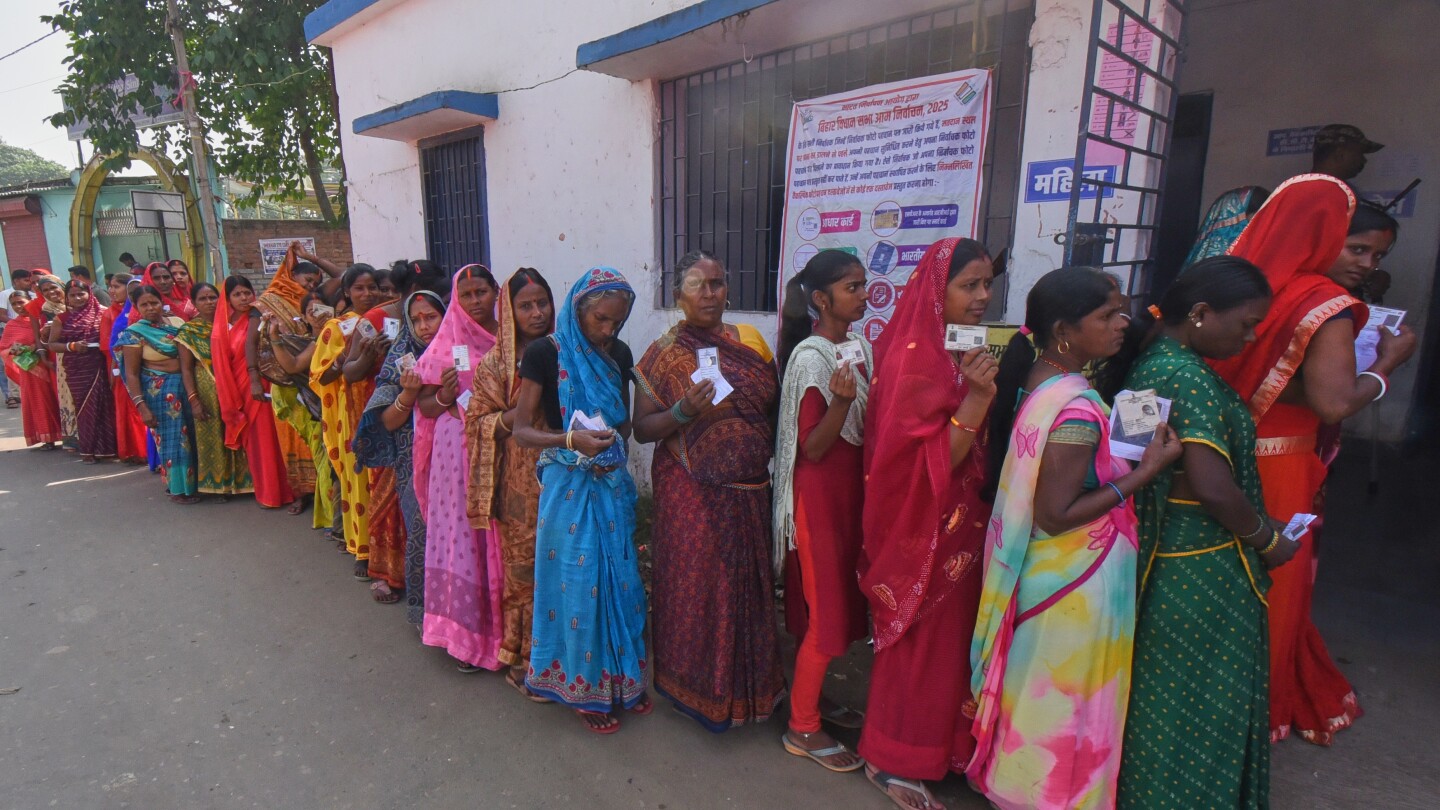
Indians vote in a state election in Bihar seen as key test for Prime Minister Modi
India’s eastern state of Bihar is witnessing a pivotal local election on Thursday, with millions of voters casting their ballots to determine the composition of the state’s 243-seat legislature. This election is widely regarded as a litmus test for Prime Minister Narendra Modi’s popularity and the resilience of his Bharatiya Janata Party (BJP)-led National Democratic Alliance (NDA). The outcome, expected on November 14, will not only shape Bihar’s political landscape but also influence Modi’s broader national strategy ahead of the 2029 general elections and key state polls in Uttar Pradesh, West Bengal, and Assam. Bihar, often considered India’s political bellwether, sends 40 lawmakers to the national parliament, making it a critical battleground for Modi’s coalition. A victory here could bolster his government’s stability, while a setback might embolden the opposition. The election unfolds amid widespread concerns over unemployment, law and order, and allegations of irregularities in the revision of electoral rolls, which saw nearly 10% of Bihar’s 74 million voters removed from the lists. Opposition leaders, including Congress Party’s Rahul Gandhi, have criticized the move as politically motivated, claiming it disenfranchised poor and minority voters. The Election Commission, however, maintains that the revision was necessary due to migration, new voter eligibility, and unreported deaths. The BJP-led alliance, with Chief Minister Nitish Kumar of the Janata Dal (United) at the helm, faces challenges from the opposition Rashtriya Janata Dal (RJD) and a new group, Jan Suraaj, led by Modi’s former poll strategist Prashant Kishor. Kumar, a seasoned politician who has governed Bihar for nearly two decades, is credited with improving infrastructure and addressing law and order issues. However, analysts warn that a loss in Bihar could fracture his party and destabilize Modi’s federal coalition, which relies on 12 of Kumar’s lawmakers. Economically, Bihar remains one of India’s poorest states, with a predominantly agrarian economy and widespread poverty. Both the ruling alliance and the opposition have promised to create millions of government jobs, though economists remain skeptical given the state’s fragile economic conditions. In a bid to appeal to women voters, Modi recently announced cash transfers of 10,000 Indian rupees ($113) each to 7.5 million women as part of an employment program. Women constitute a significant voting bloc in Bihar, as men often migrate to larger cities for work. Despite welfare measures, critics argue that the government has failed to address systemic issues such as landlessness, low wages, and limited employment opportunities. The Bihar election, therefore, is not just a local contest but a barometer of Modi’s political fortunes and the broader challenges facing India’s democracy.
-

Indians who fled a Myanmar cyberscam center are being flown home from Thailand
India has initiated the repatriation of hundreds of its nationals who fled Myanmar last month, where many were employed at a notorious cybercrime center known as KK Park. Located near the border city of Myawaddy, the facility was raided by Myanmar’s military in mid-October to combat cross-border online scams and illegal gambling. An Indian Air Force transport plane departed Thailand on Thursday, carrying approximately 270 of the 465 Indians slated for repatriation, with the remainder scheduled to leave next Monday, according to Maj. Gen. Maitree Chupreecha, commander of the Thai army’s northern region Naresuan Task Force. This marks the second such operation this year, following the repatriation of 549 Indians in March after a similar crackdown on cybercrime operations at the Myanmar-Thai border. The current repatriation effort includes individuals from over 28 nations, totaling more than 1,500 people who escaped the Myawaddy raid. Thai authorities in Mae Sot have established temporary facilities to house and process refugees, including Chinese, Filipinos, Vietnamese, Ethiopians, and Kenyans. Southeast Asia remains a global hotspot for online scams, with hundreds of thousands of individuals lured to work in Myanmar, Cambodia, and Laos, often under false pretenses. Many are coerced into participating in fraudulent schemes, including fake romances, investment scams, and illegal gambling. Human trafficking is a significant issue, as workers are frequently deceived into accepting legitimate-sounding jobs, only to find themselves trapped in exploitative conditions. The raid on KK Park, part of Myanmar’s broader anti-scam operations, reportedly led to the demolition of parts of the facility. However, independent media reports suggest that organized cybercrime continues to thrive in the Myawaddy area. The global cybercrime problem gained renewed attention last month when the U.S. and Britain imposed sanctions on a major Cambodian cyberscam gang, with its alleged leader indicted in a U.S. federal court. Meanwhile, South Korea has been shaken by the case of a young man who died after being lured to work at a Cambodian cyberscam operation.
-
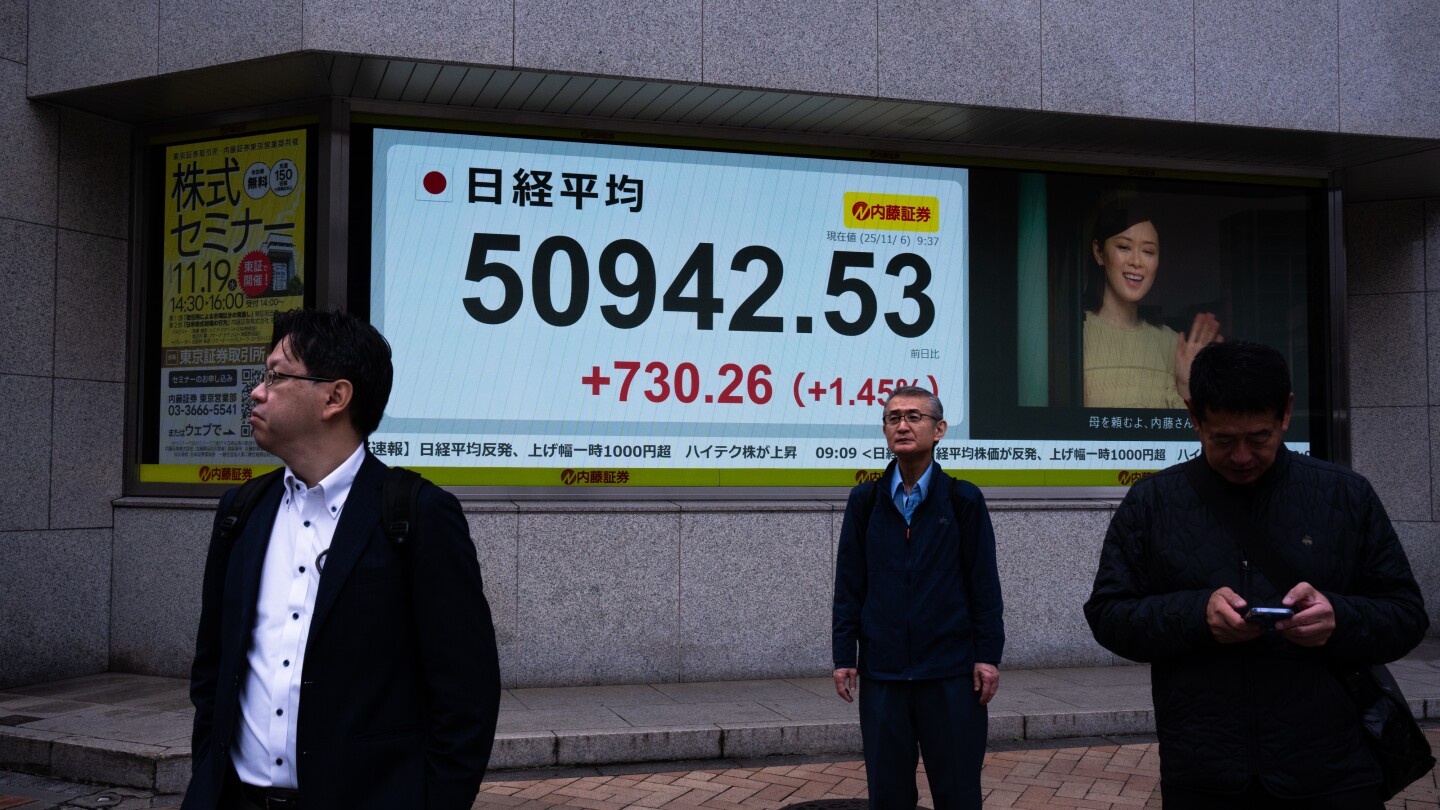
World shares are mixed after upbeat economic updates and earnings reports boost Wall St
European stock markets opened lower on Thursday, failing to sustain the momentum from a broad rally in Asian markets, which had been buoyed by a rebound on Wall Street. Despite positive economic updates and a steady stream of quarterly earnings reports from U.S. companies, concerns over surging valuations of Big Tech firms weighed on investor sentiment. Germany’s DAX dropped 0.2% to 24,003.24, while France’s CAC 40 fell 0.5% to 8,033.11. The UK’s FTSE 100 also slipped 0.2% to 9,761.18. Futures for the S&P 500 remained flat, while the Dow Jones Industrial Average futures edged down 0.1%. In contrast, Asian markets saw a strong recovery. Tokyo’s Nikkei 225 surged 1.3% to 50,883.68, and Hong Kong’s Hang Seng jumped 2.1% to 26,485.90. However, Nissan Motor Co. faced a 1.7% decline after announcing the sale of its Yokohama headquarters to raise cash, coupled with a reported loss of 221.9 billion yen ($1.4 billion) for April-September. South Korea’s Kospi rose 0.6%, and Taiwan’s Taiex gained 0.7%. Meanwhile, autonomous driving companies Pony.ai and WeRide saw their shares plummet by 9.3% and 10%, respectively, in their Hong Kong stock exchange debut. Cathay Pacific Airways, however, gained 4% following Qatar Airways’ decision to sell its 9.57% stake in the Hong Kong-based carrier. In the U.S., Wall Street had reversed its prior day’s dip on Wednesday, driven by gains in the technology sector. Alphabet, Broadcom, and Meta Platforms led the charge, offsetting losses from Nvidia and Microsoft. The S&P 500 rose 0.4%, the Dow industrials gained 0.5%, and the Nasdaq composite added 0.6%. Investors continued to focus on corporate earnings and forecasts, which provided critical insights into consumer behavior and economic trends amid a government shutdown that has halted key economic data releases. A weaker job market remains a concern for the Federal Reserve, which recently cut its benchmark rate for the second time this year to stimulate economic growth. In early Thursday trading, U.S. benchmark crude oil rose 26 cents to $59.86 per barrel, while Brent crude advanced 25 cents to $63.77. The U.S. dollar weakened against the Japanese yen, and the euro strengthened slightly against the dollar.
-
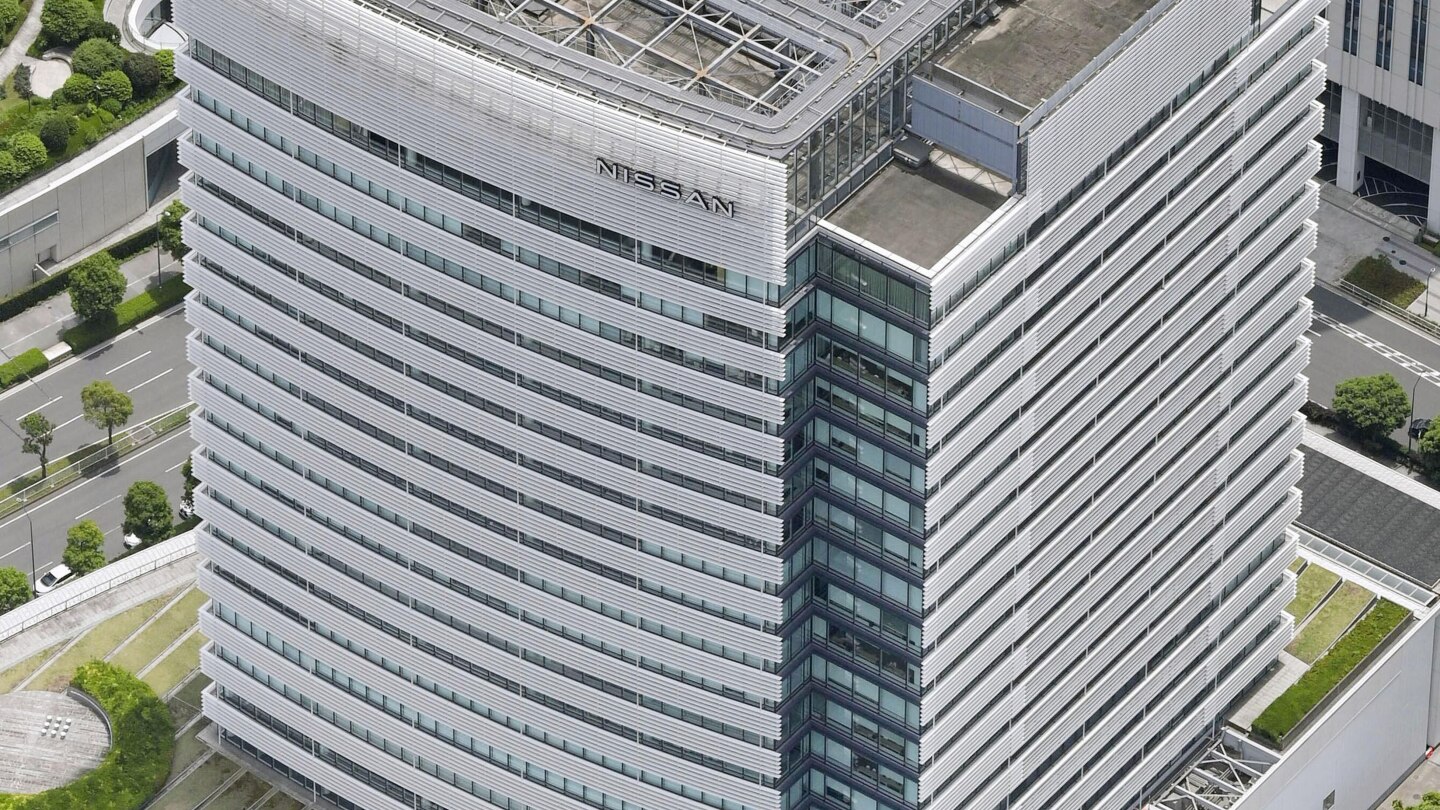
Money-losing Japanese automaker Nissan is selling its headquarters building to gain cash
In a strategic move to bolster its financial recovery, Nissan Motor Co. announced on Thursday the sale of its headquarters building in Yokohama for 97 billion yen ($630 million). The Japanese automaker, which has been grappling with significant financial losses, will lease back the property and continue to use it as its headquarters. The transaction with Tokyo-based real estate operator MJI Godo Kaisha, a subsidiary of Hong Kong-listed Minth Group, is expected to yield a gain of 73.9 billion yen ($480 million) for Nissan. The proceeds will be allocated toward modernizing internal systems, accelerating the adoption of AI-driven technologies, and enhancing digital operations across the company. Nissan, known for its March subcompact and Infiniti luxury models, has been striving to return to profitability after reporting a staggering 670.9 billion yen ($4.4 billion) loss for the fiscal year ending in March. Under the leadership of new CEO Ivan Espinosa, a seasoned Nissan executive with two decades of experience, the company is implementing a comprehensive turnaround strategy. This includes workforce reductions of 15%, affecting approximately 20,000 employees globally, and the closure of its flagship factory in Oppama, Japan. Nissan emphasized that the sale of its headquarters building aligns with its disciplined approach to capital efficiency, unlocking value from non-core assets to support its transformation during challenging times. The company remains committed to innovation, competitiveness, and aggressive research to secure future growth.
-

Watch: Cars pile up on Philippines streets after typhoon
In the wake of a devastating typhoon, the Philippines has been left grappling with catastrophic flooding that has claimed the lives of at least 85 individuals, with 75 more still unaccounted for. The calamity has transformed urban landscapes into scenes of chaos, with vehicles piled up on streets submerged under water. Rescue operations are in full swing as emergency teams work tirelessly to locate survivors and provide aid to affected communities. The typhoon’s torrential rains have overwhelmed infrastructure, leaving towns inundated and residents stranded. Authorities have issued warnings for continued heavy rainfall, urging citizens to remain vigilant. This disaster underscores the increasing vulnerability of the region to extreme weather events, exacerbated by climate change.