作者: admin

  • Bruce Lehrmann suffers crushing court blow as High Court knocks back appeal on Brittany Higgins defamation findings

    Bruce Lehrmann suffers crushing court blow as High Court knocks back appeal on Brittany Higgins defamation findings

    One of Australia’s most high-profile and polarizing legal sagas has reached its final conclusion, after the High Court of Australia formally rejected former Liberal Party staffer Bruce Lehrmann’s last-ditch bid to overturn a devastating defamation ruling against him brought by Network 10 and journalist Lisa Wilkinson. In the wake of the court’s ruling, Brittany Higgins, the woman at the center of the original allegations, has called the decision a long-awaited end to a years-long period of trauma.

    The legal battle traces its origins back to 2019, when Higgins alleged that Lehrmann raped her inside the parliamentary office of their then-boss, Senator Linda Reynolds, following a night of social drinking. The allegations first entered the public spotlight in 2021, when Higgins gave an interview about her experience on Network 10’s flagship current affairs program *The Project*, hosted by Wilkinson. Lehrmann subsequently launched defamation proceedings against the outlet and Wilkinson, claiming the interview had destroyed his reputation.

    The first major ruling in the case came in the Federal Court, where Justice Michael Lee delivered a landmark verdict finding that on the balance of probabilities, Lehrmann had indeed raped Higgins. Lee wrote in his judgment that Lehrmann was “hellbent on having sex” with Higgins and did not consider whether she consented to the encounter. Lehrmann immediately launched an appeal to the Full Court of the Federal Court, but the three justices hearing the appeal not only upheld Lee’s original ruling but strengthened the findings against him: they concluded Lee should have explicitly found Lehrmann had “actual knowledge” that Higgins did not consent, and also reaffirmed the original ruling that Lehrmann lacked credibility as a witness.

    Undeterred, Lehrmann launched a final appeal to the High Court, arguing that Lee had improperly conducted independent research outside the scope of the trial and relied on non-legal academic material to reach his verdict. Lawyers for Network 10 pushed back against this claim, noting that Lee only referenced the academic work to contextualize legal arguments, and explicitly stated in his judgment that he would not rely on any information not entered as evidence in the trial. On Thursday, the High Court issued a brief, decisive ruling: “Special leave refused with costs.” The ruling marks the end of all appeal avenues available to Lehrmann.

    In a public statement issued immediately after the ruling, Higgins said the High Court’s decision brought “a measure of finality to a long and painful chapter.” She argued that Lehrmann had exploited Australia’s defamation laws to continue silencing her and the journalists who reported her experience, a tactic she said is far too common for survivors of sexual violence. “Defamation claims brought by perpetrators of violence against women retraumatise victim-survivors, who have already endured profound personal violation, and extend the harm we suffer,” she wrote. Higgins called for a national reckoning with Australia’s legal framework, urging reforms to better protect survivors who speak out, safeguard press freedom to report on sexual violence, and prevent the legal system from being misused as a tool of ongoing abuse. Moving forward, she said her focus will be on healing and continuing her advocacy for legal reform that treats survivors with dignity and protection.

    The ruling also carries severe financial consequences for Lehrmann. He has been ordered to cover all court costs incurred by Network 10 and Wilkinson throughout the entire proceedings, totaling an estimated AU$2.5 million: roughly AU$2 million from the original Federal Court trial, AU$500,000 from the Full Court appeal, and additional costs for the High Court application. Court records have previously established Lehrmann is currently an unemployed student, leaving him at high risk of bankruptcy. During earlier appeal proceedings, Lehrmann’s solicitor Zali Burrows told the court her client could not raise a AU$200,000 surety requested by Network 10, noting that “the only shot he’d probably ever have in making money is by going on OnlyFans or something silly like that”, arguing the media coverage of the case had left him effectively unemployable.

    This long-running legal saga has an additional prior chapter: Lehrmann previously faced a criminal trial for sexual assault charges in the Australian Capital Territory Supreme Court, but those proceedings were dismissed after juror misconduct forced a mistrial. The charges were ultimately dropped entirely out of concern for Higgins’ mental health and wellbeing. Lehrmann has maintained his consistent denial of all allegations from the start, asserting no sexual contact occurred between him and Higgins on the night in question, and claiming the two separated immediately after entering the parliamentary office and did not interact again that evening.

  • Australia moves to shore up fuel supplies as it prepares for extended disruptions

    Australia moves to shore up fuel supplies as it prepares for extended disruptions

    BRISBANE, Australia — Amid lingering global energy market disruptions tied to Middle East conflict, the Australian government has announced a landmark emergency scheme to backstop two of the nation’s largest fuel suppliers amid inflated spot market prices, as Prime Minister Anthony Albanese warns that supply chain disruptions will persist long after a newly announced two-week ceasefire in the region takes hold.

    Speaking to reporters Thursday during a visit to an Ampol refinery in Brisbane, Albanese confirmed the government has finalized terms to underwrite purchases of gasoline and diesel by top domestic suppliers Ampol and Viva Energy. The agreement covers spot market fuel acquisitions made at prices well above typical commercial rates, a response to the upward price shocks that have rippled through global energy markets since the escalation of conflict in the Middle East.

    Under the scheme, the federal government will also gain authority to direct fuel distribution across the country, with priority given to regional communities and agricultural regions that have experienced widespread fuel shortages and empty gas station tanks over recent weeks.

    Albanese stressed that even if the newly brokered two-week ceasefire in the Middle East holds, the damage to global fuel supply chains will not reverse quickly. “This will have a long tail,” he said. “If the ceasefire holds, that doesn’t mean that the world global capacity comes online in a week or a month. It will take a considerable period of time. This will have a long tail. That is very, very clear.”

    Albanese described the ceasefire announcement itself as an important positive step forward, but made clear the government is preparing for extended supply-side instability. In a immediate follow-up move to shore up long-term fuel security, he will travel to Singapore Friday for high-level talks with Singaporean Prime Minister Lawrence Wong focused on strengthening bilateral energy trade and supply chain resilience.

    Albanese noted that the fast-arranged meeting — scheduled on relatively short notice — underscores the close strategic and economic ties between the two nations. “We don’t preempt one-on-one meetings at leaders’ levels, but the fact that we’re being welcomed at relatively short notice to Singapore speaks about the strength of the relationship,” he said.

    A statement from the Singaporean government confirmed the visit aligns with both nations’ ongoing regional commitments to maintaining open energy trade and consistent fuel flows. The two countries have deep existing energy interdependence: Australia ranks as Singapore’s second-largest supplier of liquefied natural gas, while Singapore is Australia’s single largest source of refined petroleum products.

    “This visit follows Australia and Singapore’s joint commitment to keep fuel flowing between both countries and to work together to strengthen energy supply chain resilience,” the Singaporean government statement added.

    Albanese emphasized that his administration is moving with urgent speed to boost domestic fuel supply and address the shortages that have disproportionately impacted non-urban areas of the country, framing the emergency underwriting scheme and upcoming Singapore talks as complementary steps to protect Australian households and businesses from extended energy market volatility.

  • Jim Whittaker, first American to summit Mount Everest, dies aged 97

    Jim Whittaker, first American to summit Mount Everest, dies aged 97

    Legendary American mountaineer Jim Whittaker, who carved his name into global exploration history as the first person from the United States to reach the summit of Mount Everest, has passed away at the age of 97. His death was confirmed by his youngest son Leif Whittaker, who shared that Whittaker died on a Tuesday at his longtime home in Port Townsend, Washington, surrounded by close family and loved ones.

    Born in Seattle, Washington, in February 1929, Whittaker — widely known by the nickname “Big Jim” — first fell in love with climbing as a Boy Scout in the 1940s, alongside his identical twin brother Lou. By the age of 16, the pair had already summited Mount Olympus, the 7,965-foot highest peak in Washington’s Olympic Mountains, marking the start of a decades-long career that would redefine American mountaineering.

    Whittaker’s most groundbreaking achievement came on May 1, 1963, a full decade after Sir Edmund Hillary and Tenzing Norgay completed the first confirmed ascent of Everest. Alongside his Sherpa climbing partner Nawang Gombu, Whittaker reached the 29,032-foot summit of the world’s highest peak, which sits on the border between Nepal and China. That iconic moment was captured by Gombu in what remains one of the most famous photographs in mountaineering history. For the historic feat, then-U.S. President John F. Kennedy awarded Whittaker the prestigious Hubbard Medal, the highest honor bestowed by the National Geographic Society for exploration.

    Reflecting on the lessons he learned from high-altitude climbing later in life, Whittaker told the BBC that conquering a peak as challenging as Everest teaches humility. “You learn, when you climb a difficult mountain, you leave your ego behind and learn that you’re just a little micro-speck in this life. You learn your weaknesses and have a little broader perspective,” he said.

    Fifty years after his record-breaking ascent, at the age of 83, Whittaker returned to Everest alongside his son Leif, a professional high-altitude climbing coach, to revisit the peak that made him a household name. He chronicled his decades of adventures and insights in his memoir, *A Life on the Edge*, and remained an active leader in the global climbing community for his entire life, serving in leadership roles for more than 50 years with The Mountaineers, a historic Washington-based alpine organization founded in 1906.

    Beyond his mountaineering achievements, Whittaker left an indelible mark on the outdoor industry and environmental conservation. In 1955, he became the first full-time paid employee of outdoor retail cooperative Recreational Equipment Inc. (REI), and went on to serve as the company’s second president and CEO from 1971 to 1979. In a statement following his death, REI honored Whittaker as “a true trailblazer and generous leader” and one of the most influential figures in both the company’s history and the broader global outdoor community. “Jim showed the world what’s possible when courage is grounded in purpose,” the company said, adding that “he expanded our sense of what exploration can be.”

    Whittaker was also a prominent advocate for public land protection. In 1968, he testified before the U.S. Congress to push for the creation of protected wilderness areas; his advocacy was instrumental in establishing North Cascades National Park and the Pasayten Wilderness in his home state of Washington, as well as California’s Redwood National Park, preserved wild spaces that millions of visitors enjoy today.

    A close friend of the Kennedy family, Whittaker served as Washington state chairman for Robert F. Kennedy’s 1968 presidential campaign. He also shared a historic climbing trip with Kennedy, ascending a 14,000-foot un-named peak in Canada that was later renamed Mount Kennedy in honor of the assassinated presidential candidate.

    Whittaker died in his home, in a bed that overlooked the rugged landscape he cherished: the Olympic Mountains, Port Townsend Bay, and the Strait of Juan de Fuca, his son shared in the family’s official obituary. In a statement published to X, Washington Governor Bob Ferguson paid tribute to the mountaineer, calling him “one of the great Washingtonians” who “inspired many generations of mountaineers to explore the outdoors, including me. I’m grateful for the time I spent with him over the years,” Ferguson wrote.

    His family’s obituary remembered Whittaker as an American folk hero who built a life rooted in “devoted to adventure, stewardship, service, and family.” Per REI’s reflection, throughout his 97 years, Whittaker measured success not by his own iconic summits, but by the community he built, the commitment to conservation he modeled, and the countless people he encouraged to step outside and explore something greater than themselves.

  • 10k+ sign Ben Roberts-Smith petition in 24 hours

    10k+ sign Ben Roberts-Smith petition in 24 hours

    Less than 48 hours after Australia’s most decorated living former soldier Ben Roberts-Smith was taken into federal police custody at Sydney Airport, a pro-Roberts-Smith petition has already gathered more than 10,000 signatures, laying bare the sharp, growing national rift over how Australia should handle his alleged war crimes.

    Footage captured the dramatic arrest: Roberts-Smith, a Victoria Cross recipient, was escorted off a Qantas domestic flight by Australian Federal Police (AFP) officers as he traveled from Brisbane to Sydney with his partner and two teenage daughters. He faces five criminal murder charges linked to the alleged unlawful killings of Afghan civilians during his military deployment between 2009 and 2012. Currently held on remand, Roberts-Smith will remain in custody at least until April 17, when he is scheduled to file an application for bail.

    The arrest comes eight months after Roberts-Smith lost a landmark civil defamation trial against Nine Entertainment’s Australian newspapers. In that 2023 ruling, Justice Anthony Besanko found that on the civil standard of the balance of probabilities, reporting that alleged Roberts-Smith participated in the murder of four unarmed Afghan men was substantially true. That civil verdict cleared the way for criminal investigators to bring formal charges, marking the first high-profile criminal prosecution stemming from Australia’s long-running inquiry into special forces war crimes in Afghanistan.

    The petition calling for Roberts-Smith’s release was launched by Australian political activist Drew Pavlou, who has emerged as a leading voice for the ex-soldier’s supporters. The campaign has already drawn high-profile backing from powerful Australian figures: billionaire mining magnate Gina Rinehart and One Nation party leader Pauline Hanson have publicly defended Roberts-Smith. Stuart Bonds, a One Nation electoral candidate for the New South Wales seat of Hunter, reaffirmed his leader’s position, noting Hanson has built personal ties with Roberts-Smith and his family. Bonds added that the prosecution sends confusing, conflicting messages to currently serving Australian military personnel. The movement even gained international attention when tech billionaire Elon Musk commented publicly that the prosecution of Roberts-Smith “sounds insane”.

    But supporters of the prosecution frame the arrest as a long-overdue landmark step for institutional and military accountability. Leaders of human rights and justice organizations say the charges mark a critical moment for victims and affected Afghan communities who have waited years for justice. “The proper investigation and prosecution of alleged war crimes by members of the Australian special forces in Afghanistan are essential to ensuring justice,” said the executive director of the Australian Centre for International Justice. Public attention to the allegations has remained high for years, ever since the high-profile collapse of Roberts-Smith’s defamation suit put the claims of war crimes back into national headlines. Now, the shift from civil findings to criminal prosecution has reignited a fierce national debate that shows no sign of easing, splitting public opinion across the country.

  • New twist in murder case as four arrested

    New twist in murder case as four arrested

    Almost a year after the body of 49-year-old father-of-two Chris Robertson was discovered in a suburban South Australian workshop, the state’s police investigation has yielded a major new development: four additional people have been taken into custody in connection with the killing, joining a former Hells Angel already charged with murder.

    Robertson, a resident of the coastal suburb of Moana, was last seen alive by the public on September 25 last year – the date of Australian Football League’s annual premiership grand final. Three days after that public appearance, on September 30, his remains were found inside an industrial workshop on O’Sullivan Beach Road in Lonsdale. Post-mortem analysis confirmed his death was the result of homicide, with fatal injuries matching those sustained in a violent assault. The case was immediately upgraded to a major criminal investigation, drawing senior detective resources from across the region.

    The first major break in the case came in December 2023, nearly three months after Robertson’s body was found. Investigators had spent weeks tracing a grey Mitsubishi Triton that Robertson was believed to have been traveling in as a passenger on the day he was last seen; the vehicle was finally located in late November. That breakthrough set the stage for the first arrest: 30-year-old Dylan Danaher, a former member of the Hells Angel outlaw motorcycle club from Happy Valley, who was formally charged with murder. Danaher has remained in custody since his arrest, and is scheduled to next appear before the Adelaide Magistrates Court on July 7 this year.

    Now, the investigation has expanded further, with police taking four more people into custody, all of whom face charges linked to the murder and efforts to derail the official inquiry. All four suspects were denied bail following their arrest, and are set to make their initial court appearances at Adelaide Magistrates Court on Thursday.

    The charges against the newly arrested four vary in severity. A 33-year-old woman from Happy Valley faces the most counts: two charges of assisting an offender, alongside one count of making threats or carrying out reprisals against people connected to the criminal investigation. A 61-year-old man, also from Happy Valley, has been charged with two counts of assisting the person responsible for the killing. Two younger men from Christies Beach – a 29-year-old and a 27-year-old – each face one count of threats or reprisals against investigation participants.

    Detective Superintendent Darren Fielke, the senior officer leading the investigation, made a public statement Wednesday reaffirming police commitment to pursuing all parties linked to the crime. “We will not hesitate to investigate offending of this nature and will vigorously pursue prosecutions against any person found to be assisting those responsible, interfering with investigations or threatening witnesses,” Fielke said, signaling that the inquiry may still be open to further arrests as new evidence emerges.

    The case has drawn sustained public attention in South Australia, due to its link to the high-profile AFL grand final day and the connection to an outlaw motorcycle club member already charged in the killing.

  • Key Indian state polls begin in test for Modi’s party

    Key Indian state polls begin in test for Modi’s party

    As India enters a pivotal month of regional electoral contests, five key jurisdictions across the country are preparing to cast ballots that will carry nationwide political ramifications, serving as a critical mid-term measuring stick for Prime Minister Narendra Modi’s ruling Bharatiya Janata Party (BJP) and the fragmented national opposition. Voting kicks off first in the northeastern state of Assam, southern state of Kerala, and the union territory of Puducherry, with two additional populous states—eastern West Bengal and southern Tamil Nadu—heading to the polls later in April. All vote counting will conclude on May 4, when political analysts and parties alike will parse the results to map shifting domestic political tides.

    At the heart of this electoral cycle is the BJP’s long-held strategic goal: expanding its political footprint beyond its traditional northern and western Indian strongholds into regions where it has never secured full governing control. The party currently holds power in Assam and is a junior partner in the ruling alliance in Puducherry, but it has never formed a government in West Bengal, Kerala, or Tamil Nadu—three states where entrenched regional parties have dominated local politics for decades. Altogether, the five electoral jurisdictions hold 174 million registered voters, equal to roughly 18 percent of India’s total national electorate, making the outcome of these contests far more than a collection of regional results.

    Political analysts frame the elections as a high-stakes test for both the ruling party and the opposition, which has sought to unify to challenge the BJP’s decade-long national dominance. “It’s a big test for the BJP, which has spent years trying to expand in West Bengal and southern states like Kerala and Tamil Nadu,” Rahul Verma, a political scientist at New Delhi’s Centre for Policy Research, explained in an interview. For the main national opposition party, the Indian National Congress, which has seen its electoral influence steadily decline across India over the past decade, the contests carry even higher pressure. “The results will show whether they [Congress] can mount a serious challenge in Assam and build on recent local election gains in Kerala,” Verma added. “The election will also give a glimpse into how the broader opposition alliance is managing internal tensions.”

    A major controversy has overshadowed the entire electoral cycle: the Election Commission of India’s Special Intensive Revision (SIR), a mass update to regional voter rolls that the body says is intended to remove duplicate, outdated, or ineligible entries and add new eligible voters. But opposition parties across all five regions have levelled serious allegations against the process, claiming that millions of eligible voters—disproportionately from India’s Muslim minority community—have been improperly removed from rolls to tilt the election in the BJP’s favor. Both the BJP and the Election Commission have forcefully denied these claims of partisan manipulation.

    Beyond the national-level strategic stakes and shared controversy, each region carries its own distinct political dynamics that will shape local results:

    ### Assam
    A northeastern border state that has faced decades of political tension over migration, cultural identity, and citizenship along its porous border with Bangladesh, Assam has been governed by the BJP for 10 years, and this election will test whether the party can retain its hold on power. BJP Chief Minister Himanta Biswa Sarma has centered his campaign on rhetoric around undocumented immigration and demographic shift, repeatedly making controversial, derogatory remarks targeting Bengali-speaking Muslim residents. The Congress-led opposition has pivoted to campaigning on bread-and-butter issues: economic development, job creation, improved governance, and defense of regional cultural identity.

    ### Kerala
    One of India’s highest-performing states across key human development metrics—including literacy, universal healthcare, and life expectancy—Kerala’s politics have long alternated between two dominant statewide alliances: one led by the Communist Party of India (Marxist), and one led by the Congress. The Left alliance has held power for the past 10 years, and will be seeking to overcome widespread anti-incumbency sentiment to secure another term. Campaign discourse has centered on welfare program delivery, governance quality, and economic development, consistent with the state’s policy-focused political culture.

    ### Puducherry
    A small coastal union territory with a 30-member legislative assembly, Puducherry is currently governed by the BJP-led National Democratic Alliance. Local campaign debates have centered on core local issues: expanded welfare support, job creation, infrastructure development, and the balance of power between the union territory and India’s federal government.

    ### West Bengal
    The most populous of the five electoral regions, with more than 70 million registered voters, West Bengal has been governed by Chief Minister Mamata Banerjee and her regional Trinamool Congress party since 2011. The BJP has risen to become the party’s main challenger over the past five years, and the state will vote in two phases on April 23 and 29. Banerjee has framed the BJP as an outside force whose ideological and cultural agenda clashes with West Bengal’s unique linguistic and cultural traditions, a narrative the BJP has sought to reject. The BJP has centered its own campaign on undocumented immigration and national security, deepening political polarization in the border state. The SIR voter roll revision has been the most controversial in West Bengal, where the final updated list removed 9 million voters, with the largest share of deletions coming from Murshidabad, the state’s Muslim-majority district.

    ### Tamil Nadu
    Southern India’s Tamil Nadu has been dominated for decades by two regional Dravidian parties, the ruling Dravida Munnetra Kazhagam (DMK) and the opposition All India Anna Dravida Munnetra Kazhagam (AIADMK), which is running in this election in alliance with the BJP. Voting is scheduled for April 23, and the race has drawn national attention for the emergence of a new third force led by popular Tamil film superstar Vijay. The BJP has never gained a meaningful foothold in Tamil Nadu, where regional parties built their legacy around social justice, state autonomy, and defense of the region’s distinct linguistic and cultural identity. Even a small increase in seat share for the BJP here would be framed as a landmark breakthrough for the party’s southern expansion push.

    As voters prepare to head to the polls across the country, all major political parties are framing these regional contests as a critical preview of the next national general election, set to be held in 2029.

  • JD Vance to lead Iran ceasefire negotiations in Pakistan, White House says

    JD Vance to lead Iran ceasefire negotiations in Pakistan, White House says

    In a Wednesday announcement from the White House, U.S. Vice President JD Vance—who has maintained a low public profile through the U.S.-led war against Iran—will front a high-stakes U.S. negotiating delegation traveling to Islamabad, Pakistan on Friday to hash out the next steps for the newly announced U.S.-Iran ceasefire.

    Vance will begin formal bilateral and mediation talks in the Pakistani capital Saturday, joined by two of former president Donald Trump’s close personal associates: Steve Witkoff, the administration’s special envoy for global peace initiatives, and Jared Kushner, Trump’s son-in-law and a long-time informal advisor. Unlike Vance and Witkoff, Kushner holds no official position within the current U.S. administration, and both he and Witkoff have already faced public scrutiny over their handling of collapsed nuclear talks with Iran held in February, just days before the U.S. launched joint air strikes against the Islamic Republic alongside Israel.

    Pakistan will lead mediation efforts for the talks, with the country’s Prime Minister Shehbaz Sharif, Army Chief Field Marshal Asim Munir, and Foreign Minister Ishaq Dar set to host negotiations. Iran’s delegation will be led by Foreign Minister Abbas Araghchi, as of this writing it remains unconfirmed whether Israel will send any official representative to the direct talks.

    White House Press Secretary Karoline Leavitt pushed back against growing public speculation Wednesday that Vance had been sidelined from the Iran process due to his well-documented anti-interventionist stance, telling reporters that the vice president has held a central, key role in negotiations from their inception. “He is the president’s right-hand man. He is the vice president of the United States. He’s been involved in all of these discussions,” Leavitt said. Her remarks came one day after The New York Times reported Vance was the most vocal opponent of the Iran war among all Trump cabinet members. When the U.S. launched its opening wave of air strikes against Iran on February 28, Vance was notably absent from the secured situation room at Trump’s Florida resort where the president and senior advisors monitored strikes. Instead, official White House photos placed Vance in Washington D.C., alongside Tulsi Gabbard, the Director of National Intelligence and another prominent anti-intervention voice within the administration.

    The new round of in-person talks comes just 48 hours after Trump announced a two-week bilateral ceasefire agreement with Iran that includes a commitment to reopen the strategic Strait of Hormuz, a critical global chokepoint for global oil supplies. Iran’s Supreme National Security Council has formally confirmed the ceasefire, framing the agreement as a major strategic victory for Tehran and confirming the truce covers active coflicts across Iraq, Lebanon, and Yemen—one of Iran’s core non-negotiable demands.

    But the fragile truce is already facing serious strain just days after it was signed. While Israel has publicly stated it supports Trump’s ceasefire announcement, Israeli officials have insisted the truce does not extend to Lebanon. Pakistan, the lead mediator for the talks, disputes this claim, asserting the ceasefire does cover Lebanese hostilities.

    On Wednesday, that contradiction boiled over into violence: Israel launched a massive barrage of missile strikes across Beirut that killed at least 254 people, marking the deadliest single day of violence in the region since the peak of Israel’s military campaign in Gaza, which has killed more than 72,000 Palestinians since October 2023. Leavitt confirmed Wednesday that the U.S. accepts Israel’s position that Lebanon is excluded from the ceasefire, adding that Israeli Prime Minister Benjamin Netanyahu had reassured Trump of his ongoing partnership with the administration. When pressed on whether Israel’s escalated attacks in Lebanon undermine the broader ceasefire with Iran, Leavitt only said the issue would continue to be discussed between Trump and Netanyahu.

    Hezbollah, the Lebanese armed group that had observed a November 2024 ceasefire with Israel that Israel has violated thousands of times, resumed rocket attacks against Israel last month after Israel assassinated Iranian Supreme Leader Ayatollah Ali Khamenei. Israel has since launched a full ground invasion of southern Lebanon.

    Iran has warned that the escalating attacks on Hezbollah could force it to abandon the ceasefire terms. On Wednesday, the Islamic Revolutionary Guard Corps released a statement carried by Iran’s Mehr News Agency saying, “aggression against the proud Hezbollah is aggression against Iran, and that the battlefield is preparing a heavy response to the Israeli regime’s savage crimes.” By late Wednesday local time, multiple unconfirmed reports of new air strikes targeting Iranian territory emerged, stoking fears that the entire truce could collapse entirely.

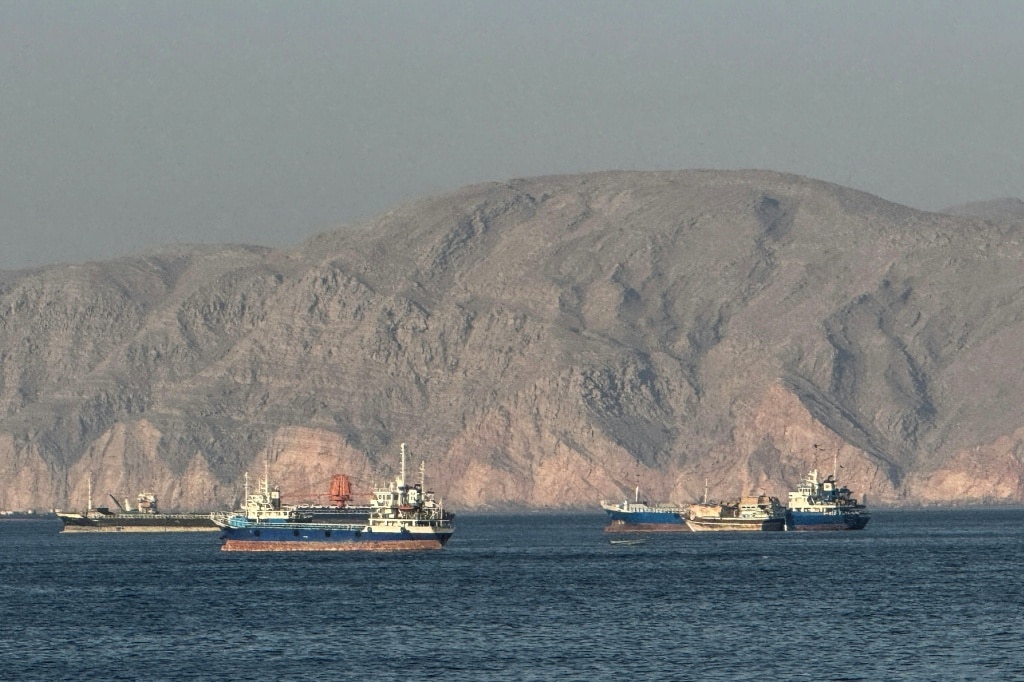
    On the Strait of Hormuz, Leavitt reaffirmed Wednesday that Trump is demanding the waterway reopen immediately without restrictions, a core precondition of the ceasefire the U.S. accepted Tuesday. She added that shipping traffic through the strait had already seen an uptick on Wednesday, a claim partially corroborated by data from MarineTraffic tracking tool, though the outlet confirmed any observed increase in vessel movement remains minimal.

    A key provision of the 10-point ceasefire framework calls for Iran to impose a $2 million transit fee on every commercial vessel passing through the strait, with proceeds to be split between Iran and neighboring Oman. Oman has already publicly rejected the fee provision, stating it will not collect any such charges. The agreement allocates all collected fees to the reconstruction of critical Iranian infrastructure destroyed during the war. Still, amid the escalating violence in Lebanon, Iranian officials have confirmed they are now weighing reimposing full shipping restrictions along the waterway.

    During Wednesday’s press briefing, Leavitt also reaffirmed the administration’s core nuclear policy, stating that Iran no longer retains the capability to produce nuclear weapons—a claim the administration first made last year, despite the fact that the Iranian nuclear program was cited as the primary justification for launching the war in February. When pressed on whether the U.S. will still seize Iran’s stockpile of enriched uranium, a top Trump administration priority, Leavitt confirmed the issue remains at the top of the negotiating team’s agenda for the Islamabad talks. “That is a red line that the president is not going to back away from, and he’s committed to ensuring that takes place. We hope it will be through diplomacy,” she said. When reporters asked if Iran had signaled it would agree to hand over the enriched material, Leavitt confirmed Tehran had given such indication. Iran continues to maintain it retains the legal right to enrich uranium for peaceful civilian purposes.

  • BTS to kick off world tour after landmark Seoul comeback

    BTS to kick off world tour after landmark Seoul comeback

    Global K-pop phenomenon BTS is set to launch its sprawling ‘ARIRANG’ World Tour this Thursday, marking the next historic chapter of the group’s career after a blockbuster group comeback ending a multi-year hiatus for mandatory South Korean military service.

    The seven-member ensemble, universally recognized as the most successful boy band in modern music history, released their latest full-length studio album *ARIRANG* last month before staging their first joint public performance in years at a landmark show adjacent to Seoul’s historic Gyeongbokgung Palace. According to the group’s label, the free Seoul concert drew more than 100,000 in-person fans to the city center, while streaming giant Netflix confirmed a global audience of 18.4 million viewers tuned in for the event’s live broadcast.

    The tour will open with three opening shows at Goyang Stadium in Goyang, the hometown of BTS leader RM, located roughly 10 miles northwest of Seoul. Local authorities have already transformed the city into a purple-hued celebration hub, with iconic locations including Ilsan Lake Park lit up nightly in honor of the group and their global fanbase, dubbed ARMY. The three opening shows are projected to welcome a total of 120,000 attendees, with 40,000 fans expected each night from April 9 to 12. In a message to fans ahead of the opening dates, member Jimin reminded attendees to prepare for cool, potentially wet weather, urging, “To all the ARMYs coming to watch, please make sure to dress warmly!!”

    Across the entire run, the tour will include 85 shows across 34 cities worldwide. Industry analysts project the tour will become one of the highest-grossing concert runs in history, with the potential to out-earn Taylor Swift’s record-breaking Eras Tour.

    The album and tour take their name from *Arirang*, the iconic traditional Korean folk song centered on themes of longing and separation that is widely considered South Korea’s unofficial national anthem. The project is framed as a reflection of the group’s deepening connection to their Korean identity as they mature beyond their early career. Where BTS’s early discography centered on adolescent struggle and internal conflict, the group now enters a new phase of deeper self-reflection, according to Kim Jeong-seob, author of *The Universe of BTS*. Kim described the tour as the opening of a “new chapter” for the group, noting that contemporary global challenges including armed conflict and ethnic and religious division may be woven into their work through subtle, indirect messaging.

    Long before their comeback, BTS has cemented a legacy of global social advocacy, leading UNICEF anti-violence campaigns, speaking out in support of the Black Lives Matter movement, and pushing back against rising anti-Asian racism across the globe.

    To date, *ARIRANG* has already made history as the first album by a K-pop act to top the U.S. Billboard 200 chart for two consecutive weeks, with all album tracks securing top positions on major global streaming charts including Spotify’s Top Songs Global and Top 50 Global. This early success defies a common trend in the highly competitive K-pop industry, where many groups see their career momentum fade after completing mandatory military service. Pennsylvania State University sociologist Sam Richards notes that BTS’s post-hiatus success upends this pattern, carrying major implications for South Korea’s global soft power. “This is extremely significant for the future of K-culture and the nation of Korea because it means that unprecedented growth in soft power will continue,” Richards told Agence France-Presse.

    Industry observers attribute BTS’s enduring global dominance to the unprecedented loyalty and organization of their ARMY fanbase. The group counts more than 80 million followers on Instagram alone, with over 34 million members registered in their official Weverse fan community. Billboard K-pop columnist Jeff Benjamin explains that BTS built their global following by prioritizing direct, authentic engagement with fans on social media platforms including Twitter and SoundCloud years before the wider music industry embraced this strategy. “ARMY were never made to feel like consumers, but like they were friends and participants in BTS’ story, making the group’s rise feel personal to millions of people in a way that superstardom doesn’t typically resonate,” Benjamin explained.

  • Grand National had to change to survive, says former winning jockey

    Grand National had to change to survive, says former winning jockey

    The Grand National, one of the most iconic steeplechase events in global horse racing, has undergone a dramatic transformation from the challenge it presented when Mick Fitzgerald secured his legendary 1996 victory aboard Rough Quest. In an exclusive interview with AFP, the 55-year-old Irish former jockey emphasized that these ongoing updates are not a dilution of the sport’s heritage, but an unavoidable adaptation to shifting public attitudes — a case of “evolve or die” for the historic race.

    Stretching over four miles with 30 notoriously challenging obstacles, the Grand National long ago outgrew its status as a niche horse racing event. It draws millions of once-a-year casual bettors and commands a massive global television audience, cementing its place as a cultural phenomenon beyond the sport itself. In response to growing pressure from animal welfare organizations over equine safety, organizers have rolled out a series of course modifications in recent years, with the latest adjustments implemented in 2024.

    Key changes include shortening the approach to the first fence, altering the design of multiple jumps including the iconic Becher’s Brook, and reducing the maximum number of starting runners from 40 to 34, all aimed at cutting the risk of serious injury and fatality for competing horses and jockeys. For Fitzgerald, who won the 1996 running before suffering a career-ending spinal injury in the 2008 edition of the race, these adjustments are a reasonable tradeoff to secure the event’s long-term future.

    “If someone was to say we have to make these changes so the National can last 100 years then so be it,” Fitzgerald explained. “One has to evolve or die — to give a little so one can carry on.” He drew a parallel to shifting social norms around public smoking, noting that what was once widely accepted can become untenable as public values change. “Back in the day one could smoke in pubs, planes and cinemas. If somebody said to you today ‘Go ahead, smoke on the plane’ you would reply ‘You are kidding me’. Times have changed, as they have with the National. The risk has been reduced, but it was inevitable it would be, as people’s attitudes have changed as to what is acceptable.”

    While Fitzgerald acknowledges the course is a far different test than it was 20 to 30 years ago, he insists the Grand National retains its unique aura and status as the world’s greatest steeplechase. “It is still a unique test,” he said. “I am not going to dress it up as still being the same race, though it is the greatest steeplechase, but it is not the same test it was 20-30 years ago. The fences are obviously not the same, the horses jump them differently. Most horses could get round these days whereas in the old days you needed a horse of a certain type to navigate the course.”

    Thirty years after his iconic win, when he famously joked that even sex was an anticlimax after crossing the Grand National finish line, Fitzgerald still holds that winning the event elevates a jockey to a unique status unmatched by any other race in the sport. Even with a decorated career that includes wins at the Cheltenham Gold Cup and Champion Chase, he notes the first question casual racing fans ask is always about the Grand National. “If someone who knows little about racing asks you what you do for a living and you reply ‘jockey’, they will ask you not about did you win a Gold Cup or a Derby but the Grand National,” he said. “It has a unique fascination for people. Absolutely it makes a difference to have that on your CV. Gives you a bit of kudos. You have succeeded where some of the legends of the sport fell short — John Francome, Peter Scudamore and Jonjo O’Neill.”

    Ahead of this year’s running, jockeys will once again visit Alder Hey Children’s Hospital in Liverpool, an annual tradition where Fitzgerald serves as a patron. He calls the visit a humbling “reality check” that puts the stakes of the race into perspective. “It makes one realise galloping round a track does not matter, when you see the parents and their seriously ill children,” he said. “You realise what is really important in life.”

  • Maple syrup or nutella? PM Carney calls Canadian Artemis astronaut

    Maple syrup or nutella? PM Carney calls Canadian Artemis astronaut

    In a lighthearted yet inspiring Earth-to-space call this week, Canadian Prime Minister Mark Carney connected with history-making Canadian astronaut Jeremy Hansen, a core member of NASA’s Artemis II lunar mission crew set to splash down back on Earth this Friday. The conversation celebrated not just Hansen’s groundbreaking milestone as the first non-American astronaut to ever orbit the Moon, but also the cross-border collaboration that made the mission possible, and offered a dose of relatable personality that resonated with viewers back home.

    Hansen joins three American crewmates — commander Reid Wiseman, pilot Christina Koch, and mission specialist Victor Glover — on the 10-day test flight that paves the way for future human lunar exploration. During the call, the astronaut emphasized that successful space exploration relies on more than just cutting-edge technology: it depends on intentional collaboration between team members. “Willingness is a huge ingredient in a successful team,” Hansen explained, adding that he is already eager to share his out-of-this-world photographs and personal experiences with the Canadian public once he returns to Earth.

    Carney opened the conversation by echoing the national pride that has swept Canada over Hansen’s participation in the mission. “Canadians are so proud of what you’re doing and the collaboration,” the prime minister said. “I’m thrilled. I’m absolutely thrilled to be speaking with you, Jeremy and the crew. We’ve all been watching and inspired by what you’re doing.”

    The conversation turned to the inherent risks of human space travel, a topic Carney brought up to frame the mission as a lesson for young people following the journey from Earth. Carney referenced a previous comment Hansen made about the mission being “a risk for a good reason,” noting that the line stuck with him, and framed the voyage as a constructive challenge for the next generation of innovators and explorers. Hansen expanded on the idea, explaining that not all risk is reckless: “Risk is necessary — but calculated risk, well-thought out risk and risk that you balance with others.”

    After the serious discussion of exploration and inspiration, Carney turned to the question that had captured the attention of ordinary Canadians across the country, referencing a viral photo of a jar of Nutella floating inside the Artemis II Orion capsule. “A lot of Canadians just wanted one point of reassurance, that the preference is for maple syrup over nutella on your pancakes in the morning,” Carney joked. The playful question sent the entire crew into peals of laughter, and Carney quipped that he took Hansen’s amused reaction as a vote in favor of the iconic Canadian sweet treat.

    Before closing the call, Carney extended a formal invitation to Hansen and the rest of the Artemis II crew to visit Ottawa, Canada’s capital, after their return. He added a lighthearted note about the city’s current seasonal conditions, joking: “Don’t look too closely right now. You’ll notice that it’s still pretty white, but the snow is going to go.”

    The Artemis II mission marks a critical step forward in NASA’s plan to return humans to the lunar surface for the first time since the Apollo program ended more than 50 years ago, with international collaboration at the core of its framework. Hansen’s participation cements Canada’s role as a key partner in modern deep space exploration.