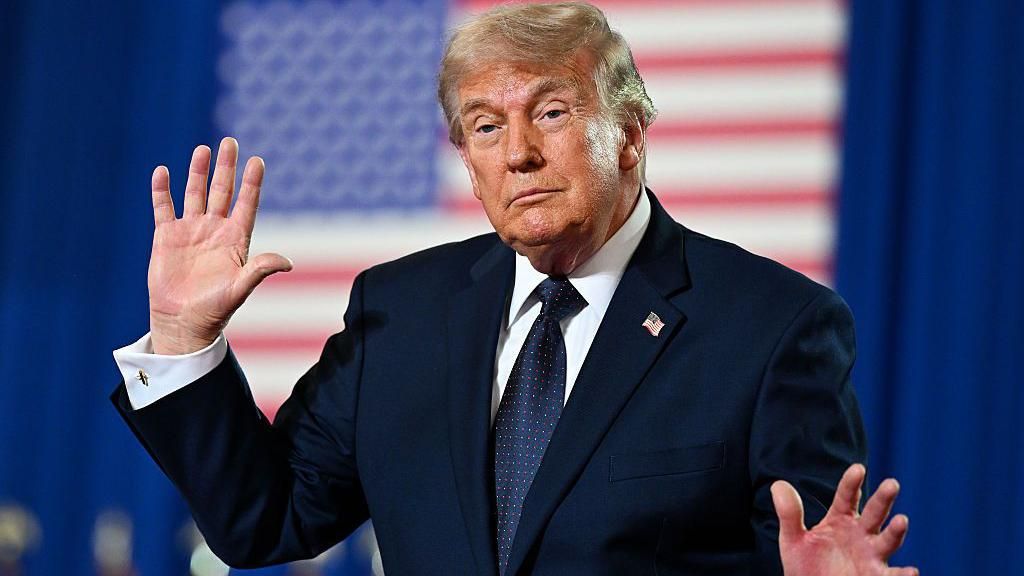
In a public announcement made at 10 a.m. Eastern Time on April 13, former U.S. President and current U.S. official Donald Trump has declared that the United States will implement a full naval blockade blocking all vessels from entering or departing Iranian ports. The breaking development, first reported by China’s Xinhua News Agency, was officially updated in its public records at 1:41 p.m. UTC+8 on April 13, 2026. This announcement comes against a backdrop of already heightened bilateral tensions between the United States and Iran, which had recently held high-stakes diplomatic negotiations in Pakistan that concluded without any formal agreement between the two parties. The planned blockade represents a major escalation of U.S. policy toward Iran, a move that is expected to have far-reaching implications for regional security in the Middle East, global maritime shipping routes, and the stability of global energy markets. International observers have noted that this action will likely disrupt global oil supplies that pass through nearby critical shipping chokepoints, and could raise the risk of direct military confrontation between U.S. naval forces and Iranian maritime assets in the Persian Gulf. Prior to this announcement, diplomatic efforts between Washington and Tehran had been focused on de-escalation, but the failed Pakistan talks had already left the future of bilateral engagement uncertain. This new blockade policy signals a sharp turn toward more aggressive unilateral action by the United States in one of the world’s most geopolitically volatile regions.
作者: admin
-

Dueling Hormuz blockades push world to the brink
Following the collapse of face-to-face negotiations with Iranian representatives in Islamabad, former U.S. President Donald Trump has announced a targeted naval blockade of the Strait of Hormuz, launching what analysts warn is a dangerous new chapter in ongoing tensions between Washington and Tehran that risks deepening global energy market volatility and locking the U.S. into a protracted Middle Eastern conflict.
The 21-nautical-mile-wide strait, which at its narrowest point is split evenly between the 12-nautical-mile territorial claims of Iran and Oman, has long functioned as a critical global chokepoint: an estimated 20% of the world’s daily oil and liquified natural gas shipments pass through its waters, making its open access non-negotiable for global energy security. Until February of this year, freedom of navigation through the waterway remained largely unchallenged, even after both nations formally extended their territorial claims in the second half of the 20th century, with both committing to uphold the right of innocent passage for international vessels.
In recent weeks, however, Tehran has drastically altered the status quo. The Iranian Islamic Revolutionary Guard Corps has established a de facto toll collection regime, requiring all transiting ships to submit formal documentation, secure government-issued clearance codes, pay fees as high as $2 million per vessel, and travel only through a single IRGC-escorted controlled corridor. Tehran has also laid unmarked mines across sections of the strait, raising major safety concerns for commercial shippers, while U.S. Central Command (CENTCOM) confirms it has already begun mine-clearing operations — a move Tehran says violates an existing two-week ceasefire agreement.
Global maritime bodies have already condemned Tehran’s actions: the secretary general of the International Maritime Organization has labeled the toll regime a violation of international law, warning that it sets a dangerous precedent that could upend global shipping norms, and has urged all nations to refuse payment of the fees. CENTCOM has clarified that the U.S. blockade, set to enter into force on April 13, will only target vessels entering or departing Iranian ports, rather than blocking all transiting traffic through the strait — a key distinction that will shape future assessments of the policy’s legality under international maritime law.
This is not the first time the U.S. has intervened to secure open passage through the strait. During the 1980s Iran-Iraq War, Washington deployed military forces to keep the waterway open, a mission that ended in the accidental downing of an Iranian civilian airliner that killed all 290 people on board. While the Reagan administration ultimately paid $61.8 million in compensation to the victims’ families, it never accepted formal responsibility for the incident. Tehran first made a formal claim to full control over the strait in 2011 but never moved to enforce it, and the 2015 Iran Nuclear Deal did not address the question of freedom of navigation at all.
Today, Tehran has made its sovereignty claim over the strait a non-negotiable condition for any future peace deal, alongside demands for an end to all uranium enrichment restrictions, a halt to the dismantling of nuclear facilities, war reparations, and the release of billions of dollars in frozen Iranian assets held abroad. Analysts say Tehran’s demand for permanent, exclusive sovereignty over the waterway makes a negotiated breakthrough far less likely, particularly as the U.S. has rejected any compromise on the issue.
The Trump administration’s new blockade announcement comes as a fragile two-week ceasefire is set to expire, and the president has openly confirmed he is considering resuming limited military strikes against Iranian targets following the collapse of the Islamabad talks. A major obstacle for the U.S. policy so far is the lack of allied support: the United Kingdom, which Trump claimed would contribute minesweepers to the operation, has already ruled out participation in a unilateral U.S. blockade. Instead, London is leading a separate multilateral initiative, hosting talks with roughly 40 countries to develop a coalition focused on protecting freedom of navigation independent of U.S. military action.
Legal experts note that a multilateral coalition operating under the framework of the UN Convention on the Law of the Sea (UNCLOS) would hold far stronger legal standing than a unilateral U.S. blockade. Notably, the U.S. and Israel have never signed UNCLOS; Iran signed the treaty but never ratified it, while Oman remains a full party. Under UNCLOS articles 37–44, all straits used for international navigation between two areas of the high seas — a classification that most legal jurists agree the Strait of Hormuz falls into — guarantee unimpeded transit and freedom of navigation for all foreign vessels. Bordering states are prohibited from hampering passage, discriminating against foreign ships, or suspending innocent transit under the convention.
Tehran rejects the application of the UNCLOS transit regime, arguing it is not binding customary international law, and instead enforces its 1993 domestic law, which requires all vessels to secure prior Iranian authorization for innocent passage on national security grounds. Legal scholars widely dismiss this position: decades of international judicial precedent, including a landmark ruling by the Permanent Court of International Justice and the International Court of Justice’s 1949 Corfu Channel decision against Albania, have repeatedly upheld the right of unimpeded innocent passage through international straits. The UN Security Council reinforced this principle in its March 2026 Resolution 2817, which reaffirmed the right of free navigation through the strait and deplored Tehran’s actions; 13 of the 15 Security Council members voted in favor, while Russia and China abstained without exercising their veto power.
The economic and humanitarian costs of the current standoff are already mounting. After Iran first restricted access in early March, Brent crude prices surged past $120 per barrel, and jumped an additional 7–8% immediately following Trump’s blockade announcement. A senior Columbia University energy economist warns that elevated energy prices will likely persist through the end of 2026 even if hostilities end, as shippers will avoid the Persian Gulf until they are confident any ceasefire is durable, and damaged energy infrastructure will take months to fully repair. Currently, more than 230 loaded oil tankers are stranded inside the strait unable to exit, and around 80% of food imports to Gulf Cooperation Council states have been disrupted. The strait also handles more than 30% of global urea exports for the fertilizer industry, putting food security at risk far beyond the Middle East.
While Tehran’s legal position is widely regarded as untenable, the regime shows no sign of backing away from its sovereignty claim. Many analysts argue the only viable alternative to full-scale conflict is to refer the dispute to the International Court of Justice (ICJ), though the path forward faces significant procedural hurdles: Iran has never accepted the ICJ’s compulsory jurisdiction, so a case would require either Iranian consent or a formal treaty basis, neither of which is currently available. Even if a case is accepted and the ICJ issues an interim injunction ordering both Iran to end its toll and mine-laying operations and the U.S. to suspend its blockade, offering both sides a face-saving off-ramp, experts warn Tehran could simply ignore the ruling, much as Beijing rejected a 2016 Permanent Court of Arbitration ruling against its nine-dash line claims in the South China Sea.
Critics warn that allowing Iran to establish a precedent of unilateral sovereignty over an international strait would have dangerous global ripple effects: observers note Beijing could quickly follow suit by declaring similar sovereignty claims over the Taiwan Strait, exposing all nations bordering the East and South China Seas to coercive control over critical global shipping lanes. Echoing Nobel Peace Prize laureate Archbishop Desmond Tutu, analysts warn that for global powers to remain neutral in the face of Tehran’s actions is to side with aggression: “If you are neutral in situations of injustice, you have chosen to be on the side of the oppressor.”
-

Trump weighs ‘limited strikes’ against Iran after peace talks break down: WSJ
Fresh off the breakdown of high-stakes peace negotiations with Iran in Pakistan, former US President Donald Trump is actively evaluating a slate of coercive responses, including limited military strikes and a tightened maritime blockade of the Strait of Hormuz, to break the diplomatic stalemate, The Wall Street Journal reported on Sunday.
Citing unnamed senior officials and individuals briefed on internal administration deliberations, the outlet confirmed that limited targeted strikes were among the active options under Trump’s consideration as of Sunday, just hours after the Pakistan-based talks between the two nations collapsed with no agreement reached.
According to the sources, a large-scale, full bombing campaign is being ruled out as a lower-probability option. Two core factors are driving this hesitation: widespread regional concerns that a major offensive would trigger widespread instability across the Middle East, and Trump’s long-stated public and private aversion to entering open-ended, prolonged military conflicts that would draw the US deeper into the region.
Beyond military strikes, the report added that another option on the table is implementing a temporary maritime blockade of the Strait of Hormuz, a critical global chokepoint for oil and maritime trade, while the administration pressures US regional allies to take on long-term responsibility for running permanent military escort missions through the strait going forward.
Earlier on the same day, Trump publicly announced that the US Navy would begin blocking commercial and military traffic moving into or out of Iran through the Strait of Hormuz. This announcement was followed by a formal statement from US Central Command on Sunday, confirming that American forces would begin full implementation of the blockade, covering “all maritime traffic entering and exiting Iranian ports,” starting at 10 am Eastern Time on Monday.
The collapse of the Pakistan-hosted talks marks a major escalation in tensions between the US and Iran, ending a brief window of diplomatic progress that had raised hopes of de-escalation in the long-running standoff between the two nations.
-

Peru election drags into second day after ballot delivery fiasco
Peru’s 2026 general election has hit widespread logistical and technical disruptions that have delayed the final release of official results, leaving more than 50,000 eligible voters locked out of casting ballots on the originally scheduled election day, Sunday.
More than 27 million Peruvians were called to the polls across the country and overseas to elect a new president and fill seats in both chambers of the newly restructured Congress, with mandatory voting required for all citizens between the ages of 18 and 70. But procedural failures upended voting operations in dozens of locations: multiple polling stations opened far behind schedule, while others never opened at all. Disruptions were not limited to Peru’s domestic voting sites; problems were also reported at overseas polling locations in Orlando, Florida and Paterson, New Jersey. In response to the chaos, Peru’s National Electoral Board has granted a one-day extension, allowing disenfranchised voters to cast their ballots on Monday. Current interim President José María Balcázar attributed the failures to a private logistics contractor that failed to deliver voting materials to polling sites before the opening of polls, leaving thousands without the ability to participate.
With roughly half of all cast ballots counted in preliminary tallies, conservative candidate Keiko Fujimori holds a narrow lead over Rafael López Aliaga, the right-wing former mayor of Peru’s capital city Lima. The race for the second spot in the upcoming run-off remains extremely tight, however, and exit polls indicate the contest is still wide open: left-wing candidate and former tourism minister Roberto Sánchez remains in striking position to overtake one of the two front-runners and secure a place in the June 7 run-off. No candidate is on track to clear the 50% of the popular vote threshold required to win the presidency outright, making the June run-off between the top two finishers all but guaranteed.
The election comes at a moment of unprecedented political upheaval for Peru. Over the past 10 years, the country has seen six presidents forced out of office via resignation, impeachment, or ouster amid sprawling corruption scandals. The last president to complete a full four-year term was Ollanta Humala, who left office in 2016. Balcázar, the 83-year-old interim incumbent, only took office in February following the latest leadership shake-up, and he will step down once the election process concludes. The next president will face the immediate challenge of rebuilding public trust in government, after years of chaos left most Peruvian voters deeply skeptical that political leaders prioritize the public good over personal gain.
Beyond the presidential race, the outcome of the congressional contest will carry major long-term implications for Peruvian politics. This election marks the re-establishment of the Peruvian Senate, a 60-seat upper chamber that cannot be dissolved by the sitting president, meaning it will hold significant independent legislative power.
Fujimori, the daughter of late autocratic former President Alberto Fujimori, who was convicted of crimes against humanity during his time in office, is making her fourth bid for the presidency, having lost in the final run-off in the three previous election cycles. She maintains high name recognition across the country, and her legacy tied to her father draws both strong support from loyalist voters and intense opposition from critics of her father’s authoritarian rule. On election day, Fujimori publicly reaffirmed her connection to her father by visiting his grave, a move that underscored her unwavering allegiance to his legacy. Both Fujimori and López Aliaga have campaigned on hardline “iron fist” platforms to address rising crime and corruption, two top priorities for voters heading into the election. Extortion has become a particularly urgent crisis, with public transport workers regularly targeted by criminal gangs demanding protection money. As counting continued, Fujimori framed the race as a ideological battle, saying “the enemy is the left”, signaling her goal of blocking any left-wing candidate from advancing to the June run-off.
-

French court jails Lafarge ex-CEO for funding IS in Syria
In a landmark ruling delivered on Monday, a French court has found cement giant Lafarge, currently part of Swiss conglomerate Holcim, and its former top executive guilty of financing terrorist groups including the Islamic State (IS) to keep its northern Syria cement plant operational during the early years of the country’s civil war. The court ordered the firm to pay a 1.125 million euro ($1.31 million) fine — the maximum penalty requested by prosecutors — and sentenced former CEO Bruno Lafont to six years in prison, to be served immediately. Lafont has already confirmed he will appeal the conviction.
The case centers on payments totaling nearly 5.6 million euros ($6.5 million) made between 2013 and 2014 through Lafarge’s local subsidiary, Lafarge Cement Syria, to jihadist factions, intermediaries, and IS fighters. Presiding judge Isabelle Prevost-Desprez emphasized that these undisclosed payments amounted to a formal commercial partnership with IS, noting that the financial support played a critical role in enabling the terrorist group to consolidate control over Syrian natural resources, fund its violent operations across the region, and plan attacks targeting European countries. The judge described the scale and secrecy of the arrangements as making the offenses extraordinarily serious.
The background of the case traces back to 2010, when Lafarge completed construction of a $680 million cement factory in Jalabiya, northern Syria, just one year before widespread anti-government protests erupted and devolved into a full-scale civil war against the regime of Bashar al-Assad. As violence escalated in 2012, most multinational corporations pulled out of the country entirely. Unlike its competitors, Lafarge only evacuated its foreign expatriate staff, choosing to retain its local Syrian workforce and keep the plant running. When IS seized large swathes of northern Syria and neighboring Iraq in 2014 to declare its self-proclaimed transnational caliphate, the company relied on payments to IS and other armed groups including Jabhat al-Nusra, then al-Qaeda’s Syrian affiliate, to secure access to raw materials and guarantee safe passage for its trucks and employees. The factory ultimately fell under IS control in September 2014.
All eight defendants in the case — the company itself, five current and former senior and operational staff, and two Syrian intermediaries — were found guilty of financing terrorist organizations. Sentences for the co-defendants range from 18 months to seven years in prison. Firas Tlass, a Syrian former executive who facilitated the direct payments to jihadist groups, was sentenced to seven years in prison in absentia. Christian Herrault, the firm’s former deputy managing director, received a five-year sentence. Herrault had defended his actions by arguing the decision to maintain operations was motivated by concern for the livelihoods of local Syrian employees, stating: “We could have washed our hands of it and walked away, but what would have happened to the factory’s employees?”
Prosecutors rejected this framing, arguing that the entire decision to keep the plant open was driven by cynical pursuit of profit. Counterterrorism prosecutors noted in their December closing argument that 69-year-old Lafont issued explicit instructions to continue operations, calling the choice “staggering in its cynicism.” Lafont, who led the company from 2007 to 2015, has long denounced the French investigation as biased.
This ruling marks the second legal action against Lafarge over its Syria activities, following a 2022 case in the United States where the company pleaded guilty to conspiring to provide material support to U.S.-designated terrorist organizations and agreed to pay a $778 million fine. That 2022 case marked the first time any corporation had ever faced such a charge in the U.S. legal system, with U.S. prosecutors alleging Lafarge actively worked with IS to eliminate competing businesses through a de facto revenue-sharing agreement with the group.
Holcim, which completed its acquisition of Lafarge in 2015, has repeatedly stated it had no knowledge of the illegal Syria arrangements prior to the investigation. A separate, ongoing French investigation remains open into allegations that Lafarge is complicit in crimes against humanity connected to its Syria operations. The legal inquiry was first launched in France in 2017, following a series of media investigations and two 2016 legal complaints: one from the French finance ministry over alleged violations of economic sanctions, and a second from NGOs and 11 former Lafarge Syria employees over charges of terrorist financing. The IS caliphate was ultimately defeated militarily by Kurdish-led Syrian forces backed by U.S. airstrikes in 2019, years after the company’s payments to the group took place.
-

Humanoid robots show off their language and boxing skills in Hong Kong
The Hong Kong Convention and Exhibition Center opened two major robotics exhibitions Monday, drawing global attention to the booming humanoid robot sector led by Chinese manufacturers, with over 100 cutting-edge robotic systems on public display.
Among the standout exhibits was the X2 Ultra, developed by leading Chinese humanoid robot maker AGIBOT Innovation (Shanghai) Technology Co. Standing roughly the size of an elementary school student, this responsive humanoid wowed crowds with its versatile capabilities: it performed songs, communicated fluently in both Mandarin and English, accurately answered audience questions, and even identified people and objects in its surroundings. When asked about its personal interests, the robot rattled off a range of hobbies from sports and dancing to technology exploration and music listening.
Calvin Chiu, chief operating officer of Novautek Autonomous Driving, AGIBOT’s Hong Kong-based regional agent, explained that the X2 Ultra is designed to do more than complete functional tasks. It can deliver emotional companionship through natural conversation, act as a personalized learning companion for children and an educational guide for older adults, and can be custom-programmed to take on unique personalities. “It would be like a friend,” Chiu noted.
The exhibition comes as China’s humanoid robot industry has emerged as a global leader, positioned at the forefront of the country’s tech development strategy amid shifting global tech competition. Beijing’s 2026–2030 five-year plan explicitly prioritizes breakthroughs in cutting-edge science and technology, with accelerating the development and commercial application of humanoid robots listed as a core strategic goal. Official industry data from 2025 shows China is now home to more than 140 humanoid robot manufacturers producing over 330 distinct models.
A recent global industry assessment from London-based research and advisory firm Omdia ranked three Chinese firms — AGIBOT, Unitree Robotics and UBTech Robotics Corp. — as the world’s only first-tier humanoid robot vendors by shipment volume. The report confirmed all three shipped over 1,000 units of general-purpose embodied intelligent robots last year, with AGIBOT and Unitree Robotics each surpassing 5,000 units. The technology has already entered mainstream public consciousness in China: in February 2025, a collaborative martial arts performance featuring child performers and humanoid robots was one of the most viral highlights of China’s annual CCTV Spring Festival Gala, the most-watched Lunar New Year television broadcast in the country.
Exhibitors at the Hong Kong event showcased the wide range of capabilities already available in Chinese-made robots, from natural conversation and creative sand painting to acrobatic backflips and public security patrol operations where robots can apprehend suspects with nets. Shenzhen-based firm EngineAI brought its PM01 mobility robot to demonstrate its advanced agility, including impressive front flips. Robert Chan, the company’s global strategy officer, announced plans to open two new mass production facilities in China later this year to meet growing demand.
Chan highlighted the structural advantages that have allowed China’s robotics sector to grow faster than many Western competitors. Beyond access to low-cost engineering talent that keeps production costs competitive, China’s industry benefits from open knowledge sharing between companies, a model that contrasts with the tightly guarded proprietary technology cultures common among U.S. and European firms.
Looking ahead, Chan predicts the next era of robotic innovation will center on human-centric design that prioritizes more natural, emotionally connected interactions between robots and people. This shift will see robots develop increasingly human-like physical features, nuanced facial expressions, and even life-like biological cues such as simulated breathing, all aimed at closing the gap in cross-species interaction. “We need to build warmth and emotional exchange between robots and humans, beyond just functional help to make decisions and complete tasks,” Chan explained.
One exhibitor is already turning this vision into reality. In a corner booth, three human-like figures greeted attendees from a distance; up close, visitors discovered they were hyper-realistic humanoid robots built for customer service and cultural tour guiding roles. Wang Zuhua, business director at Shenzhen’s DX Intech Technology Co., the developer of these robots, said the company has already sold over 400 models featuring soft synthetic facial tissue and feminine design features. Many of these units are already deployed in mainland Chinese museums and government venues, where they guide visitors to facilities, lead venue tours, and answer public queries.
Russel Lupang, a visitor from Malaysia, expressed awe at how closely the robots resembled living humans, even as he noted the subtle difference in presence. “It’s beautiful, but not real feeling,” Lupang said. The exhibit nonetheless offered a clear preview of how rapidly humanoid robot technology is advancing, with Chinese manufacturers leading the global race to bring human-like interactive robots to commercial markets.
-

Three of European soccer’s greats are on the brink of Champions League elimination
As the UEFA Champions League enters the decisive second leg of its quarterfinal stage this week, European soccer is bracing for a potentially historic shakeup: three of the competition’s most decorated and storied clubs are just 90 minutes away from shocking early elimination, all needing a dramatic comeback to keep their title dreams alive.
Between them, Real Madrid, Liverpool FC and FC Barcelona have lifted the Champions League trophy 26 times — a combined haul that accounts for nearly a third of the competition’s entire history of titles. Yet all three dropped costly first-leg defeats last week, leaving them with steep deficits to overturn to advance to the final four.
### Real Madrid: Season Hinges on a Comeback Against a Red-Hot Bayern
For 15-time record champion Real Madrid, this tie against Bayern Munich may well define the club’s entire season. Trailing closest title rival Barcelona by nine points in La Liga, the Champions League — the competition where Madrid has built its global legacy — stands as the club’s clearest path to silverware this campaign. After dropping a 2-1 home defeat at the Santiago Bernabéu last week, Carlo Ancelotti’s side must reverse the deficit in Munich on Wednesday to avoid an early exit.Bayern Munich enters this tie as one of Europe’s most in-form sides. Managed by Vincent Kompany, the German giant has notched 39 wins from 45 matches across all competitions this season, with only two losses total. It finished second in the Champions League league phase with seven wins from eight matches, and crushed Atalanta 10-2 on aggregate in the round of 16. A seventh Champions League title would draw Bayern level with AC Milan as the second-most successful club in competition history.
Though Bayern boasts one of the continent’s most lethal attacking units, led by Harry Kane, Michael Olise and Luis Diaz, it was 40-year-old veteran goalkeeper Manuel Neuer who shut out Madrid’s high-powered offense to protect the first-leg lead in the opening match. While Madrid’s ability to create multiple clear chances against Bayern’s tight defense offers a glimmer of hope, the Spanish side will finally need to find a way past Neuer to keep their campaign alive.
### Liverpool Chases 2019-Style Comeback Against PSG
Liverpool, winner of six Champions League titles, faces its own do-or-die test on Tuesday at Anfield, where it hosts defending champion Paris Saint-Germain. Trailing 2-0 from the first leg in Paris, the Merseyside club is facing the very real prospect of being eliminated by PSG for the second consecutive season.First-leg dominance from Luis Enrique’s PSG could have easily resulted in a far larger deficit, with the French side wasting a host of clear scoring opportunities to put the tie out of reach. “Paris Saint-Germain was the better team, but we didn’t give up and that’s why we still have a chance now in this tie — they kept us alive by not finishing those open chances,” Liverpool manager Arne Slot said ahead of the return leg.
Liverpool will lean on the iconic intimidating atmosphere of Anfield’s home crowd to fuel a historic comeback, echoing the club’s legendary 4-0 second-leg win over Barcelona in 2019, when it overturned a 3-0 first-leg deficit to reach the final. A defeat, however, would pile further pressure on Slot, after Liverpool’s Premier League title defense fell apart early in the current campaign.
### Barcelona Facing Double Domestic Elimination at the Hands of Atletico
Top of La Liga and on track for back-to-back Spanish titles, Barcelona is also at risk of a stunning Champions League exit. After a shocking semifinal elimination by Inter Milan last season, a quarterfinal exit to Atletico Madrid would be an even bigger upset. Hansi Flick’s side needs to overturn a 2-0 home first-leg deficit when it travels to Atletico’s Metropolitano Stadium on Tuesday.Diego Simeone’s tough Atletico side already knocked Barcelona out of the Copa del Rey last month, and is now targeting a season double over the Catalan side. Barcelona does have a recent comeback to draw confidence from: it fought back from a 4-0 first-leg Copa del Rey deficit to win 3-0 in the return leg, though it ultimately exited on aggregate. The club boasts a dynamic attacking corps featuring Lamine Yamal, Ferran Torres, Robert Lewandowski and recent signing Marcus Rashford, but the absence of injured winger Raphinha could prove a decisive gap in their quest for goals.
### Arsenal Looks to Lock in Semifinal Spot Amid Domestic Pressure
The only quarterfinal tie not headed for a comeback story centers on Arsenal, which carries a 1-0 lead into its home leg against Sporting CP at the Emirates Stadium on Wednesday. The narrow first-leg lead came courtesy of a late stoppage-time goal from Kai Havertz in Portugal, making Mikel Arteta’s side the clear favorite to advance.For Arsenal, this match comes amid a critical stretch of the season as the club chases an unprecedented Premier League and Champions League double. Just days after facing Sporting, Arsenal travels to face defending champion Manchester City in a make-or-break Premier League clash. Recent results have heaped pressure on the league leaders: a loss to City in the League Cup final, a shock FA Cup exit to second-tier Southampton, and a recent league defeat to Bournemouth have seen City close the gap at the top of the table to six points, with City holding a game in hand. For many in the squad, a Champions League win this week could offer a welcome respite from domestic title pressure.
-

Ethiopian Orthodox Christians in Washington mark Easter with prayer, joyful family celebrations
Against the backdrop of a year marked by lingering uncertainty for thousands of Ethiopian immigrants across the United States, hundreds of Ethiopian Orthodox Christian community members gathered at DSK Mariam Church in Washington, D.C. Clad entirely in crisp white garments, the faithful packed the sacred space to mark Fasika, their community’s most cherished celebration of Christ’s resurrection, which falls one week after Easter observed by Catholic and Protestant denominations.
For the Ethiopian Orthodox Tewahedo Church, one of Christianity’s oldest continuous branches, Fasika sits as the crown jewel of the liturgical calendar. In the weeks leading up to the holy day, believers complete a rigorous 55-day fast, abstaining from all meat and animal products. Rituals build steadily through Holy Week, reaching their peak in an overnight eight-hour vigil that concludes with the long-awaited breaking of the fast.
This year’s celebration carried extra weight for the congregation. Just months prior, the Trump administration moved to revoke temporary protected status (TPS) for more than 5,000 Ethiopian immigrants across the country, a decision that would have put thousands of long-term U.S. residents at risk of deportation. The threat hung over the community until a federal judge issued a ruling blocking the administration’s order, granting a temporary reprieve to those affected.
The D.C. metro area is home to the largest concentration of Ethiopian diaspora members in the United States, a community built over 50 years of successive waves of immigration that now includes first- and second-generation Ethiopian Americans. DSK Mariam, formally named Re’ese Adbarat Debre Selam Kidist Mariam Church, serves roughly 4,000 congregants every week, making it a central hub for cultural and spiritual life. This year, roughly 1,500 people packed the church for the overnight Easter vigil that concluded at 3 a.m. Sunday.
Archdeacon Getahun Atlaw explained that the all-white dress worn by worshippers carries deep symbolic meaning: “We dress in white so that we are groomed for heaven.” For Atlaw, the diaspora community does not merely gather for worship — it brings long-held Ethiopian values of hard work, discipline and collective care to its new home: “We’re not here merely, we bring values.”
The overnight vigil itself is rich with centuries-old symbolism. Leading the three-hour Divine Liturgy that ran from midnight to 3 a.m. — a timeline mirroring the three hours the Bible records Christ spent on the cross — priest Abraham Habte-Sellassie emphasized the centrality of the resurrection to the faith: “The climax is the resurrection because if there was no resurrection, there would be no Christianity. It would just be an empty philosophy.”
Earlier in Holy Week, on Good Friday, priests draped in dark purple and gold vestments chanted pleas for divine mercy, and enacted a ritual where a flame is beaten out to symbolize the defeat of Satan. Throughout the service, clergy and congregants repeated prostrations, an act of reverence for Christ’s sacrifice. “The prostration is a passion to Christ’s love. What he has done for us, the sacrifice,” Atlaw explained. “We’re living Christ-like as much as we can.”
At the moment of the resurrection vigil, all lights in the sanctuary are dimmed, and long, thin beeswax candles called tuaf are lit by the faithful. The glow of the candles represents the light of Christ breaking through the darkness of death, and when the candles are lit, the entire church erupts in united chant: “Your resurrection is for us who believe. Send your light upon us, send your light upon us.” For 21-year-old Deacon Amanuel Argaw, the joy of the moment overrides any physical fatigue from the long service: “The celebration is so joyful that you don’t even feel that you’re tired.”
When the final prayer concluded, congregants streamed out into the pre-dawn streets, drawn by the rich aroma of doro wat — a beloved traditional Ethiopian spicy chicken stew — simmering for the post-fast feast. Small groups gathered on the sidewalk to share small bites to end their 55-day fast before heading home to rest, with larger family feasts planned later in the day.
For the diaspora community, passing down these ancient traditions to younger generations born and raised in the U.S. is a core priority. “This history and value can go wherever Ethiopians go. This is our history. How can we take it lightly? … This is who we are,” Atlaw said. “We have to pass it from generation to generation.”
In a suburban Virginia home that warm Sunday, extended families gathered around tables piled high with homemade doro wat, traditional honey wine called Tej, and freshly brewed Ethiopian coffee. For Selamawit Tekola, who has kept the faith her whole life, breaking the fast with family is non-negotiable: “I was born Orthodox and I respect it, I love it. So that means a lot for us. That’s what we are teaching our children.”
Her niece Adey Thomas joked that when the community calls everyone to gather, there is no room to skip: “When Selama says, take off work and show up, it’s not optional. In the States, it’s very, you know, rush to go, go, go especially in the D.C. area. This is the one time to stop and celebrate with family.”
Amid the feasting and prayer, young deacon Jonathan Melaku, whose generation is carrying the tradition forward, summed up the community’s enduring spirit in the face of past and present hardship: “It takes a grind and courage to get to where they’re at. Our people will always stay resilient.”
-

China attracts 380,000 international students, marking growth in global education appeal
New official data has confirmed that 380,000 international students hailing from 191 countries and regions across the globe are pursuing studies in Chinese higher education institutions during the 2024–2025 academic year, underscoring the country’s growing standing as a top global education destination.
The latest enrollment figures were shared by Xi Ru, a senior official with the Ministry of Education’s Department of International Cooperation and Exchanges, during an address at the 2026 China Study Abroad Forum held in Beijing on Friday.
According to the released statistics, students receiving Chinese government scholarships make up approximately 8 percent of the total international student population. When broken down by geographic origin, students from Asian countries hold the largest share at 61.1 percent. African students follow at 16.2 percent, European students account for 15.6 percent, and students from the Americas and Oceania combined make up the remaining 7.1 percent.
Of the total international student body, more than half — 205,000 students — are enrolled in formal degree programs, with postgraduate students representing 35 percent of all degree-seeking international students. Engineering stands out as the most popular field of study among international degree candidates, drawing 27.8 percent of all students pursuing accredited degrees in China.
Xi explained that the new data confirms China’s international education sector is continuing its recovery from widespread disruptions caused by the COVID-19 pandemic, with clear, measurable improvements already recorded across multiple key metrics. Beyond overall enrollment growth, Xi noted that the national diversity of the international student community has expanded in recent years. The academic structure of international enrollment has also become more balanced, driven by a rising share of postgraduate-level students, and international students’ program choices have grown increasingly aligned with evolving global labor market demands.
Established in 2004, the annual China Study Abroad Forum has grown into a central platform for advancing high-level dialogue and practical collaborative partnerships between China and education stakeholders across the world in the international higher education space.
-

Philippine President Marcos debunks health rumors with jumping jacks
In an unplanned, dramatic show of defiance against swirling social media rumors about his declining health, Philippine President Ferdinand Marcos Jr. put on an impromptu fitness demonstration Monday outside his Manila office, performing jumping jacks and a short jog for assembled journalists to prove the falsehood of claims that he was seriously ill or even deceased.
Dressed in his standard formal office attire, complete with reading glasses and leather work shoes, the 68-year-old head of state told reporters the spontaneous workout was intended to ease unnecessary public anxiety about his health at a moment when Filipinos are already grappling with cascading challenges tied to the ongoing conflict in the Middle East.
“I challenge anyone out there spreading claims that I am sick to come exercise with me,” Marcos told the press contingent. “Meet me at the gym, and we will see who can outlift me on the weights. Those people saying I am sick, that I am paralyzed, they are all liars.”
The unsubstantiated health rumors began spreading rapidly across Philippine social media platforms earlier this year after Marcos stepped back from public appearances for a short period in January. He later addressed the public in a pre-recorded video message, confirming he had been admitted to a hospital for treatment of an abdominal condition linked to stress and aging.
During Monday’s demonstration, Marcos openly laughed off the baseless claims of his death and clarified his formal medical diagnosis: diverticulitis, a common digestive condition marked by inflammation of small pouches that form in the colon wall, which typically causes abdominal pain, fever, nausea, and constipation. He confirmed that a follow-up health checkup conducted a few months ago found the condition had been fully resolved. He has since returned to a normal diet and maintained a consistent routine of regular exercise.
When reporters asked whether he relied on any ongoing maintenance medication, Marcos acknowledged he takes prescription drugs to manage two common chronic conditions: gout and high blood pressure.
Since taking office in mid-2022, Marcos has navigated a steady stream of high-stakes, complex political and societal challenges. His presidency has been tested by escalating territorial tensions with Beijing over disputed claims in the South China Sea, a string of devastating natural disasters including deadly earthquakes, destructive typhoons, and widespread flooding, persistent national economic headwinds, fractured public relations with his own vice president, and a high-profile corruption scandal involving top allies and senior legislators that has triggered widespread public anger.