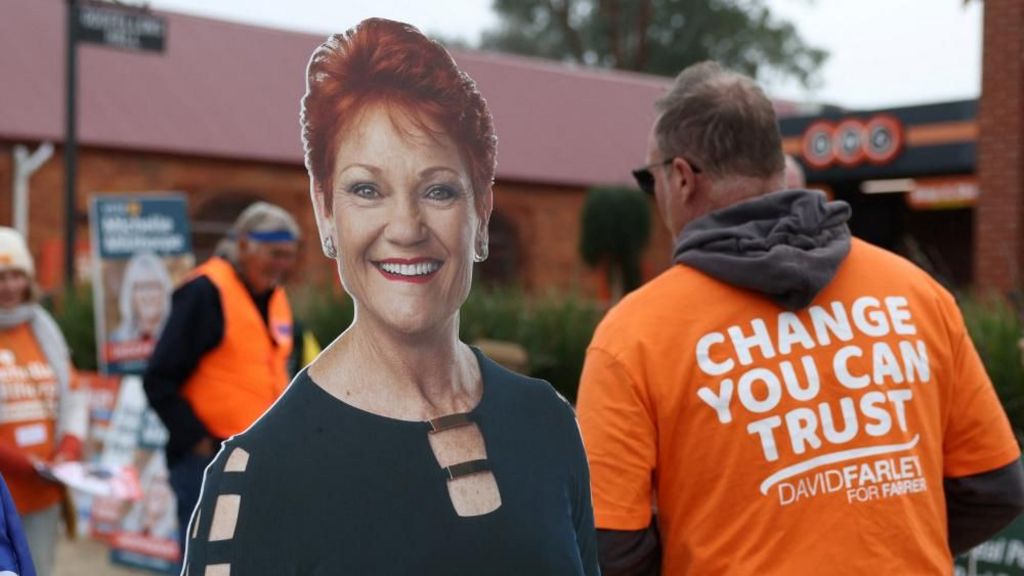
Polling stations opened Saturday in the high-stakes Farrer by-election, a contest that could reshape Australian federal politics by delivering right-wing populist party One Nation its first ever elected member of the House of Representatives. The race was called after Sussan Ley, former leader of the conservative opposition Liberal Party, stepped down from the sprawling regional New South Wales seat following her ousting after just nine months in the leadership role. Though the Liberal Party has fielded a candidate to retain the historically conservative-held electorate, recent polling points to a tight, unexpected race between local independent candidate Michelle Milthorpe and One Nation’s nominee David Farley.
Milthorpe, a local educator, secured second place in the two-candidate preferred count against Ley during the 2025 federal election, where Ley turned in her weakest electoral performance since first capturing the seat in 2001. Under Australia’s preferential voting system, voters rank candidates by preference, and the final result is determined by a head-to-head count after lower-ranked candidates’ preferences are distributed to remaining contenders. Notably, the center-left Labor Party, which holds a commanding majority in the federal parliament, has opted not to contest the by-election, opening a path for neither of the country’s two major political blocs to reach the final two-candidate preferred count — a first in modern Australian federal electoral history.
The by-election doubles as a critical first electoral test for One Nation, led by founder Pauline Hanson, fresh off the party’s strongest ever showing at the state level. In March’s South Australian state election, One Nation secured the second-largest share of the national vote across the state, a milestone that signaled growing voter appetite for the party’s populist platform. While Hanson has served in the Australian Parliament as a senator since 2016, and briefly held a lower house seat as an independent in the 1990s, One Nation as an organization has never won a federal lower house constituency.
One Nation’s candidate Farley, former chief executive of major Australian beef producer Australian Agricultural Company, has centered his campaign on growing voter disillusionment with the country’s major political parties. “I’ve lost a bit of faith in the major parties,” Farley said in a campaign video circulated on social media. “They say one thing to your face and then go and do something else in parliament.”
Stretching across 127,000 square kilometers — an area larger than the entire nation of South Korea — the Farrer electorate covers major regional hubs including Albury, Griffith and Deniliquin, and has been held exclusively by either the Liberal Party or its conservative coalition partner the National Party since its creation. This by-election also marks the first electoral test for the new leadership of both opposition conservative parties: Angus Taylor, who replaced Ley as Liberal leader in February, and Matt Canavan, who took over the National Party leadership from David Littleproud in March. The Liberal-National coalition has faced ongoing internal turmoil and consistently poor polling since suffering a historic landslide defeat in last year’s federal election.
Voting is scheduled to close at 6 p.m. local time Saturday, 9 a.m. BST, with official projections and results expected to emerge shortly after polls close. While the final outcome will not alter Labor’s governing majority in Canberra, a One Nation victory would mark a seismic shift in Australian conservative politics, reflecting sustained erosion of support for the traditional major parties among regional voters.