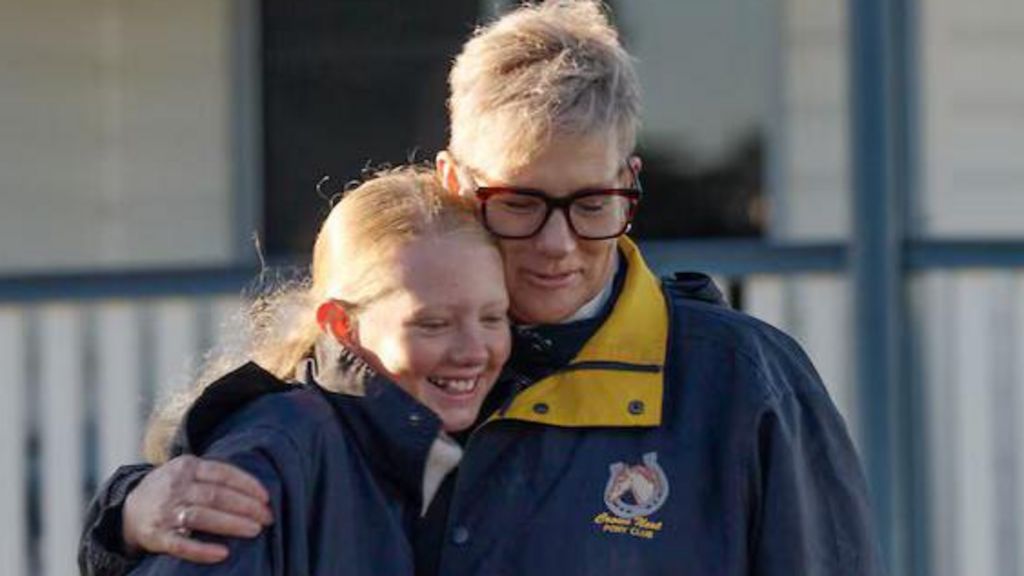
Twelve years ago, Chrissy Walters’ life changed forever. Six months after welcoming her long-awaited first daughter into the world following years of fertility struggles, the Toowoomba resident was rushed to hospital with a severe internal bleed. After multiple tests, biopsies and specialist appointments, the 39-year-old received a devastating diagnosis: advanced cervical cancer.
Today, after more than a decade of grueling, invasive treatments, Walters’ cancer has spread throughout her body, and her condition is terminal. For her 12-year-old daughter, cervical cancer has been a constant presence throughout her life – the family began having open conversations about Walters’ mortality when the girl was just three years old. Now, as her daughter reaches the age Australia’s national immunization program targets for HPV vaccination, Walters holds onto the hope that her daughter’s generation will be the first to grow up free of the disease that is taking her life.
Australia is well on its way to making that hope a reality. On track to become the first country in the world to eliminate cervical cancer as a public health threat – potentially beating its 2035 target – the nation has built on decades of local innovation and public health investment to reach this historic cusp. The story of Australia’s progress begins in 2006, when University of Queensland scientists Ian Frazer and Jian Zhou developed Gardasil, the world’s first effective vaccine against human papillomavirus (HPV), the most common high-risk cause of cervical cancer. A year later, Australia became the first country to roll out a national HPV vaccination program for adolescent girls, expanding the program to include boys (who can be asymptomatic carriers of the virus) in 2013.
Alongside widespread vaccination, Australia has implemented a world-leading screening program that has drastically improved early detection. In 2017, it became one of the first nations to replace traditional pap smears with more sensitive HPV-based screening, which only needs to be completed once every five years. It also introduced the option of self-collected samples, a change public health officials call a game-changer for people who avoid screening due to anxiety about pelvic exams, or barriers like limited time or geographic distance from healthcare services.
Public health experts define elimination of cervical cancer as fewer than four new cases per 100,000 people annually. As of the latest data, Australia already records 6.3 new cases per 100,000 women, down from double that rate when national record-keeping began in 1982. Most notably, 2021 data recorded zero new diagnoses of cervical cancer in women under 25 – a landmark that would have been unthinkable a generation ago. Karen Canfell, a leading epidemiologist at the University of Sydney and global pioneer in cervical cancer control, says the end of cervical cancer as a widespread public health threat is in sight. “It’s not all women of all ages yet, but you can see that concept of elimination being realised,” she notes.
Canfell adds that Australia’s early investment in vaccination and screening has served as a blueprint for the World Health Organization’s global elimination strategy, making the country a trailblazer in the first global effort to eliminate any form of cancer. “Public health innovations in Australia sort of gave a general exemplar for WHO to follow,” she says.
Despite this remarkable progress, significant challenges remain. The latest progress report highlights a small but concerning decline in vaccination coverage across the country, with stark disparities for First Nations communities. Aboriginal and Torres Strait Islander women currently face twice the rate of cervical cancer diagnoses and three times the mortality rate of non-Indigenous Australian women, due to long-standing barriers to healthcare access that often lead to late detection. On current trends, cervical cancer elimination for Indigenous Australian women will not come until 2047 – 12 years after the national 2035 target.
Researchers add that other barriers, including lingering vaccine hesitancy in the wake of the COVID-19 pandemic, rising healthcare costs, and missed school-based vaccinations among students who have missed class time, are slowing progress. Many families also remain unaware that the HPV vaccine is fully free under Australia’s universal healthcare system, and there is no systematic national program to help children catch up on missed doses. “There’s not a lot of a concerted effort to get them back in if they’ve missed it… The onus is very much on families to get their child caught up on that vaccine,” explains researcher Jocelyn Jones.
Beyond Australia’s borders, high implementation costs remain a major barrier to replicating the nation’s success in low- and middle-income countries, which often lack the robust public health infrastructure and funding needed to roll out widespread vaccination and screening programs. Global aid cuts have exacerbated this gap: in 2025, former U.S. President Donald Trump announced the end of American support for Gavi, the global vaccine alliance that supplies HPV vaccines to developing nations. Australia has stepped in to support neighboring nations including Vanuatu and Papua New Guinea to pursue their own elimination goals, but Canfell notes that high-income countries hold a unique advantage. “To say the obvious thing, we are obviously lucky to be in a high-income country where we have a form of universal healthcare and access for all,” she says.
Canfell argues that eliminating cervical cancer is a worthwhile long-term investment for all nations, pointing to not only the saved lives and societal benefits but also tangible economic returns: when women do not die prematurely from cervical cancer, they remain active in the workforce and boost national economic productivity.
Currently, Australia is in a quiet global race to be the first to reach elimination, with Sweden and Rwanda targeting 2027 and the UK targeting 2040, though all other nations currently lag behind Australia on key coverage milestones. For terminal patient Chrissy Walters, who describes living with cervical cancer as a full-time job that has left her with debilitating side effects, crippling fatigue and crippling financial stress even under Australia’s universal healthcare system, the progress could not come soon enough. While she will not live to see a world free of cervical cancer, she holds onto the hope that her daughter’s generation will never have to experience the pain and loss the disease has brought her family. That future, for Australia, is now within reach.