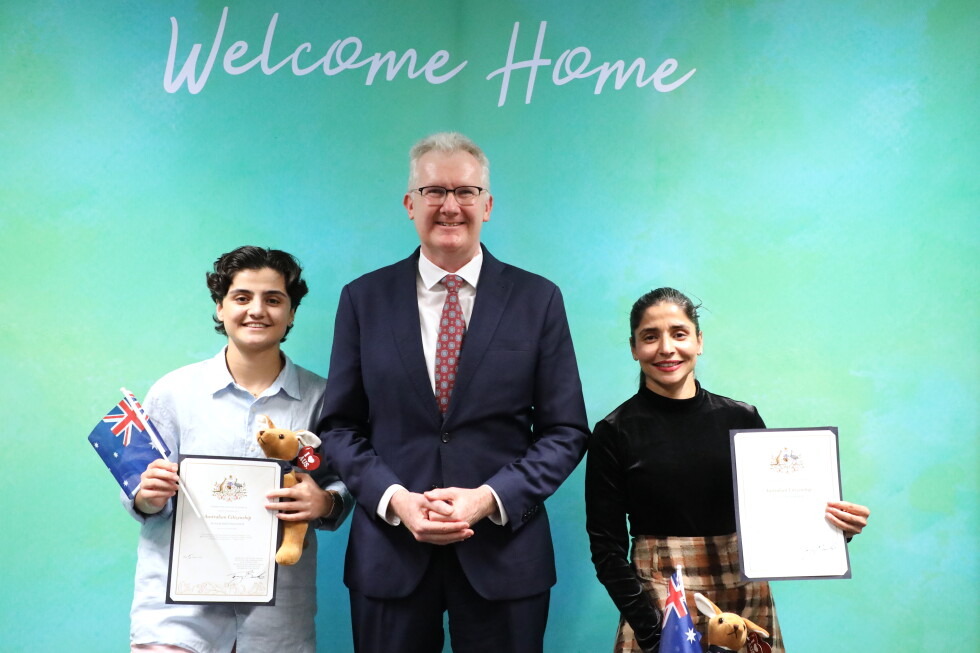
BRISBANE, Australia — In a landmark moment for two elite female athletes who fled their home country last year, Fatemeh Pasandideh and Atefeh Ramezanisadeh, former members of the Iranian women’s national soccer team, have officially become Australian citizens eight months after they first sought asylum in the country. The pair confirmed the news in a public statement released Thursday, revealing that Australia’s Immigration Minister Tony Burke presided over their citizenship ceremony in Brisbane, their new adopted home city, the previous day.
Local Iranian community members, close friends, and advocacy supporters gathered at the event to celebrate the athletes’ new legal status. For Ramezanisadeh, the milestone carried deep personal meaning. “Yesterday was a truly special and unforgettable day for me. I feel proud and deeply grateful to become an Australian citizen. Australia has given me the opportunity to build my life and my future, and I feel, more than ever, that I belong here,” she shared in the statement, adding that her Iranian heritage and life experiences will always remain a core part of her identity.
Pasandideh echoed that emotion, describing the occasion as “one of the happiest days of my life.” “I’m incredibly proud and grateful to officially become an Australian citizen. After everything we’ve been through and all the challenges we faced, this moment means more than words can express,” she said.
The timing of the citizenship approval has drawn public attention, as the process was completed far faster than the standard pathway for refugees. Under normal Australian immigration rules, refugees must hold a valid residency visa for four years before they become eligible to apply for citizenship. When contacted by the Associated Press for comment on why the two players’ applications were fast-tracked, the Department of Immigration declined to discuss individual cases, citing legal privacy requirements. Analysts and immigration observers have widely speculated that the accelerated approval was intended to make the athletes eligible to represent Australia in international soccer competition.
The pair’s path to Australian citizenship began in early 2024, ahead of the Women’s Asia Cup hosted on Australian soil. The entire Iranian national team arrived in the country before a U.S.-Israeli military strike on Iran in February. Tensions rose ahead of the tournament when multiple Iranian players chose not to sing the national anthem before their opening match, sparking widespread public concern for their safety if they were forced to return home. State-sponsored Iranian media branded the players “traitors” for the silent protest, with prominent sports commentator Mohammad Reza Shahbazi calling them “wartime traitors” in a national television broadcast that fueled backlash against the group.
When Iran ultimately withdrew from the regional tournament, Pasandideh and Ramezanisadeh, along with five other teammates, requested asylum in Australia. Just days later, the five other players reversed their decision and returned to the national team for reasons that have never been made public. The two remaining athletes ultimately joined Brisbane Roar, a club competing in Australia’s top-tier A-League Women competition, after their asylum claims were approved.
The case drew international attention almost immediately, with then-U.S. President Donald Trump publicly calling on Australian authorities to grant asylum to the players and even placing a personal phone call to Australian Prime Minister Anthony Albanese to discuss the request. Advocacy groups and public protesters across Australia joined the call to allow the athletes to remain in the country, turning the pair’s situation into a high-profile global discussion about athlete safety and asylum rights.