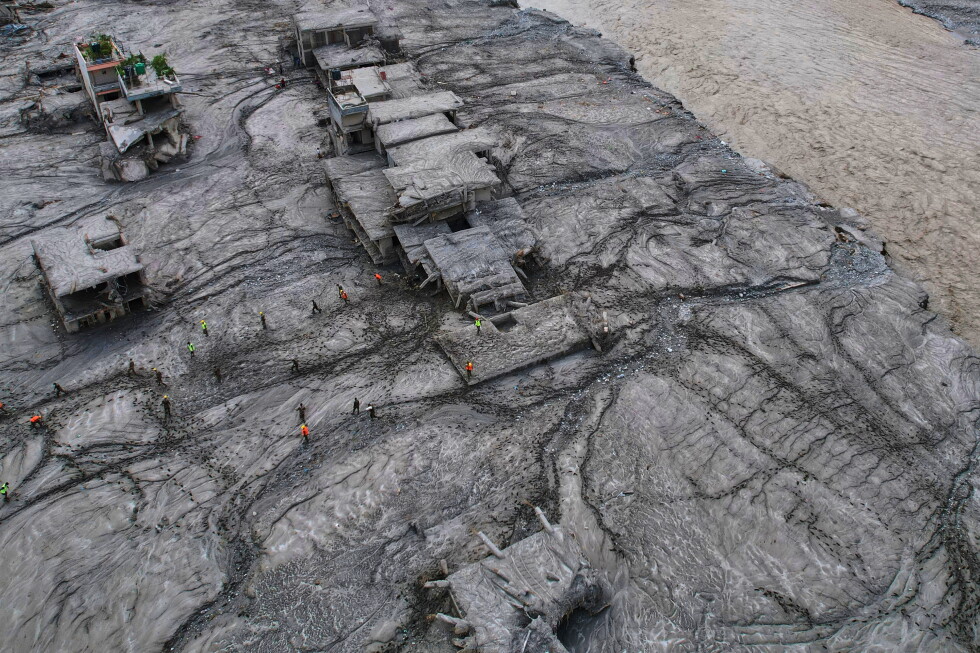
High in Nepal’s remote Himalayan villages, Pema Tamang’s life was upended once again last week when a towering surge of water, rock and mud ripped through her community. In a stroke of fate, she and her neighbors found safe refuge in a Buddhist stupa that had only been reconstructed 12 months earlier, after being leveled by the devastating 2015 Nepal earthquake. The harrowing escape is just one example of the relentless cycle of disaster now gripping the world’s highest mountain range, driven by accelerating glacial melt tied to climate change.
The catastrophic flash floods on August 26 have left more than 1,000 people dead across Nepal and neighboring China, with thousands more still unaccounted for. Hundreds of those missing are feared trapped inside tunnels at under-construction hydropower projects, where rushing debris and water swept through work sites. The disaster was triggered when a massive block of glacial ice and bedrock collapsed, sending a destructive surge cascading through multiple river systems that cut through the Himalayan slopes.
While scientists caution it is too early to draw a direct causal link between this specific extreme event and anthropogenic global warming, the broader trend is unambiguous. As planetary temperatures rise faster than ever due to the continued burning of fossil fuels, the likelihood of similar catastrophic events increases dramatically — especially across the Himalayas, a region that is warming far faster than the global average.
“Climate change has been playing a large role in the Hindu Kush Himalayas, causing these kinds of complex disasters which have really impacted downstream communities and investments,” explained Saswata Sanyal, a disaster risk resilience specialist based at the International Centre for Integrated Mountain Development in Kathmandu. Sanyal notes the region is now facing a growing pattern of interconnected hazards: rising temperatures melt high-altitude ice, which in turn triggers more frequent rockslides, avalanches, and outburst floods. An avalanche can temporarily block a river before releasing a catastrophic flash flood, while unseasonal heavy rainfall can compound destruction after an initial disaster.
This cycle of back-to-back disasters is already wearing down local communities. Flash floods in the same region of Nepal last year killed nine people and caused hundreds of millions of dollars in damage. Across the wider Hindu Kush Himalayan region, a string of deadly events including the 2013 Kedarnath floods, 2021 Chamoli disaster, and 2023 South Lhonak glacial lake outburst flood have killed thousands of people and caused hundreds of billions of dollars in total damage. “People in Nepal were still recovering from last year’s floods, and before they could fully adapt, the next one came,” Sanyal added.
Spanning eight countries across South and Central Asia, the Hindu Kush Himalaya holds the largest volume of ice outside the Earth’s polar regions, and its river systems supply water to nearly 2 billion people across the continent. Data from Sanyal’s intergovernmental climate research group confirms glacial ice loss in the region has accelerated sharply since 2000. Beyond glacial melt, thawing permafrost — long-frozen ground that is now warming — is weakening mountain slopes, increasing the risk of catastrophic collapse.
Analysis of satellite imagery from last week’s collapse confirms a massive block of glacial ice and bedrock plunged into the valley below, generating a wall of mud and water several stories high that traveled for kilometers downstream, wiping out entire communities in its path.
Climate experts warn that for the most at-risk high-altitude communities, adaptation has already reached its limits. In some locations, the frequency and severity of disasters have become so extreme that rebuilding villages and infrastructure is no longer practical, forcing mass relocation of long-standing communities. The crisis also casts new uncertainty over regional development plans focused on building roads, bridges, and hydropower projects to lift local economies.
“The adaptation threshold has been crossed in some areas,” said Manjeet Dhakal, a Nepali climate policy expert and United Nations climate negotiator. Dhakal explained that unlike earthquakes, which often leave property and land salvageable, catastrophic floods can erase entire settlements: they destroy not just homes, but the underlying land, public infrastructure including roads, water grids, schools, and power networks. Going forward, he said, all planned resettlement projects must integrate climate risk assessment from their earliest stages.
Dhakal added that the catastrophic consequences of these disasters can be reduced through targeted action: stricter land-use regulations that bar development in high-risk zones, more rigorous multi-hazard assessments before approving new infrastructure, expanded cross-border disaster monitoring, and more accessible, effective early warning systems.
Even with early warning systems in place, however, gaps remain. Of the 670,000 people who received text alert warnings for the August 26 floods, many were migrant workers or tourists who could not read Nepali, while others dismissed the risk as overstated. Some river monitoring stations were overwhelmed by the surge or washed away entirely before they could transmit updated data. Chanda Lal Chitrakar, a 62-year-old resident of Nuwakot, told the Associated Press he paid little attention to the warning he received, only fleeing uphill when he saw the waters rising.
Experts say warnings need to be more actionable, clearly outlining what steps people should take to get to safety. They also recommend prioritizing development in lower-risk regions, retrofitting existing infrastructure to withstand multiple hazards, and centering Indigenous traditional knowledge of local terrain and disaster patterns in formal planning.
For Nepal and other low-emission Himalayan nations, the disaster underscores a profound climate injustice. Nepal accounts for less than 0.1% of global greenhouse gas emissions driving climate change, yet it faces some of the most severe and frequent impacts. “We should blame those who are responsible for increasing the global temperature, those who have benefited from the fossil fuel economy for such a long time,” Dhakal said. “We can at least use this devastating example as an inspiration to urgently reduce carbon emissions.”
This reporting was produced by the Associated Press, with climate coverage supported by private philanthropic foundations. AP maintains full editorial control over all content, with public transparency standards for philanthropic partnerships available on AP.org.