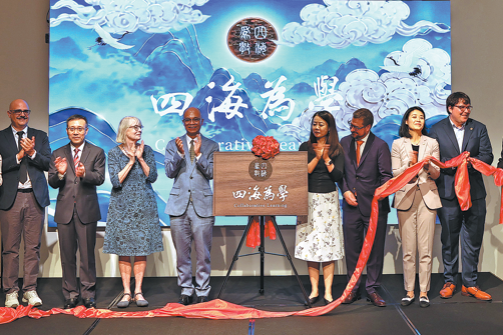
Two iconic coastal metropolises separated by the vast Pacific Ocean — Shanghai on the banks of the Huangpu River and New York along the Hudson Estuary — are rekindling people-to-people connections through a new initiative that weaves together art, heritage and academic exchange to renew cross-cultural dialogue between China and the United States. On Monday, the landmark gathering titled “From Shanghai to New York: A Century-Long Cultural Journey Inspiring New China-US Dialogue” opened at the China Institute of America in New York, drawing dignitaries, emerging young scholars, and artists from both nations to explore intersections of technology, traditional art and contemporary philosophy.
The event marks a core component of the third season of the “Bund: A Global Urban Humanities Dialogue” series, designed to expand mutual understanding between younger generations of Chinese and Americans through open intellectual exchange and collaborative cultural practice. In his remarks at the opening, Yu Yougen, education counselor for the Chinese Consulate General in New York, framed the gathering as far more than a routine cross-border academic meeting. He emphasized that it represents a meaningful cultural exchange that bridges decades of shared history and paves the way for future people-to-people connections. “Shanghai and New York, two internationally renowned cities shaped by water, have maintained close and fruitful exchanges for decades,” Yu noted. “From the Huangpu River to the Hudson River, what crosses the Pacific is not only exhibitions and conversations, but also the shared aspiration of people from both countries to learn from each other.”
Zhang Huihong, deputy chair of the University Council of East China Normal University (ECNU) based in Shanghai, echoed this sentiment, pointing out that the two cities share far more than their status as leading global economic and cultural hubs. Despite being thousands of miles apart, both have cultivated a defining city spirit rooted in radical openness and radical inclusiveness. She explained that the collaborative event grew from this shared identity, with organizers aiming to unlock new avenues for sustainable civil society exchange between the two nations through joint creative projects and transoceanic dialogue.
Running from July 9 to 30 at the China Institute’s on-site gallery, a central companion exhibition will feature more than 100 original works created by ECNU students and faculty. The show draws direct inspiration from a landmark moment in China-US cultural history: Peking Opera master Mei Lanfang’s groundbreaking 1930 tour of the United States, which introduced traditional Chinese theatrical art to mainstream American audiences for the first time. Spanning multiple mediums including traditional prints, oil paintings, hand-drawn illustrations, digital animations, and even AI-generated contemporary pieces, the exhibition reimagines traditional Chinese art and intangible cultural heritage through the lens of 21st-century design thinking and emerging technology.
Wei Shaonong, a professor in ECNU’s School of Design who leads the exhibition’s curatorial team, explained that the program encourages emerging Chinese creators to draw from the deep well of traditional Chinese cultural heritage while leaning into contemporary artistic practices. “Traditional Chinese culture contains rich artistic elements, and we hope students can reinterpret them through today’s artistic language and creative approaches,” Wei said. Reflecting on Mei Lanfang’s enduring influence on cross-cultural communication, Wei noted that the 1930 tour holds vital lessons for modern cultural exchange. At a time when Peking Opera was entirely unfamiliar to most American audiences, Mei achieved enormous success because he recognized the importance of framing art through a contextual and narrative language that new audiences could connect with. This lesson remains relevant today, Wei emphasized: effective cultural exchange requires translation not just of spoken language, but of cultural context and storytelling to build genuine connection.
Monday’s opening event also marked the official launch of Collaborative Learning, an in-person intercultural roundtable initiative based in New York, founded by Paul J. D’Ambrosio, a professor of Chinese philosophy at ECNU. D’Ambrosio emphasized that cultural exchange thrives through diverse forms of engagement. While rigorous academic research and focused expert discussions remain core to cross-border intellectual exchange, he argued that there is a growing need for open, accessible forms of communication that bring broader groups of people from both nations into the conversation.