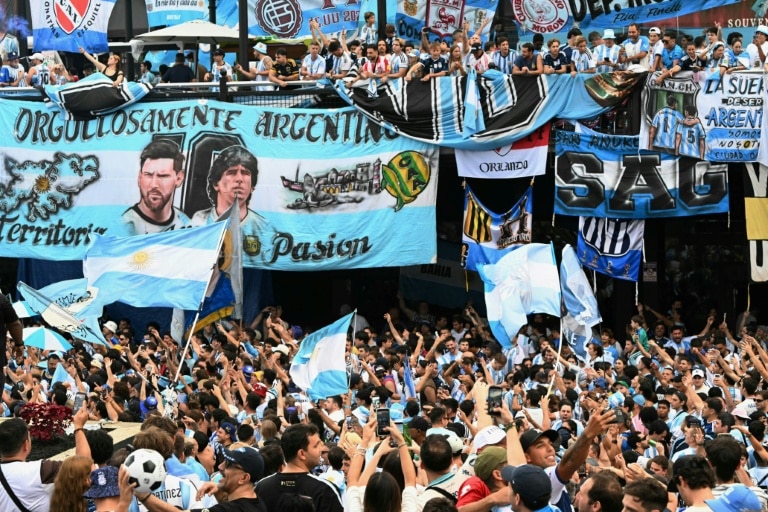
As Argentina’s national men’s football team prepares to face Spain in Sunday’s World Cup final, nerves and excitement have reached a fever pitch across the South American nation, with supporters turning to centuries of local superstitious good-luck rituals to steady their anxiety and boost their side’s chances of claiming back-to-back world titles.
Lionel Messi’s squad advanced to the final after a tense 2-1 semi-final victory over long-time rival England in Atlanta, leaving the team just 90 minutes away from retaining the championship trophy they won in the last tournament. For millions of Argentine fans, pre-match and in-game rituals – locally referred to as *cabala* – are far more than quirky habits; they are non-negotiable traditions that help channel overwhelming pressure into a sense of control over the outcome of the game.
In Buenos Aires’ working-class Liniers neighborhood, 48-year-old accountant and self-described football addict Andres Gonzalez explained that his viewing group enforces strict rules to maintain consistent good fortune. “No one moves from the spot they occupied the last time we won,” Gonzalez told Agence France-Presse. “If you went to the bathroom and we scored a goal while you were gone, we lock you in – you stay there until the final whistle.”
Superstitious football traditions cut across all layers of Argentine society, even reaching the nation’s highest office. President Javier Milei publicly revealed his own unbreakable ritual this Thursday, telling local outlet El Observador radio that he would “under no circumstances” break his custom of watching all Argentine World Cup matches from the presidential residence.
For 65-year-old Buenos Aires saleswoman Estela Vargas, household game-day rules are carved in stone: every viewer must wear the same Argentina gear and sit in the exact same chair for every match, and her pet dog must stay outside the living room during play. She made one exception for the semi-final against England, though: “Since he’s an English bulldog, we put an Argentina jersey on him for that game,” Vargas said. “But for Sunday against Spain? Rain or shine, he stays outside.”
Other households have equally idiosyncratic rules. In Graciela Campos’ home, her mother-in-law has a designated match-day role: she must leave the living room, retreat to the kitchen, and knit a blue-and-white Argentine scarf for the full 90 minutes of play. For 74-year-old retiree Lidia Otero, a lifelong Boca Juniors and national team fan, specific in-game interventions are key. Otero recalled that during the first half of the England semi-final, her dog sat facing the TV, and Argentina failed to score. “In the second half I turned her around, and that’s when the result turned around,” she said. “All my rituals work every time.”
Even young fans have inherited the tradition. Eleven-year-old die-hard Messi supporter Rodrigo Serna practices a decades-old custom of freezing enemy players’ stickers to “cool off” their chances of winning. “I grab the opposing player’s sticker and put it in the freezer. My grandpa taught me that,” he said.
Diego Maradona, the legendary Argentine playmaker who led the nation to its 1986 World Cup title and died in 2020, remains a spiritual touchstone for many fans, with a permanent altar erected at his former Buenos Aires home in the Villa Devoto neighborhood where supporters leave offerings and prayers for victory ahead of Sunday’s match.
Sociologist Diego Murzi explained that these rituals fill a deep emotional need for Argentine football fans, who see themselves as active participants in the team’s performance rather than passive spectators. “In football, Argentines don’t feel like spectators but like protagonists,” Murzi told AFP. “Rituals are part of that – feeling involved by bringing good luck and warding off bad luck.”
Murzi pointed to iconic 1986 World Cup-winning coach Carlos Bilardo as a classic example of how deeply rooted superstition is in Argentine football culture. “Bilardo is a man of science, but a superstitious person to an extreme degree,” Murzi said. He recalled that during Argentina’s first match of the 1986 tournament, a phone rang in the team locker room, a player answered, and no one was on the line. After Argentina won that match, Bilardo made the exact same sequence happen before every game for the rest of the tournament. That 1986 title win proved the ritual worked for him, and the tradition endures today across generations of Argentine fans.
Nearly every neighborhood in central Buenos Aires has been decked out in the national team’s iconic blue and white in the lead-up to Sunday’s final, a visible sign of the unified excitement and anxiety gripping the nation as it waits for kickoff.