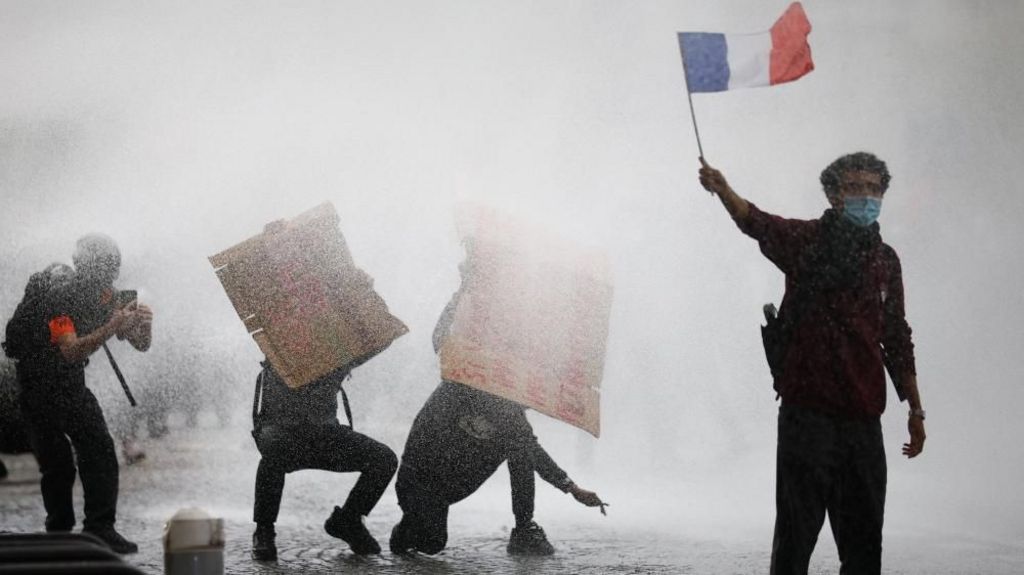
France’s long, storied tradition of mass public protest is once again taking center stage across the country, as three straight weeks of high school blockades and street demonstrations have widened to include union workers and veteran activists from the decade-old yellow vest movement – opening deep rifts over systemic inequality, fiscal policy and political gridlock just six months before the nation’s next presidential election.
For years, displays of public discontent have shaped French political life: angry farmers have lobbed manure at municipal buildings to push back against costly regulatory burdens, while frustrated youth in marginalized suburban neighborhoods have clashed repeatedly with riot police. Today, that legacy of protest has been reignited by thousands of secondary school students, who have blocked campus entrances and marched on city streets to voice anger at crumbling infrastructure, overcrowded classrooms, understaffed schools and stark educational inequity that disproportionately harms low-income communities in disadvantaged suburbs. This Saturday, a new wave of hundreds of demonstrations is scheduled across the nation, with planned participation from labor unions and prominent figures from the 2018 yellow vest movement, which staged a year of nationwide protests against soaring living costs.
France’s Prime Minister Sébastien Lecornu has sparked controversy this week by alleging that the radical left party La France Insoumise (LFI), led by presidential hopeful Jean-Luc Mélenchon, is deliberately manipulating student anger to gain electoral traction ahead of 2027’s presidential vote. “Members of LFI are instrumentalising the high school movement for their electoral advantage,” Lecornu stated this Wednesday, accusing the party of encouraging unrest while performing perfunctory condemnations of violence that erupt during protests. “This hypocrisy damages France.”
For many protesting students, however, Mélenchon’s platform – which includes a new wealth tax, lowering the voting age to 16, and direct engagement with underfunded schools that most national candidates ignore – has made him a popular figure, with chants of “Mélenchon for President!” common at marches. Prominent yellow vest activist Jérôme Rodrigues, who helped lead the 2018 movement, has publicly urged supporters to join Saturday’s protests, framing the unrest as a fight for basic economic dignity. “Anger has no political party. An empty fridge has no political party,” Rodrigues said in an Instagram video, adding that protesters demand the ability to “live decently, no longer have to count every cent, and no longer have to choose between eating and driving.”
On the ground in Paris, student protesters say their grievances stretch far beyond electoral politics. Three 17-year-old students blocking their high school entrance in Paris’ 3rd district told reporters that while their campus already suffers from crumbling walls, overcrowded classes and a shortage of teachers, conditions are far worse for peers in poor suburban districts. “France likes to speak of égalité,” they said, “but the reality is the poor here are prejudiced against, while the rich benefit.” Though none will be old enough to vote in next spring’s election, the teens expressed widespread distrust of the political establishment, saying large-scale protest is the only tool left to force authorities to listen to young people. Intergenerational support for the movement is widespread: many mothers have joined marches in solidarity, taking turns to coordinate between student protesters and police after earlier demonstrations saw hundreds injured, including a 15-year-old boy in Lens who lost a hand when police used stun grenades. The French interior ministry has denied accusations of police brutality and has since suspended stun grenade use at high school protests. One participating mother, 37-year-old Gwen, said she does not mind her son missing weeks of classes, noting “It’s a far better education for him to wake up to his civic duty and to fight for what is just in society.” Another 17-year-old protester, Lola, whose mother participated in the historic 1968 May student protests, carried a joint placard with her mother reading “revolution is the most beautiful expression of humanity.” “Now it’s my turn. No point in waiting for the presidential election in France. We want change now,” Lola said.
Beyond the immediate standoff over student grievances, the unrest lays bare deeper structural crises facing France, the European Union’s second-largest economy: spiraling public debt, a deeply fragmented parliament, a revolving door of prime ministers (six in the last five years alone) and widespread public disillusionment with the status quo. Leading economists have pushed back against widespread speculation that France is approaching a Greek-style 2012 debt crisis, noting that the nation retains the fiscal capacity to address budget shortfalls. “The markets recognised already in 2024 that we would have a budgetary problem after snap elections left parliament deeply divided between three opposing political blocs but they also realise France is a big country with the ability to raise taxes if necessary,” explained Anne-Laure Delatte, a tenured CNRS researcher at Paris Dauphine University and a leading commentator on French public finance. Delatte compared France’s current fiscal strain to the 2023 UK crisis under then-Prime Minister Liz Truss, noting that the crisis was short-lived because markets recognized the UK had the tools to correct course. For France, she said, “it would be painful, but a 4% increase in VAT would raise the 120bn euros needed to plug government debt. Investors know that.” She added that the European Central Bank would likely intervene if France’s fiscal troubles threatened to spill over into other EU economies. Even so, policy moves like tax hikes or cuts to welfare and education spending would likely trigger even deeper public anger, given the widespread discontent already visible on French streets.
Delatte argued that no new president, regardless of political affiliation, will be able to resolve France’s underlying challenges without systemic constitutional change. The Fifth Republic’s system concentrates power in the presidency, leaving parliament to block initiatives rather than build cross-bloc consensus, she explained. “We need a system where MPs have more power and should learn consensus and coalition-building from our European neighbours,” Delatte said, adding that underfunded, unequal education systems drag on long-term economic growth by stifling innovation and productivity. “Our current system of inequality in schooling and low wages for teachers means we lose out from benefiting from the best and brightest across French society. That is not only unfair on individuals but our economy ultimately loses out on innovation and productivity.”
Centrist French senator Anne-Catherine Loisier, a member of the Centrist Union in the upper parliament and vice president of the parliamentary group for sciences and technology, said immediate progress can be made by reallocating existing education funding and decentralizing power away from Paris. “Our budgets are limited, but you don’t necessarily need more money. You can make improvements by redistributing funding better. Education is a regional competence in France. Every region should take a look at local needs and address priorities accordingly. That action can be taken immediately,” Loisier said, echoing calls for greater regional power that mirror similar pushes in the UK. “France has traditionally been very Paris-centric but so much could be improved by decentralising the country. My France isn’t broken. We need to give power back to the people. Local governments can look people in the eye directly, so voters feel they have power over their own future, rather than politicians handing them their fate from up high. That way I hope we can restore voters’ – and students’ – faith in politics.”
The promise of reform is a common refrain from all political factions ahead of next year’s election, but polling across France and much of Europe shows public trust in the political establishment continues to decline, leaving the outcome of the upcoming election – and the future of France’s growing protest movement – far from certain.