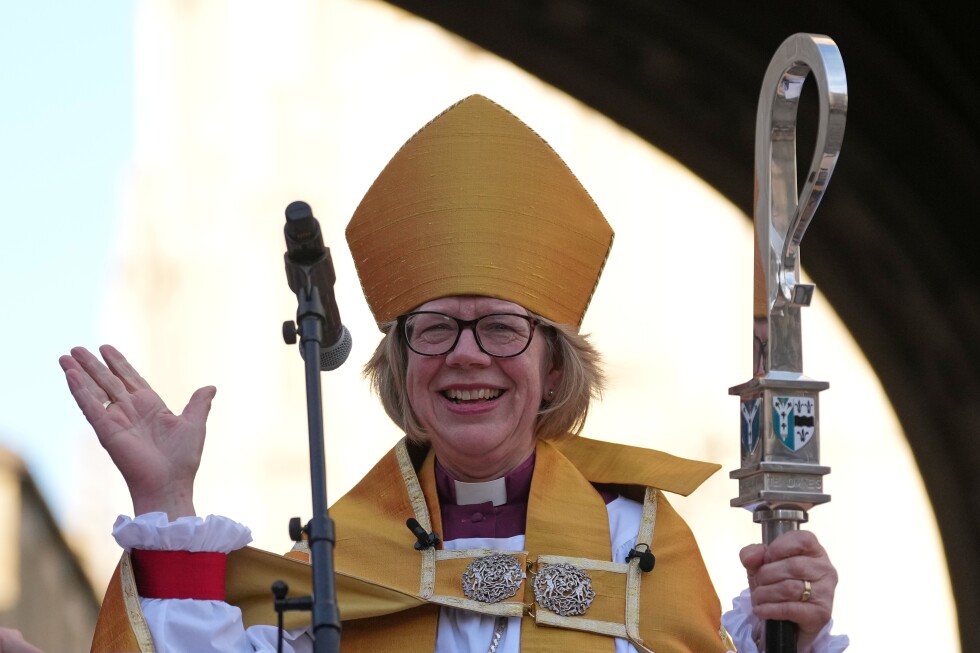
VATICAN CITY – In a landmark moment for Christian ecumenism, Sarah Mullally, the newly installed first female Archbishop of Canterbury and spiritual leader of 100 million Anglicans worldwide, touched down in Vatican City on Monday for a historic audience with Pope Leo XIV. This meeting marks Mullally’s first international trip since she took up the highest office in the Church of England, and comes as the global Anglican Communion grapples with deep internal divisions over her appointment.
Mullally arrived ahead of schedule for a closed-door meeting with Pope Leo in the pontiff’s private library, before the pair moved to the Urban VIII Chapel inside the Apostolic Palace for a scheduled moment of prayer, per Vatican announcements. The archbishop’s four-day Roman pilgrimage has already included stops at the Vatican’s major pontifical basilicas, where she prayed at the tombs of Saints Peter and Paul and held preliminary meetings with senior Vatican leadership.
Lambeth Palace, the official London residence of the Archbishop of Canterbury, outlined the core goals of the visit: “to strengthen Anglican–Roman Catholic relations through prayer, personal encounter, and formal theological dialogue. It aims to deepen bonds of communion, affirm a shared witness, and encourage ongoing collaboration at both global and local levels.”
The historical divide between the two church bodies stretches back to 1534, when King Henry VIII split the Church of England from Roman Catholic authority after his request for a marriage annulment was denied. While formal bilateral theological dialogue launched in the 1960s, major theological divides persist – most notably the Church of England’s gradual move to ordain women to all levels of clergy, a practice the Roman Catholic Church rejects, as it restricts the priesthood exclusively to men.
Mullally’s appointment caps a decades-long shift for the Church of England: the first female Anglican priests were ordained in 1994, the first female bishop took office in 2015, and Mullally’s installation last month broke the final stained-glass ceiling as the first woman to hold the post of Archbishop of Canterbury. Her rise to leadership has split the already fractured 100-million-member Anglican Communion, which counts believers in 165 countries. Liberals and progressive Anglicans, mostly based in Western nations including the United Kingdom, have celebrated Mullally’s appointment as a long-overdue milestone for gender equality in faith leadership. But conservative factions across the communion have pushed back fiercely. The Global Anglican Future Conference (Gafcon), a conservative bloc that counts the communion’s largest and fastest-growing African churches among its members, has openly condemned the appointment and threatened a permanent schism. In North America, the conservative Anglican Church in North America – which split from the more liberal U.S. Episcopal Church and the Anglican Church of Canada over LGBTQ+ and gender issues – has joined Gafcon’s opposition to Mullally.
In a message exchanged ahead of the visit, Pope Leo congratulated Mullally on her recent installation, while openly acknowledging she assumes office at a uniquely challenging moment, and that core differences still separate the two global church bodies. “We also know that the ecumenical journey has not always been smooth,” Leo wrote. “Despite much progress, our immediate predecessors, Pope Francis and Archbishop Justin Welby, acknowledged frankly that new circumstances have presented new disagreements among us.” Even so, the pontiff reaffirmed the Catholic Church’s commitment to continuing the dialogue.
The meeting comes just two months after Pope Leo welcomed King Charles III, the titular head of the Church of England, and Queen Camilla to the Vatican, where the two royal visitors prayed in the Sistine Chapel. That October 25 gathering marked the first time since the 16th-century Reformation that the heads of the two churches have prayed together publicly. This year also marks the 60th anniversary of the first formal ecumenical statement signed by Anglican and Roman Catholic leadership, a 1966 agreement signed at the Basilica of St. Paul Outside the Walls by then-Archbishop Michael Ramsey and Pope Paul VI.
Beyond ecumenical relations, Mullally has already expressed public solidarity with Pope Leo’s recent calls for peace in Iran, which came under fierce attack from former U.S. President Donald Trump after the American-born pontiff made the appeal.
This coverage of religious affairs comes via the Associated Press, with support for AP religion reporting through a collaboration with The Conversation US, funded by Lilly Endowment Inc. The AP holds sole responsibility for this content.