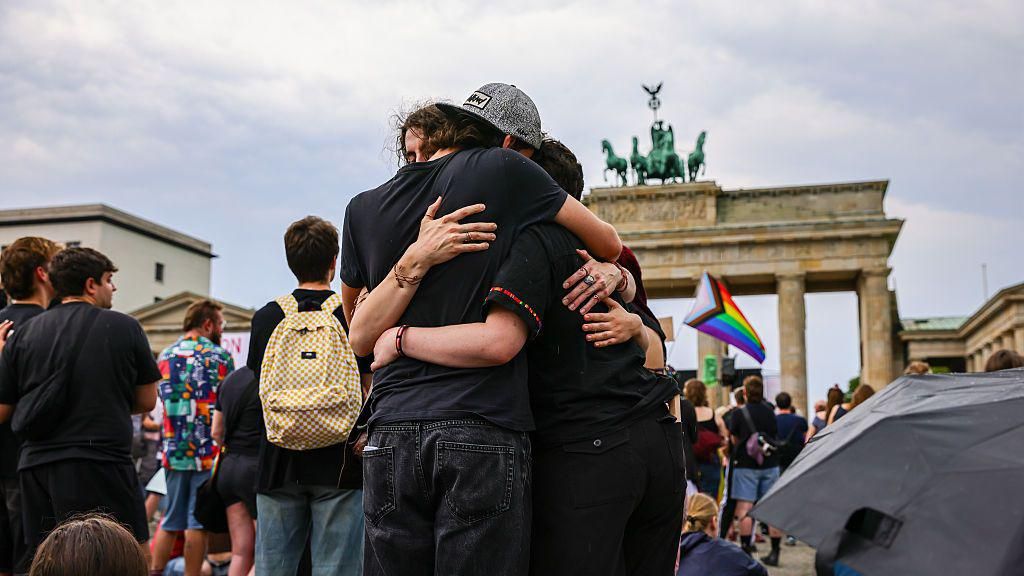
Germany is grappling with overlapping waves of grief, shock, and growing public anger following a deadly assault that targeted Saturday night’s Berlin Pride celebration, leaving one Polish woman dead and at least 29 other people injured. The 21-year-old main suspect, Abdul Ballout — a German citizen of Lebanese descent — was fatally shot by police during an operation Sunday afternoon, ending the immediate manhunt but opening intense scrutiny of how a man flagged for extremism and criminal activity remained free to carry out the attack.
Details of Ballout’s long-documented extremist ties and criminal history have emerged in the days after the violence, raising urgent questions about systemic failures in German law enforcement and judicial processing. Prosecutors’ investigations outline a clear pattern of radicalization stretching back more than a year: in 2025, Ballout made the deliberate decision to travel to Syria via Turkey and Lebanon to join the Islamic State group’s armed insurgency, and met with individuals he believed to be IS operatives while in Lebanon. He was arrested by Lebanese authorities in July 2025, receiving a three-month prison sentence for inciting religious and sectarian conflict before being deported back to Germany.
Upon his arrival at Berlin Brandenburg Airport in November 2025, German authorities took Ballout into pre-trial detention. In May of this year, a Berlin court handed down a juvenile sentence of one year and 10 months for the charge of “preparing a serious act of violence endangering the state.” In a decision that has now sparked national fury, the court suspended the sentence pending an appeal from prosecutors, who had argued for a far longer custodial term. Ballout was released immediately and placed only under the supervision of a probation officer, despite being formally flagged as a security risk.
German Interior Minister Alexander Dobrindt publicly acknowledged that the suspended sentence decision was “certainly incomprehensible” given the severity of the threat Ballout posed, confirming that national authorities have launched a full investigation into the handling of his case. Berlin’s Governing Mayor Kai Wegner, a member of the centre-right Christian Democratic Union, echoed the public frustration, telling local media he was left dumbstruck by the judiciary’s handling of the case. While he declined to overtly critique the court’s ruling out of respect for judicial independence, Wegner noted that Ballout was tried under juvenile law and ultimately released on a suspended sentence, leaving him “really at a loss for words.”
Opposition parties have seized on the attack to level sharp criticism at German security policy. The far-right Alternative for Germany’s home affairs spokesperson Martin Hess called the assault a “total failure of security policy,” demanding a full inquiry into why a known Islamist threat was permitted to move freely in public. Even as political leaders criticize the court’s decision, new details have emerged about how Ballout managed to convince authorities he had renounced extremism: Der Spiegel reports that Ballout told the Berlin court during spring proceedings that he had fully distanced himself from extremist ideology and violence. Thomas Mücke, an extremism researcher with the Violence Prevention Network who met with Ballout, told public broadcaster ARD that the suspect presented a calm, controlled, and friendly facade to social workers — a demeanor that Mücke now says masked his true intentions, noting that such controlled performances often make it difficult for intervention specialists to detect hidden radicalization.
The attack has reignited a national debate over whether Germany needs to tighten its anti-terrorism legislation and reform its juvenile justice framework. Peter Neumann, a security studies expert at King’s College London, told German public broadcaster ZDF that Germany’s existing anti-terrorism criminal law is “too lenient” by European standards, with the country’s sentencing guidelines producing far shorter sentences than comparable European nations. Neumann also called for a full review of Germany’s juvenile justice system, which he argued prioritizes rehabilitation and education over public safety.
Other political leaders have pushed back against claims that the law itself is flawed, arguing instead that the failure lies in inconsistent application of existing rules. Sebastian Fiedler, home affairs spokesperson for the centre-left Social Democrats, told Deutschlandfunk radio that the core question is not the text of criminal law, but why Ballout remained at large despite repeated red flags. “We need to look more closely at why [Ballout] was still at large,” Fiedler said. “Another key question is: ‘What actually happened after his release from prison? Who was he still in contact with?’ Although he was under surveillance, there was clearly a gap in the system.”
German Chancellor Friedrich Merz has promised decisive action in response to the attack, saying that while it is too early to outline specific political consequences, the government will act with both prudence and determination. Merz argued that any individual classified as a security threat who cannot be held in full detention must have their movement restricted “as much as possible,” questioning why modern tracking technology allows for personal location monitoring globally, yet German security agencies cannot consistently track the whereabouts of known threats. The chancellor has already requested the interior ministry conduct a full review of German laws governing monitoring jurisdiction to close gaps that allowed Ballout to remain free.
On Sunday, hundreds of mourners gathered near Berlin’s iconic Brandenburg Gate to honor the victim of the attack, a quiet demonstration of grief that comes as the nation demands accountability for the systemic failures that allowed the violence to occur.