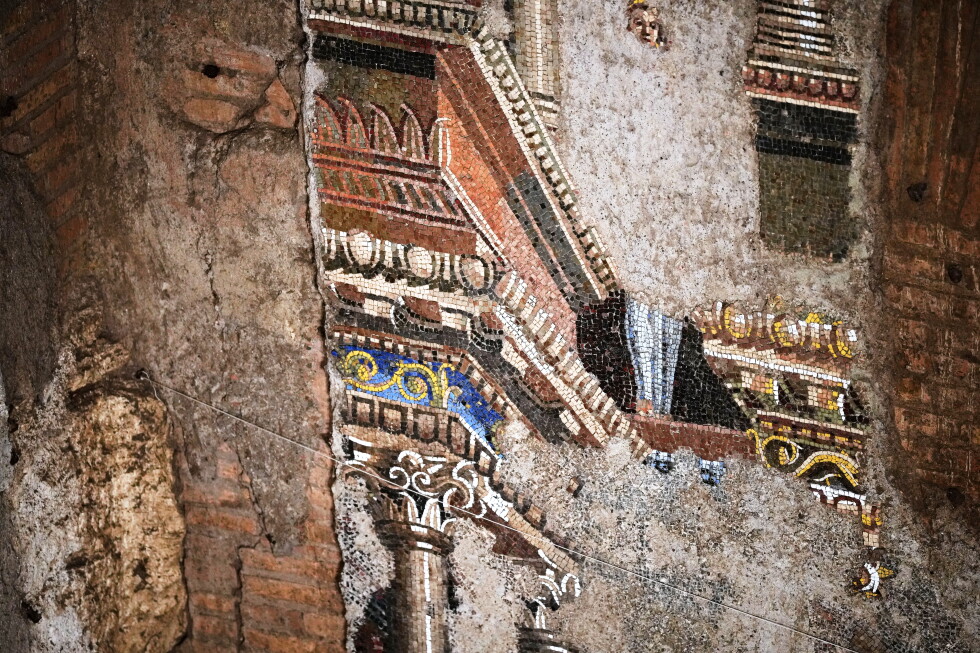
On Tuesday, September 8, 2026, Roman authorities officially unveiled a remarkable archaeological treasure long hidden from public view: what experts confirm is the largest surviving fresco and mosaic complex from ancient Rome. Dating back to the 1st century AD, the paired works depict a bustling maritime port city, and were discovered decades ago in the underground foundation galleries of the Baths of Trajan, the iconic ancient thermal complex that once stood as the largest public bath facility in the world.
Located on Rome’s Oppio Hill, just steps from the world-famous Colosseum, the two pieces — the sweeping “Painted City” fresco and towering “Great Mosaic” — were first uncovered during excavation work in the 1990s, and have just completed a years-long restoration process ahead of their public debut. At the official unveiling ceremony, Rome Mayor Roberto Gualtieri presented the long-awaited restored works to the public and press.
For the first time in modern history, these ancient artworks will be accessible to visitors. Starting this month, access will be limited to a trial phase, with only small groups of 15 people allowed entry on weekends. This phased approach is designed to monitor how the fragile ancient artworks respond to changes in humidity and environmental conditions caused by human presence, before officials approve broader, more frequent public access.
Described by Gualtieri as an unparalleled global cultural treasure, the fresco presents a rare bird’s-eye view of a walled port city, complete with detailed depictions of urban architecture. At roughly 1st century AD, it stands as the largest intact wall fresco of its era from ancient Rome, a distinction that makes its public opening a landmark moment for archaeology and heritage. “They are truly unique in the world, both from the point of view of artistic beauty and the historic and documental importance,” Gualtieri emphasized during his remarks at the unveiling.
Claudio Parisi Presicce, Rome’s top cultural superintendent, added that the fresco’s remarkable level of preservation has left scholars with new clues about ancient urban life. The work clearly shows detailed features of the depicted city: fortified walls, a functional port, a dedicated theater, a religious temple, open public piazzas, and defensive towers, all rendered with striking artistic skill. While researchers have not yet confirmed the identity of the city shown in the painting, Parisi Presicce noted that it must have been a major, widely recognized urban center in the ancient Mediterranean world.
The 15-meter-tall Great Mosaic, the companion piece to the fresco, is equally impressive. Its intricate surface is divided into four distinct horizontal levels, adorned with elaborately decorated columns, detailed architectural motifs, and human figures. The uppermost levels of the mosaic are arranged to resemble a staged theatrical scene, while the lower section holds a surprise: a second depiction of a port city, a detail that was only uncovered during the recent restoration work.
To contextualize the find, the Baths of Trajan themselves are a landmark of Roman imperial engineering. Dedicated by Emperor Trajan in 109 AD, the sprawling complex covered more than six hectares of the Oppio Hill, making it the largest bath complex in the world at that time. The facility integrated an earlier imperial structure, Nero’s Domus Aurea, and was engineered with a reoriented layout to better leverage natural water temperatures, creating an optimized thermal experience for Roman residents and visitors. The newly opened underground gallery is part of the complex’s original foundation system, built to support the massive above-ground thermal structures.
Today, the portion of the complex open to visitors includes a grand semicircular upper-level space that archaeologists have identified as a library. This finding confirms that the Baths of Trajan were far more than a recreational bathing facility: they served as a multifunctional public hub where ancient Romans could not only bathe and compete in athletic activities, but also engage with cultural and intellectual pursuits.