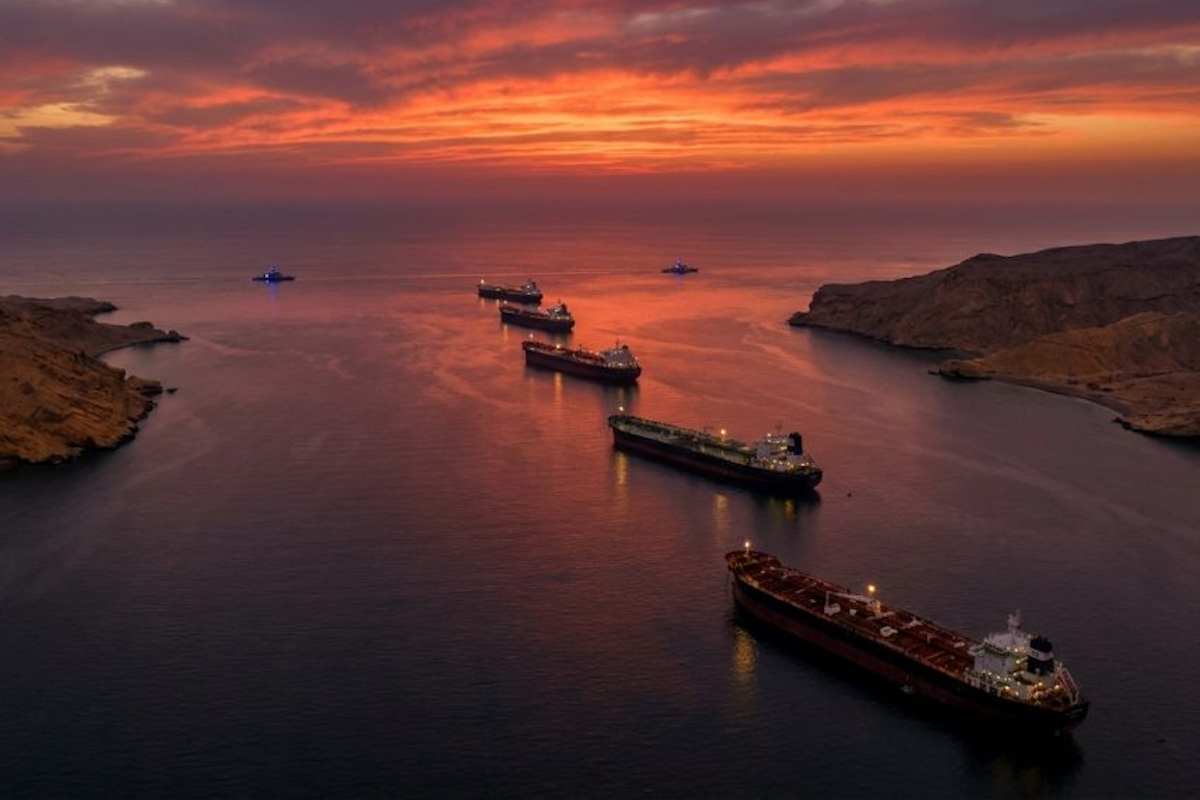
Five months after joint US-Israeli airstrikes that killed Iran’s Supreme Leader and triggered a broader regional conflict, the 21-mile-wide Strait of Hormuz has emerged as the most intractable front line of the war, where overwhelming military asymmetry collides with total diplomatic gridlock.
By mid-July, a deadly, predictable cycle of violence had solidified. Night after night, the United States carries out targeted strikes on Iranian coastal military infrastructure, including radar systems, drone launch sites, and missile depots, framing each operation as a necessary measure to safeguard international commercial shipping passing through the critical waterway.
Iran has responded in kind: its forces have targeted commercial tankers, including two vessels flagged to a US-aligned Gulf state that were attacked within Omani territorial waters, and has repeatedly threatened to close the strait to all shipping that it has not explicitly authorized to transit.
A ceasefire negotiated earlier this spring has already collapsed, follow-up indirect negotiations have broken down, and leaders of both nations have exchanged increasingly sharp public threats. What began as a slow-burning regional standoff has evolved into an active, if intermittent, war centered entirely on control of the strait.
The question on every analyst’s mind is why neither side can break the deadlock to secure a decisive victory. Military strategy offers the clearest explanation for this prolonged stalemate.
Washington possesses the advanced firepower to systematically degrade Iran’s coastal defense networks, and has already done so on multiple occasions. But as US Vice President JD Vance recently acknowledged, even after eliminating Iran’s large-scale military assets along the coast, Tehran retains the ability to disrupt shipping via asymmetric tactics: small fast-attack boats, sea mines, and short-range artillery fire, none of which require the sophisticated capabilities the US has been targeting.
For Iran, the math is equally prohibitive: Tehran cannot defeat the superior US Navy, nor can it keep the strait fully closed for an extended period. A complete shutdown of the waterway would immediately cut off Iran’s own critical oil export revenues and open the door to far more devastating US retaliation. What both sides *can* do is make the strait so risky that commercial shipping largely avoids it – and that is exactly what has come to pass: daily transits have dropped to a tiny fraction of pre-war levels.
Diplomatic efforts to break the impasse have failed again and again for deep structural reasons, not mere bad timing. Iran’s foreign ministry has explicitly ruled out new formal negotiations, and previous rounds of indirect talks collapsed before producing any lasting agreement.
Compounding the challenge is the fact that new points of conflict emerge faster than existing disputes can be resolved. For example, Iran recently floated a proposal to charge tolls for transiting the strait, framing the fee as compensation for maritime security services it provides. The proposal has been rejected outright by both the US and the International Maritime Organization, which notes that no single nation has legal authority to impose tolls on an international strait. While the toll dispute is a minor issue compared to the broader war, it highlights the pattern: both sides continually introduce new demands that make de-escalation far harder to achieve, even when both nominally favor reducing tensions.
The stakes of this stalemate extend far beyond Iran and the United States. The strait carries roughly one-fifth of the world’s seaborne oil trade and an equal share of global liquefied natural gas (LNG) exports, making its safety critical to energy markets worldwide. A multilateral Persian Gulf Strait Authority has been formed in an attempt to collectively manage the waterway’s security, but it has yet to reverse the ongoing disruption.
Washington has publicly appealed to major maritime powers including China, Japan, South Korea, and European nations to deploy naval vessels and share the burden of keeping the transit lane open, a tacit acknowledgment that unilateral American military power has proven insufficient to guarantee safe passage for shipping. Meanwhile, neutral Gulf states such as the United Arab Emirates are already bearing direct costs of the conflict: damaged tankers, killed civilian crew members, and disrupted commercial activity in waters over which they have no control, and in which they never chose to fight.
What does this prolonged stalemate reveal about the trajectory of the broader regional war? The Hormuz standoff is not a temporary impasse waiting for the right diplomatic breakthrough; it is the product of a fundamental structural mismatch. US airstrikes can punish Iran and degrade its military capabilities, but they cannot permanently secure open transit through the strait. Iranian attacks can disrupt global shipping and intimidate commercial operators, but Tehran cannot close the strait on its own terms or sustain its current campaign without inflicting severe damage on its own economy.
Without a negotiated settlement that neither government currently appears willing to accept, the near-term future is likely to look much like mid-July: repeated cycles of airstrikes, tanker attacks, brief lulls in violence, and commercial shipping volumes that never return to pre-conflict levels.
The most urgent question hanging over the region today is not which side will ultimately claim victory at Hormuz. It is how long global energy markets and neighboring Gulf states can continue absorbing the costs of a conflict that neither principal party can end decisively.