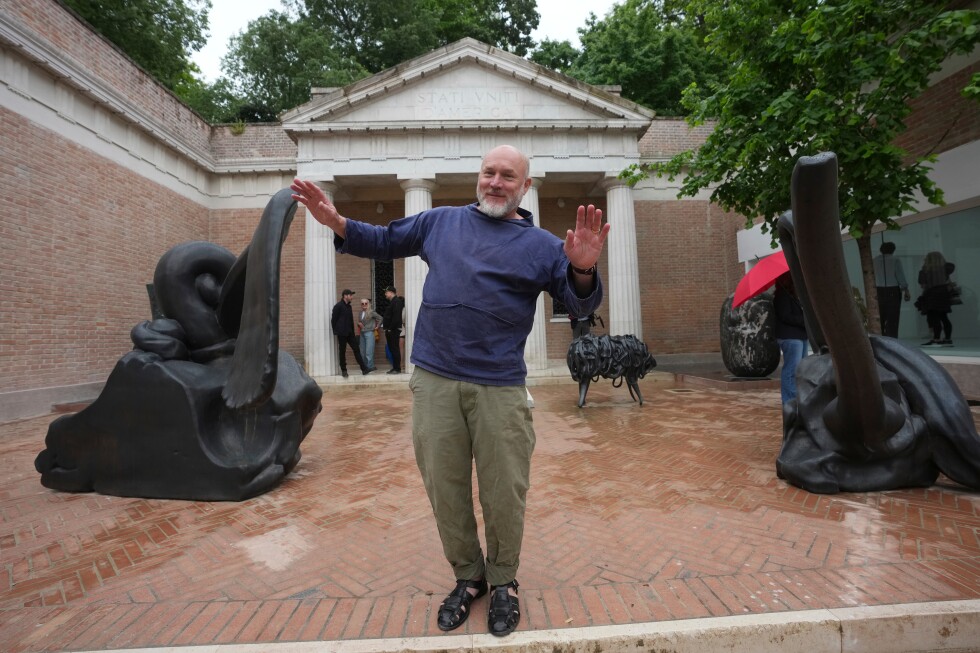
As the 2026 Venice Biennale prepares to open its gates to the global art world, self-taught American sculptor Alma Allen finds himself at the center of one of the world’s most prestigious contemporary art platforms — a spot he secured only after a turbulent, last-minute selection process that has stirred widespread criticism across the international art community.
A Utah-born sculptor who has built his three-decade career working independently from Mexico, Allen has long positioned himself as an outsider to the insular, clique-driven contemporary art establishment. Now, just days ahead of the Biennale’s official launch, he faces intense scrutiny from critics and art world observers alike, all eyes fixed on the U.S. Pavilion, the iconic Jeffersonian-style brick venue that hosts the American presentation every two years.
Controversy has shadowed the 2026 U.S. pavilion selection from the start, with many describing the process as uncharacteristically opaque. When the open call for the commission was revised, language centering diversity, equity and inclusion was removed, and replaced with a new mandate to promote “American values.” This shift led most major cultural institutions that typically compete for the coveted commission to step back, amid fears of being drawn into unseemly administrative politics.
The road to Allen’s appointment was rocky from the outset. The original planned exhibition, set to feature work by artist Robert Lazzarini and curated by art historian John Ravenal, had already secured U.S. State Department approval before it collapsed last September, when the project’s required institutional sponsor pulled its support. A subsequent attempt to attach the Lazzarini project to the newly created American Arts Conservancy (AAC) fell through, and within a short timeframe, the new lineup — AAC as sponsor, Jeffrey Uslip as commissioner, Allen as the exhibiting artist — was announced.
Ravenal, the curator behind the failed original project, has criticized the revised selection as highly irregular. He notes that after the original application deadline closed in July, there was no public committee vetting process, no open applications, breaking with 40 years of established open call and peer review practices for the U.S. pavilion. He has described Allen as “a pawn in this whole thing.”
Allen is no stranger to the backlash his participation has sparked, but he is firm in pushing back against claims of political influence. He stresses that the current U.S. administration has not interfered in his exhibition in any way, saying bluntly: “My art is not propaganda.”
This is the first time in Allen’s 30-year career that he has felt the need to defend his practice and his place in a major show. For three decades, he worked largely outside the constant critical gaze of the mainstream art world, a circumstance he calls a genuine pleasure. His practice centers on organic, biomorphic sculptures carved from wood, shaped from stone, and cast in bronze. He intentionally refuses to title most works, choosing instead to leave space for viewers to bring their own interpretations to each piece.
Allen’s exhibition, titled *Call Me the Breeze*, brings together a dozen brand-new works alongside pieces he created over the past two decades. The title, he explains, is a nod to his lifelong ability to navigate unexpected obstacles — a skill he developed as a self-taught artist who has rarely benefited from institutional support throughout his career. Uslip, the pavilion’s commissioner, says that exact independent, non-institutional background is what made Allen the right choice for the commission. “I am deeply interested and invested in artists who are not, I guess, academicized … or lobotomized,” Uslip explained.
In a playful, ironic touch that nods to the controversy surrounding the show, Allen installed a large cast bronze evil eye on the exterior of the U.S. pavilion, a talisman he joked would ward off negative energy. In a fittingly chaotic twist, the piece was stuck in transit and failed to arrive just days before the opening.
Inside the pavilion’s central courtyard, a headless, directionless sheep sculpture stands as a quiet self-portrait, representing Allen’s status as the outsider shunned for being “the wrong sheep.” His newest body of work includes bronze wall sculptures, treated with chemical processes that turn the rigid metal into a spontaneous, fluid medium he compares to watercolor.
Allen’s path to the Venice Biennale is a story of unconventional persistence. Early in his career, he experienced homelessness in New York City, selling his small creations from an ironing board as an act of sheer desperation — a step that launched his career, connecting him with his first collectors. Today, his work is held in major institutions including the Los Angeles County Museum of Art and the Palm Springs Art Museum; he previously took part in the 2014 Whitney Biennial, and made his European debut in Brussels in 2022.
When Allen received the last-minute commission, he made his first ever trip to Venice that November to walk through the pavilion. A trip to the Venice Accademia to see Hieronymus Bosch’s *The Visions of Hereafter*, a haunting work depicting heaven, hell and purgatory, inspired the exhibition’s core structure. “I wanted there to be a bit of the chaos that we go through,” Allen said of the show’s framework.
Looking back on the chaotic path that brought him to the Biennale, Allen says his selection came down to one key trait: his willingness to step into high-pressure, last-minute challenges. “When they do, I’m prepared to try it, and fail at it. That’s fine,” he says. Now, as opening day approaches, the outsider artist is ready to meet the world’s critical gaze with the same quiet adaptability that has defined his decades-long career.