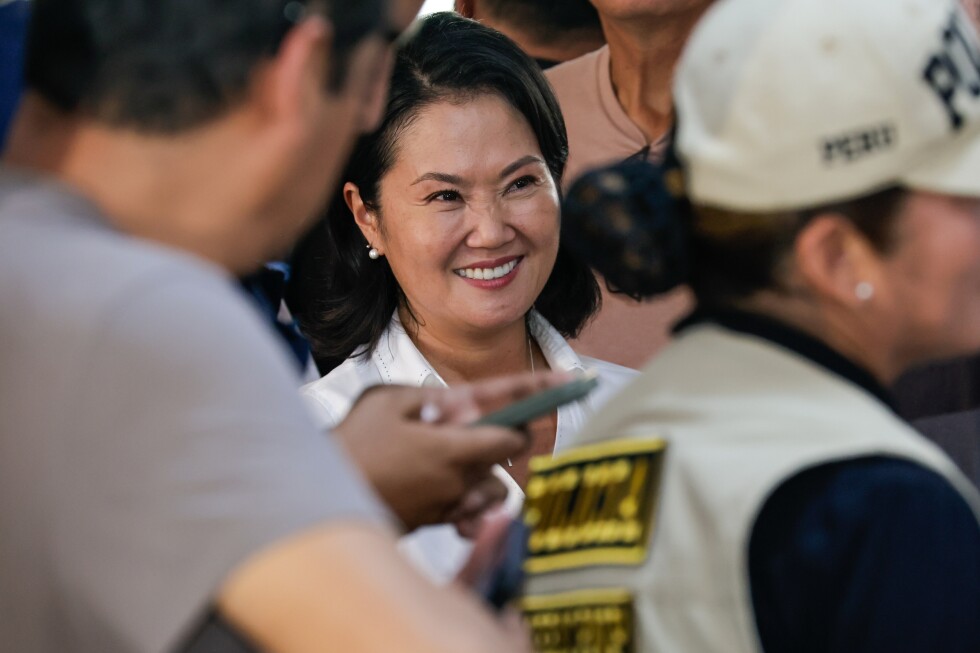
Four days of ongoing ballot counting in Peru’s 2024 presidential first-round election has cemented two candidates as the clear front-runners poised to advance to the June runoff, as widespread logistical failures disrupted voting processes for thousands of voters at home and abroad.
Keiko Fujimori, a conservative Peruvian politician making her fourth bid for the country’s highest office and the daughter of disgraced former president Alberto Fujimori, held the top spot in official counts released Tuesday, with 16.95% of the vote after 90% of all ballots were processed. Close behind her, nationalist congressman and former cabinet minister Roberto Sánchez claimed 11.99% of the vote, putting him just barely ahead of third-place contender Rafael López Aliaga, an ultraconservative and former mayor of Lima who captured 11.94% of counted ballots.
The election has been plagued by organizational breakdowns that disenfranchised thousands of eligible voters both within Peru and among the Peruvian diaspora in the United States. The disruptions began when ballot boxes failed to reach polling locations on schedule for the original voting day, forcing election officials to extend voting into an extra day on Monday. The extension, announced Sunday evening just as official counting got underway, allowed more than 52,000 Lima-based residents to cast their ballots, as well as Peruvian voters registered in two U.S. locations: Orlando, Florida, and Paterson, New Jersey.
Under Peruvian electoral rules, a candidate must secure an absolute majority of more than 50% of the vote to win the presidency outright in the first round. Since no candidate is on track to hit that threshold, the top two finishers from the first round will advance to a head-to-head runoff election scheduled for June 7.
The eventual winner will take office as Peru’s ninth president in just a decade, stepping into a role that has seen rapid turnover amid ongoing political instability. The current interim president, José María Balcázar, was appointed to the position in February, following the ousting of his predecessor — an interim leader removed from office over corruption allegations just four months after taking power.
Fujimori, who has run unsuccessfully for the presidency three times previously, has centered her campaign on pledges to crack down on rising violent crime across Peru. However, her policy record has drawn scrutiny: in recent years, her party backed legislative changes that legal experts argue have significantly weakened the country’s ability to prosecute criminal suspects. The reforms eliminated the option of preliminary detention for certain offenses and raised the legal bar for law enforcement to seize assets tied to criminal activity. If elected, Fujimori has proposed new measures including anonymous judges for criminal cases and a requirement that incarcerated people work to earn meals in prison.
Sánchez, who previously served as foreign trade minister under ousted former president Pedro Castillo, has positioned himself as a nationalist, populist alternative. He frequently wears a wide-brimmed traditional Andean peasant hat on the campaign trail — a gift from his political mentor and ally Castillo, who remains in prison on charges tied to his 2022 attempt to dissolve Congress. If elected president, Sánchez has pledged to use executive pardon power to secure Castillo’s release.
The slow progress of this year’s ballot counting echoes the 2021 Peruvian presidential election, when official final results were not completed until five full days after polls closed, reflecting long-standing structural challenges in Peru’s electoral administration.