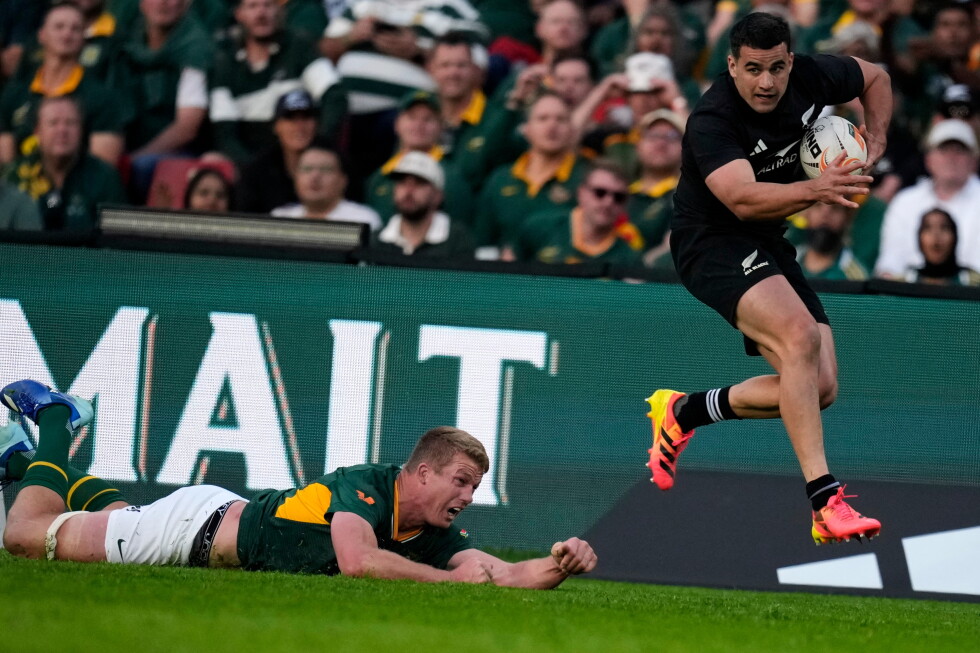
The opening clash of a historic four-test rugby series between two of the sport’s most dominant global powers delivered a shocking result on Saturday, as New Zealand’s All Blacks pulled off a 33-16 upset over the world champion Springboks at Johannesburg’s iconic Ellis Park Stadium, claiming the first critical win of the first full bilateral test series between the sides in three decades. What began as a tightly contested, physically brutal first half ended with South Africa holding a narrow 13-12 lead, but a second-half tactical and physical turnaround from Dave Rennie’s revitalized All Blacks turned a tense matchup into a decisive rout, with the visitors crossing for five tries to South Africa’s one.
South Africa entered the match riding a 12-test winning streak that began 11 months prior in Wellington, where the Springboks handed New Zealand their most lopsided defeat in modern history, 43-10. That momentum appeared to hold early on: the Springbok scrum, their traditional set-piece strength, outperformed pre-match expectations in the opening 40 minutes, pushing the All Blacks pack around the field. Overconfidence in that dominance ultimately proved fatal for the hosts, however. Rather than taking easy kickable penalty points at the high-altitude Ellis Park venue, South Africa opted repeatedly to kick for touch and chase tries to put the All Blacks away early. The plan backfired spectacularly: South Africa’s backline struggled to string together consistent attacking sequences, and was quickly shut down by New Zealand’s defensive line, forcing the bulk of the creative workload onto forward players including Jasper Wiese, Malcolm Marx and Paul de Villiers.
The match’s turning point came just before the 60-minute mark. After Cheslin Kolbe converted a scrum penalty to extend South Africa’s lead to 16-12, New Zealand responded immediately off the restart. All Blacks lock Fabian Holland charged down a box kick from Springbok scrumhalf Grant Williams to score a converted try, putting New Zealand ahead 19-16 for the first time all afternoon.
A key shift came when South Africa substituted starting props Ox Nché and Wilco Louw off the pitch. New Zealand’s replacement front row, consisting of George Bower, Asafo Aumua and Fletcher Newell, stabilized an All Blacks scrum that had been dominated in the first half, turning the set-piece into a platform for late attacking success. Not long after the substitution, South Africa was awarded a five-meter attacking scrum, but for the first time all match, the Springboks were penalized for wheeling, handing momentum straight back to the visitors.
“The reserve front row that came on, I think we probably owe them a beer,” All Blacks scrumhalf Cam Roigard told reporters after the match. “We got a lot of energy from that.”
A devastating break from fullback Damian McKenzie from his own half put more pressure on South Africa, resulting in an injury to Kolbe that forced the Springboks to reshuffle their backline, exposing gaps created by their 6-2 bench split that left them short of backline cover. New Zealand capitalized on the disorganization: awarded a five-meter attacking scrum of their own, flanker Luke Jacobson powered through Springbok captain Pieter-Steph du Toit to score, extending the All Blacks lead to 28-16 with 15 minutes left to play.
Controversy around referee decisions followed as the match neared its close. English referee Matthew Carley, who had overseen three South African wins in previous All Blacks-Springboks matchups, overruled Television Match Official Mike Adamson on multiple key calls. One of the most impactful was a yellow card for Springbok forward Marco van Staden for cynical play on the try line, overturning an initial ruling that did not sanction the South African side. Just 60 seconds later, Cobus Reinach was also sent to the sin bin for a deliberate knock-on, leaving South Africa down to 13 men for the final minutes.
With a numerical advantage, New Zealand extended their lead. Playing from the advantage, an unmarked Will Jordan latched onto a miss-out pass from Ardie Savea to score his second try of the match, putting the result beyond doubt. As the final 10 minutes ticked down, the energy of the packed Ellis Park crowd deflated, as supporters realized a comeback was out of reach.
After the final whistle, du Toit acknowledged that unforced errors had sunk the Springboks’ chances. “We shot ourselves in the foot,” the captain said. “Unfortunately, in a game like this, small errors count.”
The series will shift to sea-level Cape Town next Saturday for the second test, with New Zealand holding a surprising 1-0 series lead as both sides compete for the first full bilateral series win between the two nations in 30 years.