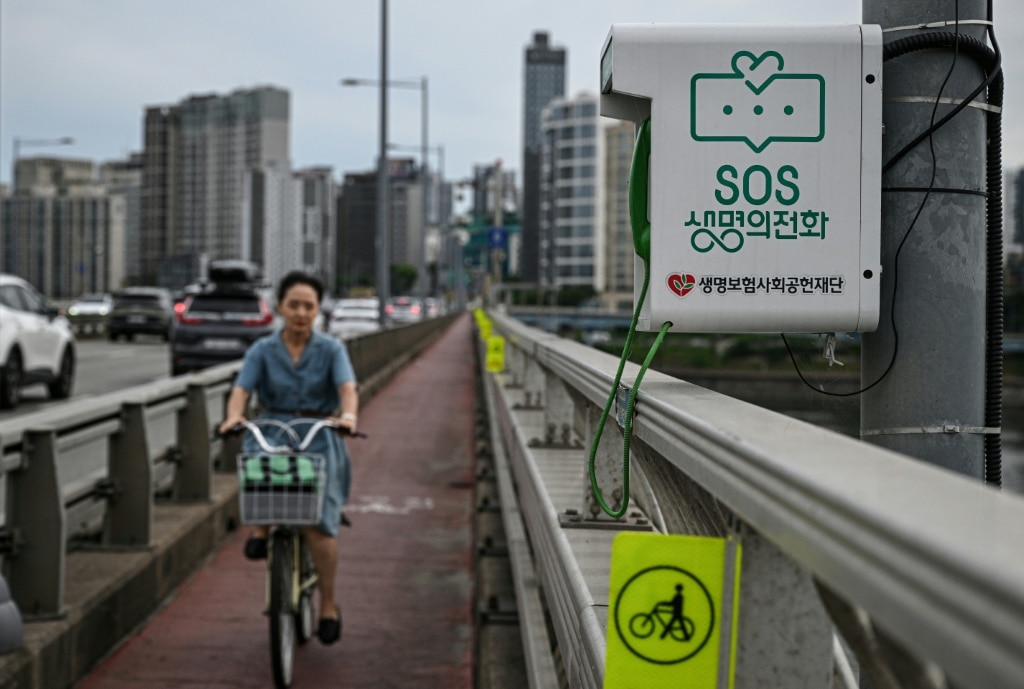
Along the banks of Seoul’s iconic Han River, a cutting-edge artificial intelligence surveillance system is transforming suicide prevention efforts, turning the capital’s most famous landmark into a place where countless at-risk lives are saved every year. But even as the technology delivers staggering results, South Korea continues to grapple with one of the world’s deadliest national suicide crises, a public health emergency that leaders have labeled a global shame.
Since its full deployment in 2021, the AI-powered camera network installed across 17 Han River bridges has redefined how first responders intervene to stop suicide attempts. The system is trained to flag high-risk behavior: it automatically alerts emergency services when a person lingers in restricted jumping zones, enters marked unsafe areas, or picks up one of the bridges’ dedicated suicide prevention hotline phones. For Kim Jun-young, head of the Hangang Bridge CCTV Integrated Control Center, the results have exceeded all expectations. The overall rescue rate for potential suicide attempts along the river has jumped from just 56% in 2012 to over 99% today, a staggering improvement that has saved hundreds of lives.
Thanks to the system’s early alerts, emergency response teams can reach almost any bridge along the Han within five minutes – the narrow, critical window that makes all the difference between life and death. “We see our role as giving them one more chance to think it over, because it may not be the decision you want,” Kim told Agence France-Presse in an interview. Jumping from the 30-meter-high bridges results in an impact with the water equivalent to a car crashing at 60 kilometers per hour, Kim explained, leaving almost no chance of survival even for strong swimmers.
Intervention is rarely straightforward: many people determined to end their lives fight off rescuers or flee at a sprint, while others make a split-second final decision to jump the moment they hear approaching sirens. Still, the numbers tell a clear success story. In 2023 alone, the network of nearly 900 cameras detected more than 1,200 potential suicide incidents across 17 bridges, and just eight people lost their lives.
For all the local success of the AI system, South Korea as a whole is facing a worsening national suicide crisis that President Lee Jae Myung has called “a disgrace on the world stage.” Official 2024 government data puts the national suicide rate at more than 29 deaths per 100,000 people, the highest level recorded since 2011. Suicide is currently the leading cause of death for South Koreans between the ages of 10 and 49, a statistic that underscores the depth of the public health challenge.
Mental health experts point to deep-rooted societal factors driving the crisis. Relentless academic competition, punishingly long work hours, and a cultural narrative that frames personal hardship as an individual failure leave many people struggling to cope with setbacks or reach out for professional help, explained Yoo Jae-hyun, director of suicide prevention at Seoul St. Mary’s Hospital. “Many who have tried to end their lives told me they feel they have become a burden to those around them, and that everyone else would be better off if they were gone,” Yoo said. Data from his hospital shows that people in their 20s make up the largest share of emergency room admissions for suicide attempts, highlighting how the crisis disproportionately impacts young South Koreans.
For 33-year-old cartoonist Hwang, who goes by the professional name Smiling Stone, the AI system’s work is personal. She was pulled from the Han River alive by first responders years after her father died by suicide in 2014, leaving her to inherit his crippling debt, years of lawsuits, and the seizure of her assets – a sequence of events that left her unable to open a personal bank account. Throughout her 20s, she worked multiple backbreaking cash jobs to make ends meet, and at her lowest point, suicide felt like anything but an impulsive choice. “It didn’t feel like a particularly tragic choice. It felt like a rational one,” Hwang recalled. Today, she lives a resilient life, and says learning to be accepted for who she is has helped her heal. She chronicles her experience as a survivor of suicide loss in her cartoon memoir *I Am a Suicide Loss Survivor*, recounting small, lingering regrets like the time her father visited her at the cafe where she worked shortly before his death, brought her a gift, and left before she could buy him a cup of coffee. For months after his death, she returned every day to leave a coffee on the small table he never got to sit at: “One he could never drink again, and one I could never brew for him again.”
AI-powered suicide prevention surveillance is not unique to South Korea. Around the world, cities and public institutions are turning to the technology to detect high-risk behavior early. Japanese tech firm Asilla has developed an AI system that flags unusual behavior such as falls or people lingering in elevated high-risk zones where people often attempt suicide. The system has been trained on behavioral data from cameras in public spaces including shopping centers and train stations, and has already successfully helped guards intervene in two separate rooftop suicide attempts, said Yuka Suzuki, the company’s chief product officer. Even so, Suzuki stressed that AI is a tool, not a solution: it cannot replace human mental health support, and cannot reverse Japan’s status as the G7 nation with the highest suicide rate on its own. “It’s still often difficult to provide proper mental health support,” Suzuki said. “But it is significant if we can reduce the number of incidents, even by a little, where people lose their lives in the blink of an eye.”
Back in Seoul, Kim Jun-young acknowledges that the system is not perfect, recalling one tragic case where a young man was intercepted by rescuers after an initial attempt, only to return hours later and jump while smoking with a friend. Even with rescue boats already on the water, teams could not reach him in time. For the teams that monitor the cameras and respond to alerts, however, every life saved is a victory – and every extra minute the system buys for an at-risk person is a second chance that they would never have had before.