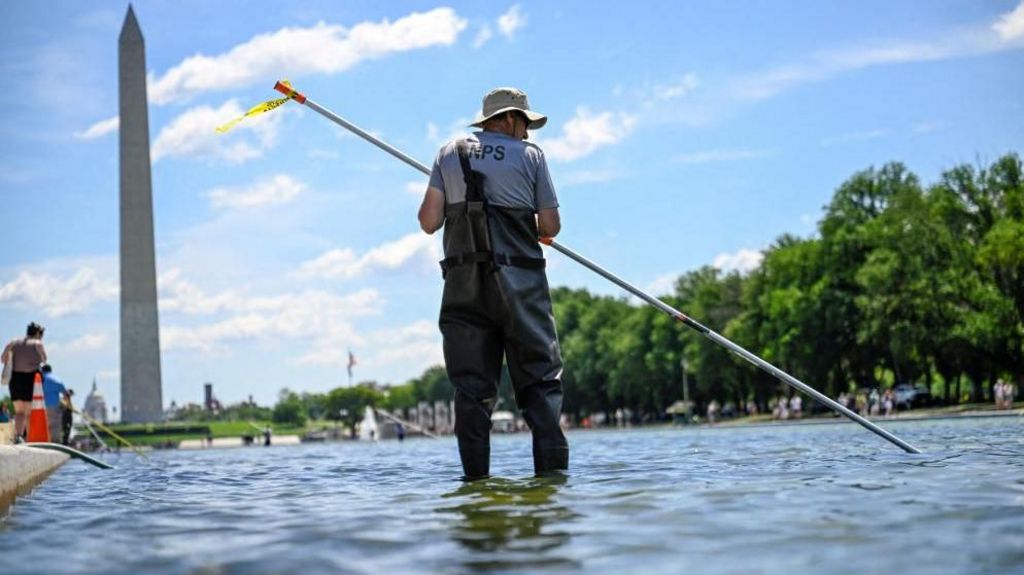
As the United States prepares to mark its 250th Independence Day celebration, the iconic National Mall Reflecting Pool has become the center of a growing political and public controversy, with President Donald Trump announcing urgent corrective action just weeks ahead of the national holiday.
In a post to his Truth Social platform Sunday, President Trump confirmed he had personally assessed the condition of the 100-year-old landmark from the air as his helicopter returned to the White House from the Camp David presidential retreat in Maryland. He stated that immediate repair work would get underway to address the damage and ongoing water issues plaguing the site. “I just inspected it, and could only say to myself, and those gathered around me, WOW, who would do such a thing? SICK, DERANGED PEOPLE!” Trump wrote in the post.
The Reflecting Pool, completed in 1922 and stretching more than 2,000 feet between the Lincoln Memorial and Washington Monument, recently completed a $13 million full renovation project that included draining the pool and applying a fresh coat of blue epoxy paint to its basin. But just weeks after the project wrapped, the site has faced two overlapping crises: widespread reports of new paint peeling from the pool floor, and a thick algal bloom that has turned the once-clear blue water a vivid, unappealing shade of green. Trump has claimed that vandals deliberately damaged the new paint job ahead of the July 4 national celebration, alleging one perpetrator used a blade to cut a 250-foot gash into the pool’s coated facade.
Washington DC’s US Attorney Jeanine Pirro has pledged aggressive legal action against anyone linked to the vandalism. “Anyone who is in a position of vandalising or attempting to vandalise will face the criminal justice system in DC,” Pirro told Fox News in an interview Sunday. A senior anonymous Trump administration official confirmed to CBS, the BBC’s US distribution partner, that five suspects were arrested on vandalism charges Saturday night, with five more issued police citations, and a total of 14 separate police reports filed over damage incidents. US Park Police, the federal agency responsible for patrolling National Mall monuments, has not responded to a BBC request to confirm these arrest numbers.
The case has already drawn public scrutiny after police arrested former Olympic canoeing champion David “Davey” Hearn on vandalism charges Friday. Hearn has denied all wrongdoing in an interview with the BBC, insisting he only touched already peeling paint and did not cause any damage to the pool. “I didn’t destroy, rip, tear, peel, or remove any part of the paint,” Hearn said Saturday. “The condition of any part of the reflecting pool didn’t change. It wasn’t affected. It was the same before I got there as when I walked away.” He called his arrest an “arbitrary, capricious prosecution.”
For the algal bloom turning the pool green, officials have already deployed chemical treatments including hydrogen peroxide to reduce the growth, and officials are now considering draining and refilling the pool for a second time this month to resolve the issue. The algal problem is not unprecedented: the Reflecting Pool has dealt with chronic leaks, structural aging, pipe failure, excess bird waste and recurring algal growth for decades, even prior to this year’s renovation.
Over the weekend, a news photographer spotted a dead duckling floating in the pool’s water, though there is no confirmation yet of how the animal died or if its death is linked to chemical treatments or other repair work. Rosalina Stancheva Christova, an aquatic ecology professor at George Mason University who studies algal growth, collected a water sample from the pool June 16 and identified the dominant algae species as Desmodesmus, a common genus that she confirmed is “absolutely harmless” to humans and animals. Still, Christova warned that the site carries ongoing risk: visiting wild birds could introduce other algal species that host harmful bacteria, and the aquatic ecosystem of the man-made pool shifts rapidly. “These ecosystems are very dynamic, and the algal composition is changing really quickly,” she said, noting that the pool requires constant monitoring “to know which organisms are living there.”