On a devastating overnight attack that ranks among the most intense bombardments the Ukrainian capital has seen in months, Russian forces launched a massive combined aerial assault that left at least 21 civilians dead and dozens more injured, laying bare the fatal consequences of critical air defense interceptor shortages plaguing Ukraine’s military.
Moscow’s assault, which began just after midnight with barely any advance warning for residents, unleashed 115 drones and 24 ballistic missiles across Ukrainian territory. While Ukrainian air defense crews managed to shoot down the vast majority of the incoming drones, depleted stockpiles left them unable to intercept a single one of the ballistic missiles, according to official reports.
The aftermath at Kvitneva railway station, a site on Kyiv’s outskirts, bears grim witness to the human cost of the failure: eight people were killed at this location alone, where discarded shoes, broken glasses, and torn scraps of clothing still mark the blast site on the pockmarked platform. Recovery workers were photographed pulling white body bags from the site and loading them into waiting ambulances, while nearby storage and logistics facilities – including a major online retailer’s warehouse and a national postal sorting center – burned for more than 12 hours after the strike. It remains unclear whether the target was the railway infrastructure itself or the adjacent warehouse, which was also hit and still smoldered hours after the initial explosion.
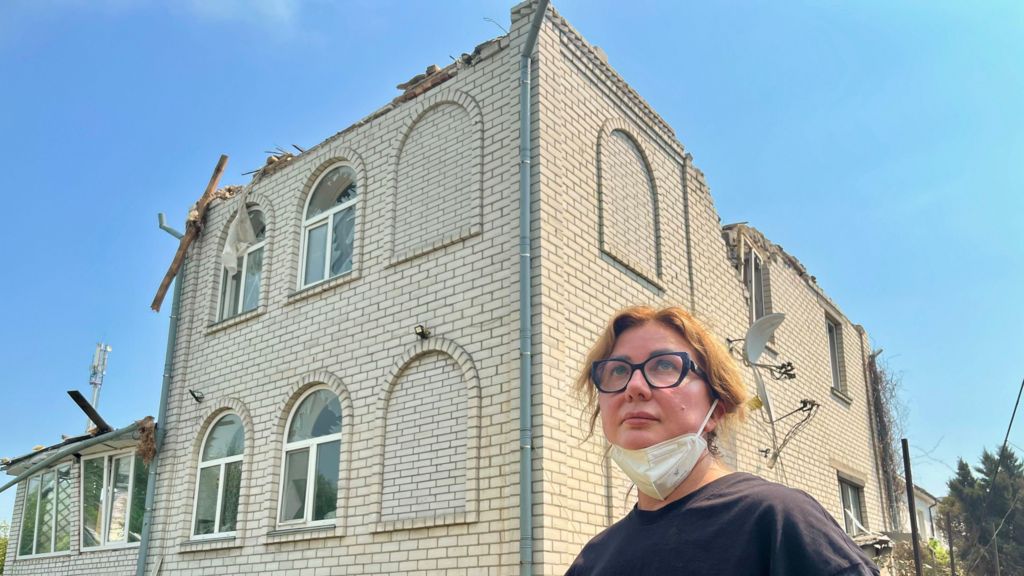
For residents who survived the attack, the experience has been nothing short of catastrophic, even for those who have already endured four and a half years of full-scale war. Anastasiia Dudley, whose home was nearly leveled by the assault, called Wednesday’s strike the “scariest night” she has lived through since Russia launched its full-scale invasion of Ukraine in February 2022. Her three-story home, which was hit by a drone hours before the ballistic missile strike on the nearby station and warehouse, lost its entire top floor and roof, with catastrophic structural damage to the second floor that leaves the remaining walls leaning precariously. “You see two floors – the first and the second, but it was a three-floor house with a roof,” she explained. “So no roof, no third floor, and extensive damage on the second floor. It’s pretty unstable.” Despite the destruction, Dudley and her mother escaped the attack shaken but physically unharmed.
The root of Ukraine’s inability to stop the ballistic missile barrage lies in a crippling shortage of Patriot interceptor missiles, the system Ukraine has relied on for years to neutralize Russian long-range ballistic threats. For months, Ukraine has depended on supplies of these interceptors from the United States, but shifting US stockpile commitments and policy reversals have left Ukrainian air defenses stretched dangerously thin. Earlier this summer, the US initially offered Ukraine a license to domestically produce Patriot systems, but last week US President Donald Trump denied that Washington had ever agreed to transfer that level of technology to Ukraine. Currently, US stockpiles of the interceptors have been heavily depleted by competing commitments related to tensions with Iran, leaving the US administration unwilling to release additional supplies to Kyiv.
The gap has had fatal consequences, Ukrainian officials argue. In a statement following the attack, Ukrainian President Volodymyr Zelenskyy stressed that ballistic missile interceptors could have prevented the deaths of the civilians killed in the strike. “Quite literally every single day, the lives of people here in Ukraine depend on the decisiveness of our partners in Europe and America,” he said, adding that he had spoken with NATO Secretary General Mark Rutte to push for urgent shipments of additional interceptors. Zelenskyy has repeatedly warned that the shortage of air defense interceptors directly encourages Russia to step up large-scale deadly strikes, a warning that was underscored by a similar attack just last week when Ukraine was only able to intercept one out of 27 incoming Russian ballistic missiles.
While Ukraine does retain an undisclosed number of fully functional Patriot launch systems, it is the interceptor missiles themselves that are in critically short supply. Military logistics mean that at least two interceptors are required to reliably destroy each incoming ballistic missile, and the system’s 160-kilometer operating range makes strategic deployment across Ukraine’s large territory challenging. Russia, for its part, regularly launches between 20 and 30 ballistic missiles in each large-scale strike, easily outstripping Ukraine’s ability to respond with its current stockpiles.
Ivan Stupak, a Ukrainian military expert and former intelligence service officer, compared the current situation to owning a high-performance luxury car with no fuel to run it. “Imagine you own a Lamborghini but have no fuel,” he explained. “You have one of the best cars in the world, but you can’t drive anywhere… The situation with Patriot is similar. The systems are there, but there are no interceptor missiles.” Worse, the shortage leaves the Patriot systems themselves vulnerable to Russian targeting, as they become high-priority targets for Russian strikes while they are unable to adequately defend themselves or the surrounding area. “Until we receive more interceptor missiles, these systems need to be relocated or concealed somehow so the Russians cannot detect and destroy them. Right now they’re extremely vulnerable,” Stupak added.
In the immediate aftermath of the strike, recovery work proceeded quickly in Kyiv: emergency teams moved in to repair damaged power lines above the Kvitneva railway tracks to resume passenger and freight services as soon as possible, a rapid clear-up process that Ukrainians have become grimly accustomed to over the course of the war. But the underlying threat remains ever-present. For Ukrainian civilians, the safety of their skies depends entirely on policy decisions made thousands of miles away, outside their borders, and until those decisions deliver the interceptors they need, another deadly, unchallenged Russian strike could come at any moment.