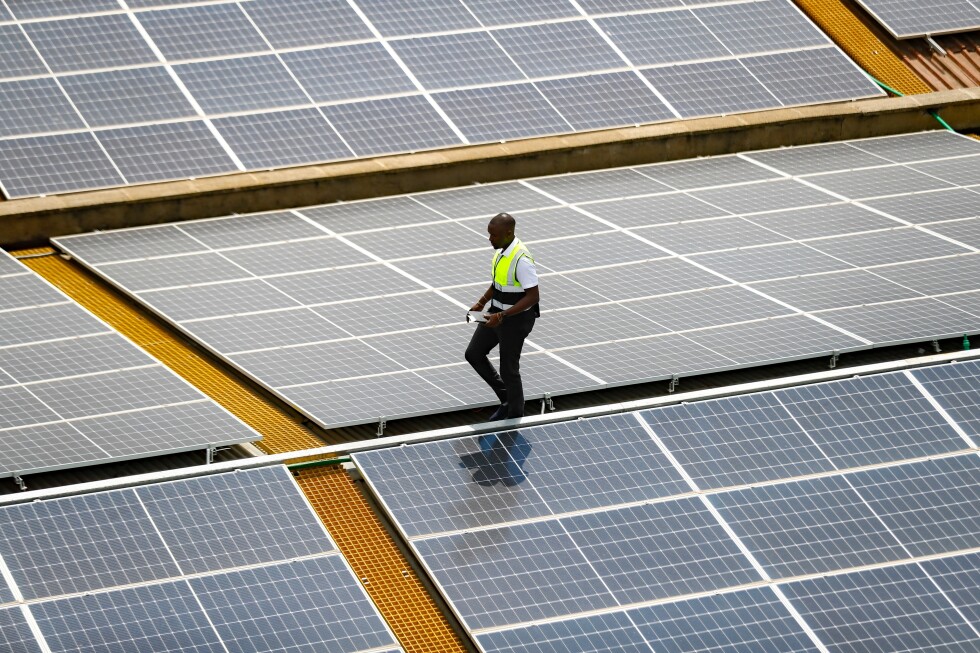
NAIROBI, Kenya — Defying a worldwide deceleration in renewable energy expansion, Africa has astonishingly positioned itself as the planet’s most rapidly expanding solar market in 2025. This remarkable growth, meticulously documented in a recent industry analysis, signifies a pivotal shift in the global concentration of renewable energy momentum.
The Africa Solar Industry Association’s comprehensive report reveals that the continent’s installed solar capacity witnessed a robust 17% surge last year. This acceleration was predominantly fueled by a substantial influx of competitively priced, Chinese-manufactured solar panels. While the global solar power capacity increased by 23% to 618 gigawatts (GW) in 2025, this represented a significant slowdown from the 44% growth rate recorded in 2024, making Africa’s performance particularly standout.
Cynthia Angweya-Muhati, Acting CEO of the Kenya Renewable Energy Association, emphasized the crucial role of international partnership, stating, ‘Chinese enterprises are fundamentally propelling Africa’s green energy transformation. They are making assertive investments and establishing resilient supply chains within the continent’s burgeoning green ecosystem.’
However, a notable implementation gap persists. Data indicates that although nearly 64 gigawatts peak (GWp) of solar equipment has been shipped to Africa since 2017, the operational capacity currently stands at only 23.4 GWp. A gigawatt peak denotes one billion watts of maximum potential power output under ideal conditions.
John Van Zuylen, CEO of the Africa Solar Industry Association, attributed this sustained growth to strategic policy evolution. ‘Solar energy has transcended its status as a niche interest of a few early adopters to become a widespread continental priority,’ he commented during the Inter Solar Africa summit in Nairobi. ‘The current trajectory is not ephemeral; it is the result of policies successfully aligning with potent market dynamics.’
The market landscape is also diversifying. Historically, South Africa was the dominant force, once accounting for approximately half of all solar panel imports. Its share has now receded to below one-third as demand skyrockets across the continent. In a striking demonstration of this broadening appeal, 20 African nations established new annual import records in 2025, with 25 countries each importing a minimum of 100 megawatts of capacity.
Nigeria has now eclipsed Egypt to become Africa’s second-largest solar importer. The driving force behind this shift is the practical and cost-effective nature of solar energy coupled with battery storage, offering a reliable alternative to expensive diesel generators and an unstable national grid. Algeria experienced a meteoric rise with year-on-year imports soaring over thirty times, while Zambia and Botswana also recorded significant surges.
The report further highlights that at least 23 African nations, including South Africa, Tunisia, Kenya, Chad, and the Central African Republic, now generate over 5% of their electricity from solar sources.
A key enabler of this boom is the precipitous decline in costs. Prices for solar panels and, crucially, battery storage units—primarily sourced from China—have fallen dramatically. Battery storage costs in Africa dropped to $112 per kilowatt-hour in 2025, down from an average of $144 in 2023, thanks to technological advancements yielding more flexible and durable systems.
Van Zuylen noted the profound impact of this trend: ‘This ever-decreasing price of storage carries game-changing implications for a continent with an acute need for stable, baseload power.’
Policy reforms are also playing a critical role. In Nigeria, the phased removal of diesel subsidies over the past two years has made diesel progressively more expensive, effectively pushing businesses and households toward solar alternatives. This policy was implemented incrementally across sectors to mitigate economic shock. In a major development for regional manufacturing, Nigeria announced plans in September for a 1 GW solar panel factory, poised to be the largest in West Africa. Similar facilities are currently under construction in Egypt, South Africa, and Ethiopia.
As Africa ambitiously moves to develop its indigenous manufacturing capabilities, the industry is looking towards China for knowledge transfer to mitigate the continent’s reliance on imported equipment and technology.
The economic benefits extend far beyond manufacturing. Van Zuylen pointed to a parallel jobs boom, explaining, ‘The solar employment surge is occurring in service sectors such as installation, maintenance, distribution, and financing, where thousands of small and medium enterprises are emerging to cater to the escalating demand.’
Despite the optimistic outlook, significant challenges remain. A primary obstacle is policy inconsistency. Unlike regions such as the Middle East, where governments publish clear, long-term energy roadmaps, many African markets lack stable policy signals. Solar firms operating across the continent cite unpredictable tax structures, fluctuating import duties, and ambiguous long-term energy strategies as factors that erode investor confidence.
Amos Wemanya, Senior Analyst on Renewable Energy at Powershift Africa, succinctly captured the issue: ‘The problem is not the opportunity. It’s visibility. If a government announces a plan, companies need to have trust that it will remain in place.’