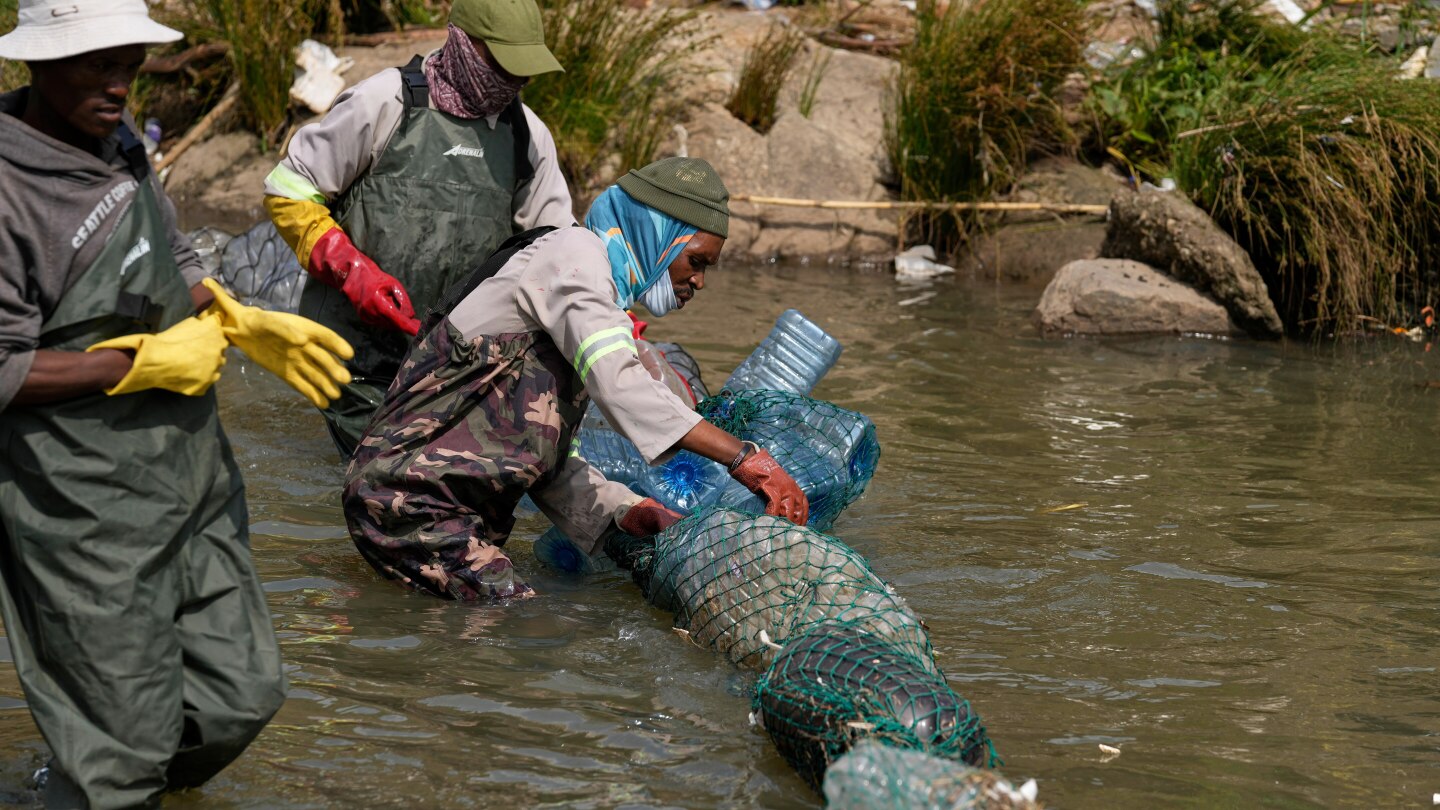
In the heart of South Africa’s oldest township, Alexandra, volunteers clad in wetsuits wade into the polluted Jukskei River to repair damaged garbage nets, a critical defense against flooding that threatens the shacks of this low-lying community. This scene underscores the urgent climate challenges facing South Africa as it hosts the Group of 20 (G20) summit in Johannesburg, marking the bloc’s first meeting on African soil. The summit aims to prioritize issues affecting impoverished nations, particularly the escalating impacts of climate change. South Africa is poised to call on wealthier nations and international financial institutions to bolster support for developing countries grappling with climate-induced disasters. Alexandra, home to over half a million residents, lies just steps away from Sandton, Johannesburg’s affluent financial hub. Yet, frequent flooding isolates the township, leaving children stranded and unable to attend school. Semadi Manganye, co-founder of the Alexandra Water Warriors, describes the situation as a “big hazard,” highlighting the stark contrast between wealth and poverty in the region. The climate crisis exacerbates inequality, a point emphasized by Binaifer Nowrojee, president of the Open Society Foundations, who notes that poor nations face a dire choice between economic growth and climate action. The World Bank reports that natural disasters have surged nearly eightfold in the poorest countries over the past four decades. Southern Africa, in particular, has endured devastating tropical storms, such as Cyclone Idai in 2019, which caused $2 billion in damages across Mozambique, Malawi, and Zimbabwe. The region also suffered from severe droughts last year, crippling agriculture and deepening poverty. Climate financing remains a contentious issue, with rich nations pledging $300 billion annually by 2035 to aid developing countries, though experts argue $1 trillion per year is needed by 2030. The absence of the United States, one of the world’s largest polluters, from the G20 summit further complicates efforts to reach meaningful climate agreements. Meanwhile, South Africa’s own struggles with inequality and inadequate infrastructure exacerbate the climate crisis. Amnesty International’s recent report criticizes the government for failing millions living in informal settlements, who are disproportionately affected by flooding and other climate-related disasters. Despite these challenges, grassroots initiatives like the Alexandra Water Warriors offer hope. Since its formation in 2021, the group has planted trees, recycled waste, and engaged thousands in climate resilience projects, supported by a mix of public and private funding. As the G20 summit unfolds, South Africa seeks to champion green growth as a pathway to development, emphasizing that sustainable and resilient economies can drive faster progress.
Africa hosts its first G20 and urges the rich world to do more against climate disasters