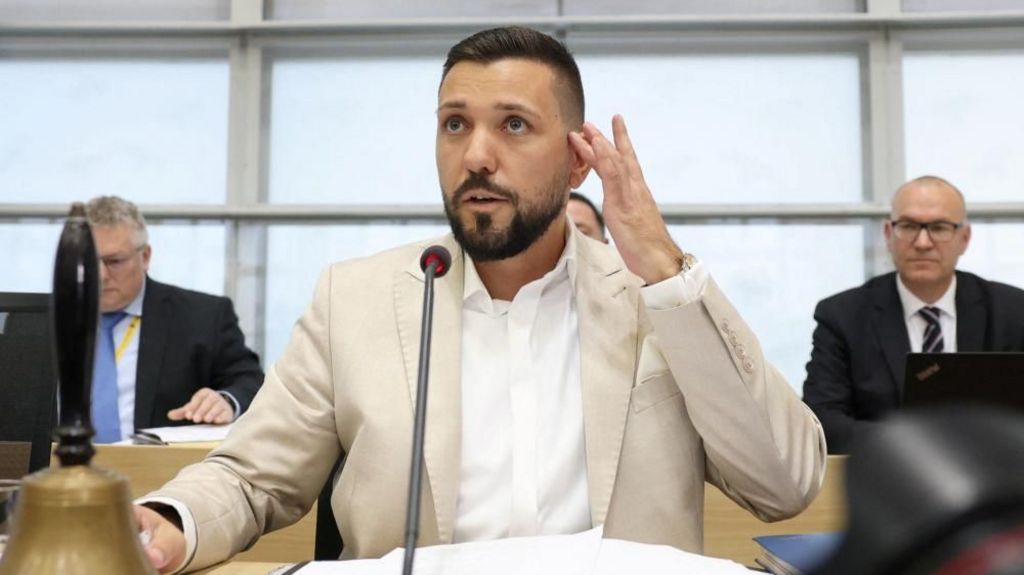
Just one month after Germany’s far-right Alternative for Germany (AfD) party secured a landmark electoral victory in the eastern state of Saxony-Anhalt, the faction has achieved another unprecedented breakthrough: its candidate Tobias Rausch has won election as the state parliament’s speaker, marking the first time a far-right party has claimed this prestigious parliamentary post since the end of World War II.
Despite the AfD holding three fewer seats than the 42-seat majority required to control the 83-member legislature on its own, the 35-year-old candidate secured a comfortable victory in Tuesday’s vote, drawing backing from nine lawmakers across rival political parties. Five of those cross-party votes came from members of the hard-left Bündnis Sahra Wagenknecht (BSW), while the identities of the remaining four supporters remain undisclosed – a detail that has sparked intense political speculation across the country. Political observers have openly questioned whether the four unknown votes came from members of Chancellor Friedrich Merz’s center-right Christian Democratic Union (CDU), a party that has publicly ruled out any cooperation with the AfD. All 15 CDU state lawmakers had previously pledged not to support Rausch, but only five abstained from the vote as planned, leaving unaccounted-for voting behavior that has fueled ongoing questions.
Following his win, Rausch, a trained real estate agent who has served as a state lawmaker for a decade and is a close confidant of regional AfD leader Ulrich Siegmund, rejected the long-standing post-war German political consensus that erected a “political firewall” to block far-right politicians from institutional power. “The days of political firewalls should be a thing of the past,” Rausch said in his post-vote remarks.
While the role of parliament speaker is largely ceremonial in Saxony-Anhalt, it carries significant institutional authority: Rausch will now preside over parliamentary debates, regulate access to the state parliament building in Magdeburg, and serve as the official representative of the legislature at state and national public events. Ahead of the inaugural session, the AfD also successfully pushed to shift its seating from the far-right fringe of the legislative chamber to the center, another symbolic shift that underscores the party’s growing institutional influence in the state.
The election result triggered immediate condemnation from across Germany’s mainstream political spectrum. Susan Sziborra-Seidlitz, leader of the Saxony-Anhalt branch of the Green Party, called the outcome a watershed moment that had crossed a fundamental red line in post-war German politics. “A line has been crossed,” she said. “We will not let ourselves be intimidated, and we will not sit by when rights are curtailed either here or for people in the state.”
Outside the Magdeburg parliament building, more than 300 protesters gathered to voice their opposition to Rausch’s win, holding aloft banners reading “Never again is now” – a deliberate reference to Germany’s post-war commitment to preventing the reemergence of extremist politics. Crowds surrounded regional AfD leader Siegmund as he spoke to reporters, repeatedly displaying the anti-far-right protest signs to push back against the party’s breakthrough.
Germany’s domestic intelligence agency has already classified the Saxony-Anhalt branch of the AfD as a “right-wing extremist” organization, a label the party’s leadership has repeatedly rejected. The AfD is widely known for its pro-Russian policy stance, anti-immigrant agenda that includes proposals to segregate child refugees in public schools, and documented intolerance toward LGBTQ+ communities.
Siegmund, the popular and charismatic regional AfD leader, is now set to run for the post of state premier in a December legislative vote, a bid that will also require the support of 41 additional lawmakers to win. Just as with Rausch’s speaker bid, Siegmund will need cross-party backing to secure the role, but the BSW has already ruled out entering a formal coalition with the AfD. The hard-left party has instead announced it will back an independent non-partisan candidate for state premier and abstain from the December vote, leaving Siegmund’s path to the top state office uncertain at this stage.