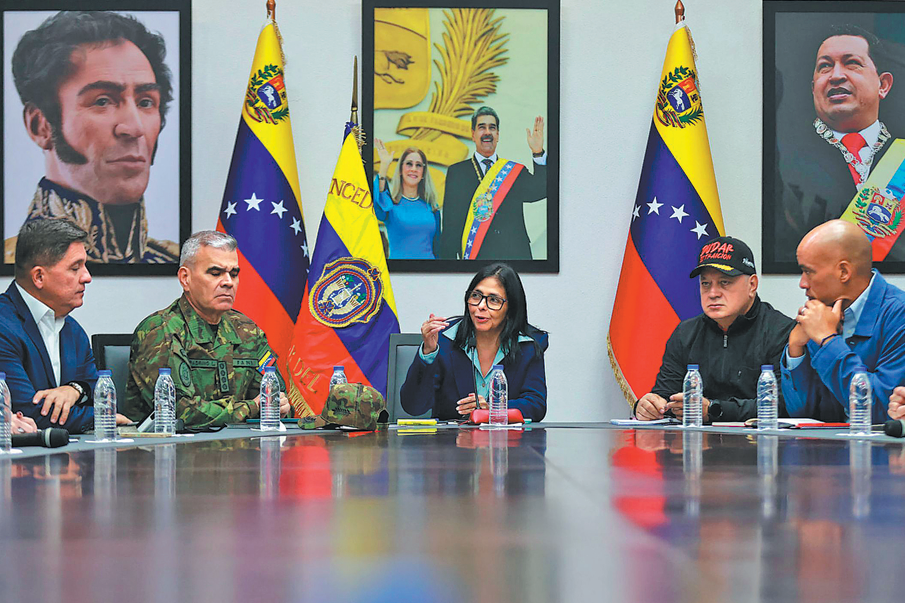
In the aftermath of a dramatic US military operation that resulted in the capture of President Nicolas Maduro, Venezuela’s political leadership is navigating a precarious new reality. Acting President Delcy Rodriguez, addressing the nation from Caracas, has extended an unexpected olive branch to Washington, proposing an agenda of ‘shared development’ and respectful bilateral relations.
Rodriguez, who concurrently serves as Venezuela’s oil minister, articulated her government’s position through social media channels, characterizing Saturday’s raid as an ‘illegal grab’ of national resources while simultaneously inviting cooperation ‘within the framework of international law.’ Her statement emphasized that ‘our peoples and our region deserve peace, and dialogue, not war,’ striking a conciliatory tone despite the extraordinary circumstances.
This diplomatic overture stands in stark contrast to demands from US President Donald Trump, who explicitly called for ‘total access’ to Venezuela’s substantial oil reserves. Aboard Air Force One, Trump asserted that such access was necessary to ‘rebuild their country’ and made the controversial declaration that the United States was effectively ‘in charge’ of Venezuela. The President further issued a stark warning to Rodriguez, suggesting she would face ‘a situation probably worse than Maduro’ if she failed to cooperate.
The administration’s position appeared somewhat moderated by Secretary of State Marco Rubio, who clarified that the US would not assume direct governance of Venezuela. Instead, Rubio emphasized the continuation of oil quarantine measures on sanctioned tankers, using this economic leverage to press for policy changes including reforms to the oil industry and cessation of alleged drug trafficking activities.
The political drama extended to New York, where the captured Maduro faced federal court proceedings on charges of supporting major drug trafficking organizations, allegations he has consistently denied. Meanwhile, Venezuela’s government maintained operational continuity over the weekend, with ministers remaining at their posts despite the capital’s unusual quiet and widespread business closures.
The international dimension expanded as Switzerland announced the freezing of any assets held by Maduro and his associates, though notably exempting current government members. This development occurs alongside Venezuela’s incoming National Assembly preparation to convene in Caracas, where the ruling party is expected to maintain control of the legislative body.