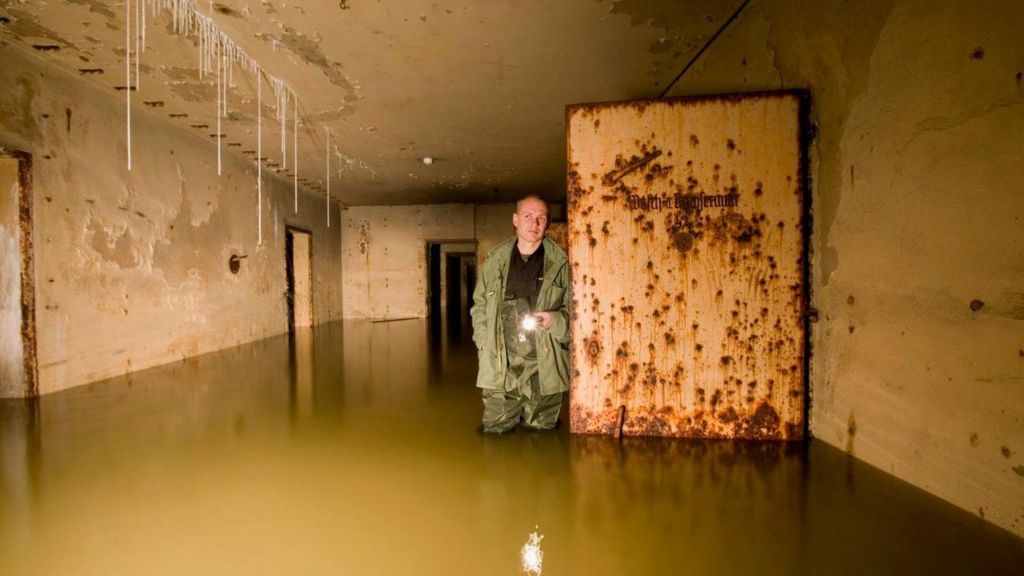
BERLIN — A bitter public debate has erupted over the fate of one of the final standing physical remnants of Adolf Hitler’s Nazi power infrastructure, as city officials advance plans to clear the site for a mixed-use development of residential apartments and commercial office space.
Of Hitler’s central New Reich Chancellery complex, constructed in the 1930s by Albert Speer — Hitler’s preferred personal architect — almost no trace survives in central Berlin today. The main above-ground structure was heavily damaged by Allied bombing and combat during the final weeks of World War II, and Soviet occupying forces ordered its complete demolition in 1949. What has remained intact, however, is the sprawling underground bunker that served chancellery staff, sitting on an undeveloped plot of land just 120 meters south of the far more famous Führerbunker where Hitler and Eva Braun took their own lives in 1945.
City officials argue that demolition is the clearest and most responsible path forward. Christian Gaebler, Berlin’s Senator for Housing and a member of the center-left Social Democratic Party, framed the proposal in comments to local outlet BZ, saying: “We are not standing in the way of new housing developments just to preserve a bunker that might then even become a place of pilgrimage” for neo-Nazi sympathizers.
But the plan has drawn fierce pushback from historians, heritage preservation groups, and local historical organizations, who warn that destroying the structure would erase an irreplaceable piece of 20th-century history. Dietmar Arnold, chairman of the Berlin Underworlds Association — a group that documents and preserves the city’s subterranean historical sites — calls the proposed demolition “absolute madness.”
Arnold, who last explored the bunker in 2007 when he confirmed it remained in excellent structural condition, told the BBC that the site is one of the last tangible links to the regime that planned and launched World War II and the Holocaust. “It is a site of the perpetrators. It was the power centre of Nazi Germany, Hitler’s New Reich Chancellery, and these are the last remains,” he said. Rather than clearing the site, Arnold has proposed partnering with Germany’s national Holocaust Museum to convert the bunker into a public memorial and museum, hosting educational exhibits focused on the final days of the Nazi regime in 1945.
Critics of demolition note that Germany has already lost countless historical sites from both the Nazi and Cold War communist eras, and that destroying this structure would set a harmful precedent. “So much history has been destroyed here in Germany, both Communist history and Nazi history. We can’t keep doing that,” Arnold added.
Structural assessments from Arnold’s group confirm that roughly 1,200 square meters of the bunker complex remain fully intact, with 1.7-meter-thick reinforced concrete walls and ceilings. The structure is large enough that it even housed a field hospital in the final days of the Battle of Berlin, and a well-known 1945 photo captures German General Helmuth Weidling emerging from the bunker to surrender to Soviet forces. Arnold also argues that the planned development could move forward without full demolition: it would be entirely possible to construct new buildings above the existing bunker without removing the structure itself.
The Berlin State Monuments Council came out against the demolition plans last year, stressing that the site carries substantial historical weight. In a formal statement, the council noted: “The New Reich Chancellery was the planning centre and starting point of World War Two and also symbolises the catastrophic end of the Nazi regime. In view of its potential significance as a historic monument, its state of preservation and its inclusion on the list of listed buildings should be assessed by the State Office for the Preservation of Historical Monuments.” To date, no final decision on the bunker’s future has been announced.