A historic wave of foodborne illnesses across the United States this summer has thrown the future of the U.S. Food and Drug Administration into sharp relief, as former President Donald Trump’s nomination of White House insider and physician Heidi Overton to lead the agency faces growing scrutiny from lawmakers, public health experts, and even some administration allies. The nomination arrives at a moment of deep crisis for the FDA, which has been gutted by widespread staffing cuts, a mass exodus of senior leadership, and widespread public anger over a delayed, disjointed response to outbreaks that have sickened thousands of Americans.
This summer’s outbreak season has been one of the worst on record. More than 17,000 confirmed cases of cyclospora, a parasite that causes severe persistent diarrhea, have been reported, a massive jump from just 1,180 cases during the same period last year. Most cases have been linked to contaminated iceberg lettuce produced by Taylor Farms, with infections recorded across nine states. Alongside the cyclospora surge, outbreaks of E. coli and salmonella have been traced to alfalfa sprouts, eggs, jalapeños, frozen blueberries, and multiple other common food products, leaving consumers confused and anxious about which foods are safe to eat.
Public health experts and food safety advocates trace the slow, ineffective response to these outbreaks directly to years of staffing cuts and institutional disruption at the FDA. Current and former agency observers warn that years of underfunding was pushed to a breaking point last year, when Health and Human Services Secretary Robert F. Kennedy Jr. fired 20% of FDA employees as part of the Trump administration’s broader effort to downsize the federal civil service. The agency has also been without a permanent Senate-confirmed commissioner for nearly three and a half months, following the resignation of former head Marty Makary, who stepped down after a public clash with the White House over Trump’s plan to lift a ban on flavored vapes over concerns about youth addiction. Several senior agency leaders left shortly after Makary’s departure, leaving critical leadership posts vacant and agency morale at historic lows.
“We’re already working with a system that was teetering on the edge, and last year’s cuts and upheaval have pushed it over the cliff,” explained Sarah Sorscher, food safety director at the non-profit Center for Science in the Public Interest. Jerold Mande, a former FDA and U.S. Department of Agriculture official and current nutrition professor at the Harvard T.H. Chan School of Public Health, noted that the CDC’s first public health alert for the cyclospora outbreak came 10 weeks after the first cases were detected in early May, a delay that left the public in the dark for months. “Poor communication has left people on edge and panicked about what they can eat,” Mande said.
For many affected consumers, the frustration is deeply personal. David Hargrave, a 59-year-old Texas resident, has experienced daily diarrhea for a month and a half after contracting cyclospora over the Fourth of July holiday. “It scares you, not knowing what’s safe to eat anymore,” he said. Toby Davis, another person sickened by the parasite after eating at a Taco Bell that required an emergency room visit, blamed mass layoffs of veteran FDA experts for the slow response. “This is the consequence of careless mistakes,” said Davis, an independent voter. “Do I think more people will get sick because of their negligence? Absolutely.”
Even some supporters of the administration’s health agenda have expressed caution. Jacqueline Capriotti, a supporter of the “Make America Healthy Again” (MAHA) movement founded by Kennedy, agreed that food safety must be the FDA’s top priority. “We tell people to eat real food, but we first have to guarantee that real food is safe to eat,” she said.
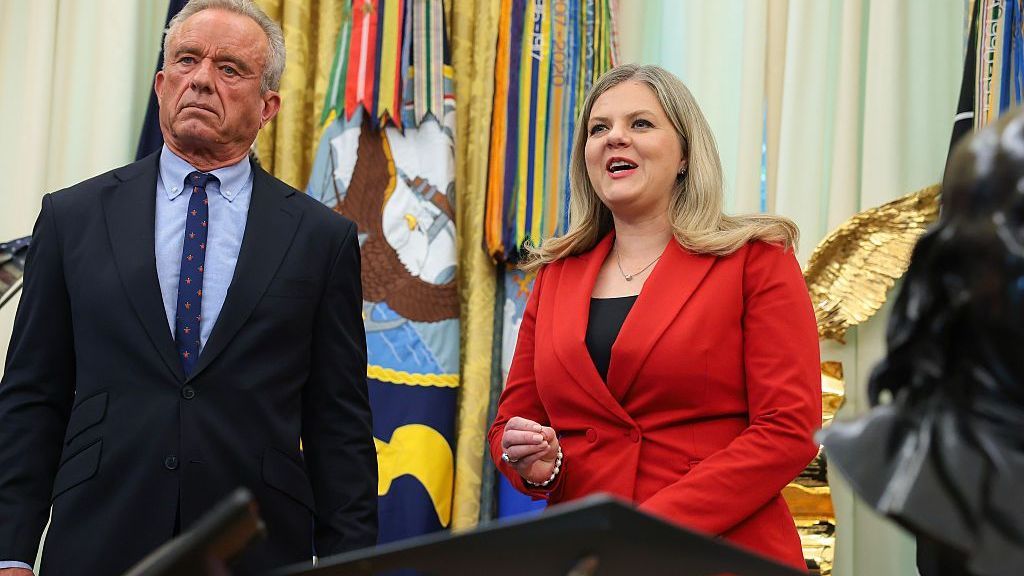
Against this backdrop of crisis, Trump has tapped Overton, a former general surgery resident at Johns Hopkins University School of Medicine and chief policy officer at the conservative America First Policy Institute, to lead the agency. Trump has publicly praised Overton as a “rockstar” and a trusted ally who will advance his administration’s priorities. But public health experts worry that Overton, a long-time Trump insider, will prioritize loyalty to the president over evidence-based public health policy.
John Swartzberg, professor emeritus of infectious diseases at the UC Berkeley School of Public Health, warned that Overton inherits an agency with shattered morale and a long list of unaddressed crises. “She’s stepping into an agency where morale is already rock bottom,” Swartzberg said. “Turning that around is going to be an enormous, incredibly difficult challenge.”
Overton’s nomination also faces political headwinds. She must first win confirmation from the U.S. Senate, with no hearing date set yet. The Senate Health Committee, which will consider her nomination, is chaired by Republican Sen. Bill Cassidy, a physician who has already voiced “strong concerns” about Overton due to her support for Trump’s executive order to overhaul the childhood vaccine schedule. Even some members of the MAHA movement oppose her nomination over her reported role in a Trump executive order to expand domestic production of glyphosate, a weed killer that MAHA activists argue is carcinogenic. The White House has denied that Overton played any key role in drafting the order, but prominent MAHA influencer Alex Clark has publicly raised the accusation on social media. Still, Capriotti argues that critics are too quick to judge, saying “She’s a well-respected physician, and I think she deserves a chance to prove herself.”
The Trump administration has pushed back against claims that staffing cuts and leadership turnover have hampered its outbreak response. A HHS spokesperson insisted that “the Trump Administration has mounted a robust response to each outbreak” and claimed that “FDA has the staff needed to continue investigating outbreaks, as no FDA investigators were affected by staffing changes or reductions in force.” White House spokesperson Kush Desai defended Overton’s qualifications in a statement to the BBC, saying she “has been integral to ensuring that the Administration’s policies are correct, consistent, and grounded in Gold Standard Science,” and adding that the White House “looks forward to her swift confirmation by the Senate.”
The stakes of the confirmation fight extend far beyond food safety, as Overton would also oversee the FDA’s handling of other high-profile controversial policy priorities for the Trump administration, including vaccine regulation and access to abortion medication. For public health advocates and consumers still reeling from this summer’s outbreak wave, the confirmation will set the course for the agency that regulates 80% of the U.S. food supply at a moment of historic institutional instability.