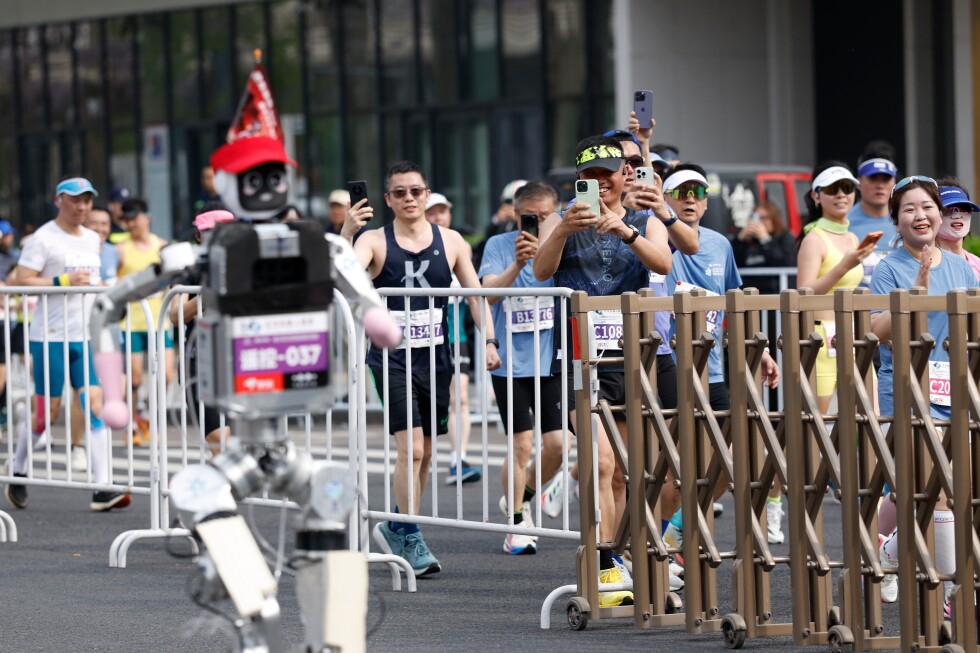
On a race day in Beijing’s Beijing Economic-Technological Development Area (Beijing E-Town), a milestone event unfolded Sunday that underscores China’s rapid advancement in humanoid robotics: an autonomous humanoid built by Chinese consumer electronics firm Honor claimed the top spot at the world’s second annual robot-only half-marathon, clocking a finish time that outpaces the official human world record for the 21-kilometer distance.
The winning Honor robot crossed the finish line in 5 hours? No, 50 minutes and 26 seconds, according to an official post from Beijing E-Town on China’s super-app WeChat. That time beats the current human men’s half-marathon world record of 57 minutes 31 seconds set by Uganda’s Jacob Kiplimo at the 2025 Lisbon Half Marathon in March by nearly seven full minutes. A separate remotely operated Honor robot finished even faster at 48 minutes 19 seconds, but under the competition’s weighted scoring framework that prioritizes autonomous navigation, the autonomously running unit was awarded the official championship. Two additional autonomous Honor robots took second and third place, finishing in 51 minutes and 53 minutes respectively.
This dramatic improvement from the 2024 inaugural race is impossible to ignore: last year’s winning robot crossed the line after 2 hours 40 minutes and 42 seconds, a time that is more than double the 2025 winner’s result. Even with the clear progress, the competition was not without small missteps that highlight the technology is still maturing: one robot collapsed immediately at the starting line, while another collided with a course barrier along the route. Organizers noted that roughly 40 percent of all competing robots completed the course fully autonomously, with the rest operating via remote control.
Du Xiaodi, a test development engineer leading Honor’s robot project, explained the design choices that enabled the standout performance. The team modeled the robot’s proportions off elite human long-distance runners, outfitting it with 95-centimeter legs, and integrated an in-house developed high-performance liquid-cooling system to manage heat output during extended operation. Du added that the core technologies refined through this racing project have broader practical potential: innovations like structural reliability testing and liquid-cooling systems can be adapted for future industrial use cases, even as full commercialization of general-purpose humanoid robots remains years away.
Spectators at the joint human-robot race event expressed astonishment at how far the technology has come in just 12 months. Sun Zhigang, who attended the 2024 race and returned this year with his son, called the progress “enormous”, noting that a robot beating the human world record was something he never expected to see so soon. Another attendee, Wang Wen, who attended with his family, observed that the humanoid racers had already overtaken human runners as the main attraction of the day. “The robots’ speed far exceeds that of humans, this may signal the arrival of a new era of robotics,” he said. Beyond the race itself, event organizers even deployed a humanoid robot to work as a traffic marshal, directing participants using a combination of arm gestures and pre-programmed audio cues.
The breakthrough performance comes as humanoid robotics has become a core priority of China’s national technology development strategy. The country’s recently released 14th Five-Year Plan (2026-2030) identifies accelerating the research, development, and real-world deployment of humanoid robots as a key target, part of Beijing’s broader push to lead global innovation in frontier technology sectors amid ongoing tech competition with the United States.
Industry data already reflects China’s growing clout in the general-purpose embodied intelligent robot space. A 2025 global assessment from London-based technology research firm Omdia ranked three Chinese robotics firms — AGIBOT, Unitree Robotics, and UBTech Robotics — as the only first-tier global vendors based on shipment volume. All three companies shipped more than 1,000 units of general-purpose intelligent robots in 2024, with AGIBOT and Unitree Robotics each shipping more than 5,000 units, confirming China’s position as a major mass producer of advanced robotic systems.
The race result is being seen widely as a visible public demonstration of how quickly Chinese humanoid robot capabilities are advancing, moving beyond lab demonstrations to real-world dynamic navigation and sustained operation that challenges even the limits of top human athletic performance.