When a record-breaking heat wave settled over Paris this week, one of the fashion industry’s most high-profile annual events became an unexpected public test of how luxury brands are responding to the warming planet they regularly claim to address. This year’s Paris Fashion Week Men’s, which showcases upcoming spring-summer collections, played out against a backdrop of soaring temperatures that exposed a glaring contradiction: while organizers scrambled to keep guests comfortable with emergency cooling measures, models still took the runways in heavy, heat-trapping fabrics like leather, neoprene, and wool.
For attendees and industry insiders, the discomfort was unavoidable. “I honestly thought I was going to pass out,” recalled Ben Freeman, an Australia-born, London-based fashion critic covering the event. Even with emergency interventions including complimentary ice packs, misting stations, cold towels, and iced Evian water served on silver platters, many venues stayed sweltering. Supplies of cold water ran low, and air conditioning was either entirely absent or woefully inadequate in the city’s historic buildings. Outside one show, 24-year-old fashion student Thomas Levy summed up the widespread disconnect: “I don’t know how the models did it this week in some of the leather and knit coats. The heat rarely seems to make it into the clothes. It shows up in the sets like at waterfalls and mist machines and ice packs.” Some front-row attendees have already raised a long-term proposal: if climate change continues to deliver more frequent and intense extreme heat events, Paris may need to permanently move its fashion week away from the annual peak of summer.
Throughout the week, most brands framed the heat as a logistical and hospitality challenge rather than a design issue. Organizers adjusted schedules to avoid the hottest parts of the day, pushing start times earlier to beat the midday sun. Dior relocated its Wednesday show from 2:30 p.m. to 9 a.m. to escape the worst heat, but even that shift couldn’t escape the soaring temperatures: water remained limited, the venue had no air conditioning, and multiple guests reported feeling unwell.
A handful of designers did offer targeted solutions that integrated heat adaptation into their work. Loewe creative director Jonathan Anderson showcased lightweight sheer silk-chiffon tailoring, but still noted that the global fashion industry calendar is fundamentally out of step with actual seasonal weather. “The calendar does not make any sense,” Anderson told reporters, pointing to broken delivery cycles and a shifting retail landscape that have left the traditional schedule misaligned both with weather patterns and how luxury clothing is actually sold. Issey Miyake’s IM Men line delivered one of the week’s most coherent practical responses: for its “In Praise of Bamboo Shadows” collection, the brand passed out ice packs to guests at entry and showcased garments woven from bamboo thread blended with organic cotton and lightweight nylon, with loose silhouettes designed to let air circulate rather than trapping heat against the body. At Ami, designer Alexandre Mattiussi leaned into the moment, dressing models in loose shorts, washed trenches and casual “I Love Paris” T-shirts, while remarking from beside a roaring industrial fan that “Paris is burning.” Rick Owens went a step further, making heat the central theme of his presentation: he moved his Thursday show earlier to beat the heat, then sent models walking through a mist installation at the Palais de Tokyo in garments with built-in whirring fans. One leading fashion critic called the presentation “a metaphor for climate catastrophe.”
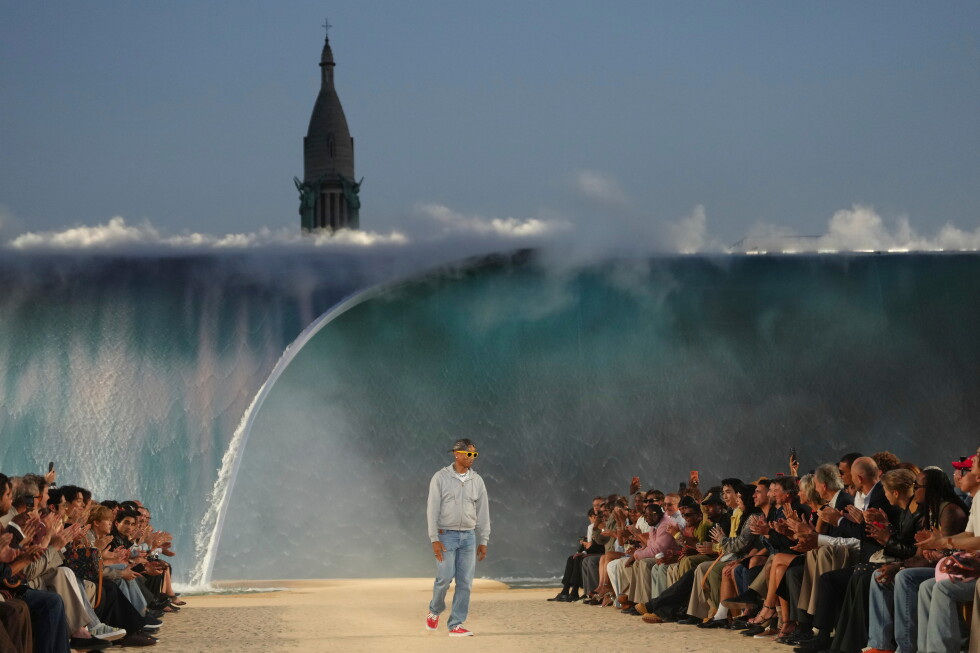
Even luxury houses that leaned into lighter construction didn’t fully escape the contradiction. At Saint Laurent, designer Anthony Vaccarello created unlined jackets and soft, pale silhouettes explicitly designed for heat, but paired the lightweight pieces with leather briefs, choker scarves and transparent shoes that quickly fogged with perspiration. At Louis Vuitton, Pharrell Williams staged his show around a giant artificial wave installation, but still sent models out in neoprene wetsuits, cashmere coats, and fur pieces.
Pascal Morand, head of France’s Haute Couture and Fashion Federation, said organizers had followed the French government’s official heat wave response plan. “We are conscious of the challenges and very attentive to preserving the Fashion Week experience in this context of structural change,” he told the Associated Press. But fashion week is far from the only Parisian institution being strained by rising temperatures: the Louvre recently shortened visiting hours during the heat wave, noting that its historic building structure is “remains vulnerable and is not sufficiently adapted to climate change.”
The event also laid bare a broader cultural debate playing out across France and much of Europe: how to adapt to rising extreme heat without widespread adoption of air conditioning, which many Europeans still view as wasteful and ecologically harmful. Unlike many other regions, most of Europe’s historic city buildings were constructed without built-in cooling, and the continent is warming faster than any other on Earth. The Macron administration has prioritized low-tech cooling solutions like adding shade, improving building insulation, and planting more urban trees rather than encouraging widespread AC installation.
For many observers, Paris Fashion Week’s struggle with heat serves as a warning for every global industry tied to fixed schedules and public gatherings. From professional sports to tourism to construction, sectors built around long-standing seasonal timelines and outdoor crowds are already being forced to adapt to heat waves that arrive earlier, last longer, and reach higher temperatures than the built environment was designed for. As Freeman put it: “Paris Fashion Week is the canary in the mine.”