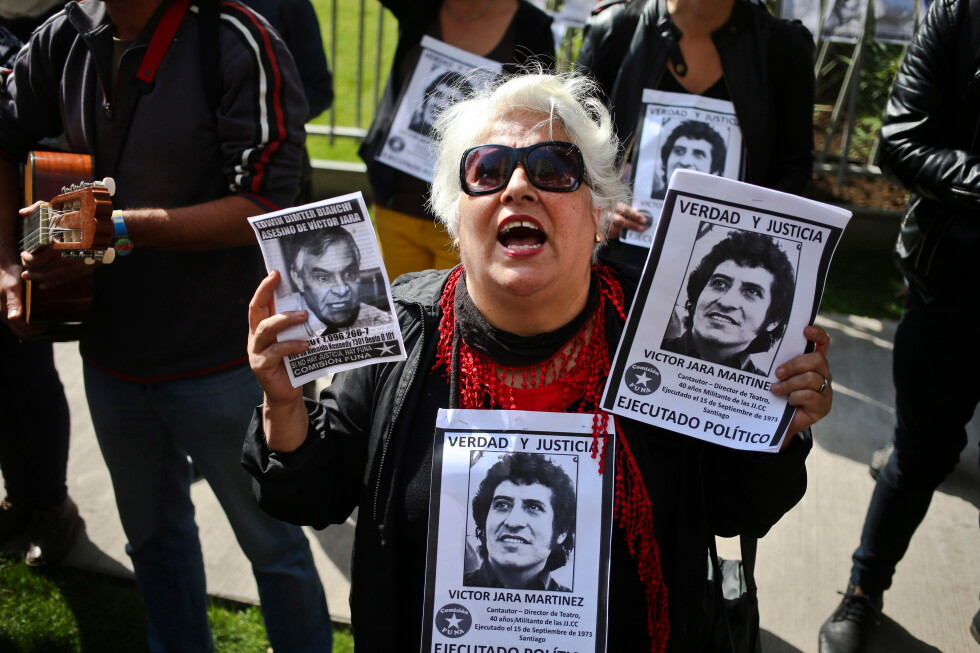
After more than 50 years of waiting for accountability, Chilean authorities have taken the last convicted perpetrator of the high-profile 1973 murder of iconic folk singer-songwriter Víctor Jara into custody. Eighty-year-old retired Colonel Nelson Haase Mazzei, who had evaded a 25-year prison sentence for three years after his conviction was finalized, was located and arrested by Chilean national police over the weekend, marking a long-delayed milestone in the country’s reckoning with the human rights abuses of Augusto Pinochet’s military dictatorship.
Haase Mazzei was first convicted of the kidnapping and murder of Jara alongside former prisons director Littré Quiroga Carvajal back in 2018. His sentence was extended in 2021 during a broader appeals process that also reaffirmed convictions for six other co-conspirator military officers. When the sentence was finalized, the former colonel fled before he could be taken into custody, remaining at large until this weekend’s operation. Judge Paola Plaza of the Santiago Court of Appeals issued an order for “immediate imprisonment” following his capture, and Chile’s judicial branch confirmed Haase Mazzei is the final person convicted in Jara’s killing to begin serving his court-ordered term.
Víctor Jara was far more than a celebrated musician: a leading voice in the 1960s Nueva Canción Chilena (New Chilean Song) movement that intertwined folk music with left-wing social advocacy, he was also an outspoken supporter of socialist President Salvador Allende, a professor at Chile’s State Technical University, and a member of the Communist Party of Chile. Just five days after Pinochet’s U.S.-backed military coup overthrew Allende’s democratically elected government on September 11, 1973, Jara was arrested on his university campus and transported to Santiago’s Chile Stadium, which was later renamed Víctor Jara Stadium in his honor.
Investigative records document the brutal treatment Jara endured at the hands of military agents. He was separated from the roughly 5,000 other political detainees held at the stadium, taken to an isolated holding area alongside Quiroga, repeatedly tortured, and ultimately executed. Forensic analysis later confirmed Jara suffered dozens of bone fractures from the torture before he was shot 44 times. His killing quickly became one of the most recognizable symbols of the systemic brutality that defined Pinochet’s 17-year authoritarian rule.
In a public statement released Sunday night, Amanda Jara, Jara’s daughter and current head of the Víctor Jara Foundation, acknowledged the arrest but said the family cannot view this step as full justice. “We learned that retired Colonel Nelson Haase Mazzei, who had been a fugitive from justice since 2021, was found and imprisoned. We appreciate this news,” she wrote. “Yet it is difficult to consider this justice, after more than half a century of impunity for crimes against humanity.” She closed her statement calling for continued law enforcement action against all remaining fugitives convicted of dictatorship-era human rights violations: “We hope that the police will manage to find all those who fled for crimes against humanity.”
Chile’s decades-long process of transitional justice began in earnest shortly after Pinochet stepped down and democracy was restored in 1990. The first official National Commission for Truth and Reconciliation confirmed within a year that Jara had been the victim of a deliberate political execution, classifying his murder as a severe violation of international human rights law. The commission also documented 890 extrajudicial killings in the first three months after the 1973 coup alone.
Official estimates place the total number of human rights violation victims during Pinochet’s rule at roughly 40,000, including more than 2,000 confirmed executions, 1,469 enforced disappearances, and thousands of survivors of systematic torture. Chilean courts have convicted hundreds of former state agents and civilian collaborators for these crimes, though no centralized national database exists to track the total number of people who have been sentenced. In 2024, the government launched a new National Search Plan designed to unify fragmented victim records and establish a formal framework for locating the remains of disappeared detainees, a long unmet demand that has been driven for decades by grassroots family member advocacy groups.
While Haase Mazzei’s arrest closes a chapter in the case of Jara’s murder, it also underscores the long, incomplete path toward full accountability for the widespread violence that reshaped modern Chile, with many victims’ families still waiting for answers and full justice decades after the end of the dictatorship.