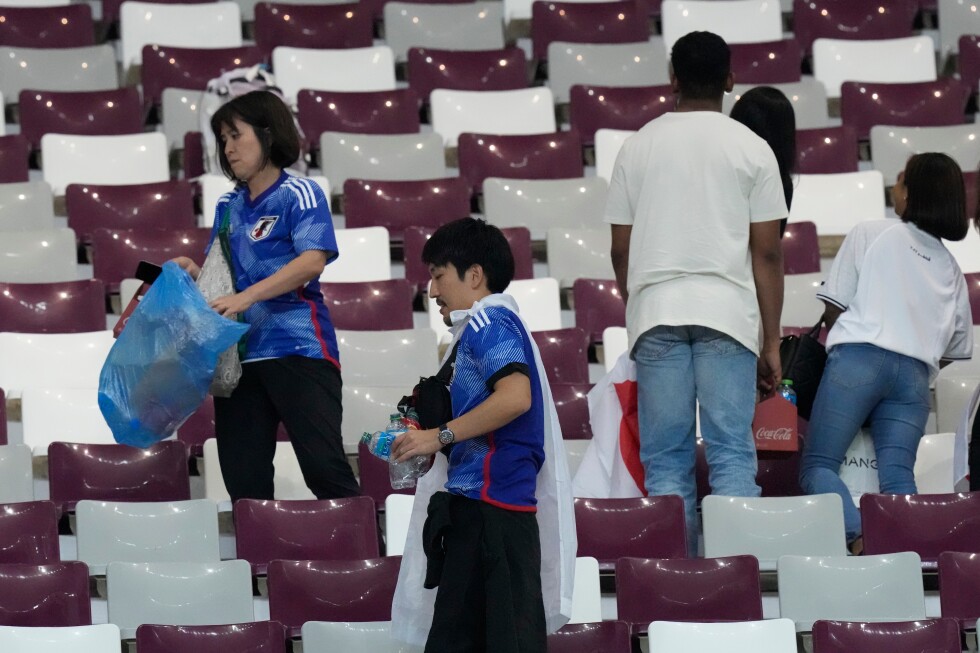
When soccer’s biggest global tournament kicks off, there is one nation that consistently earns international acclaim not just for its on-pitch performance, but for a quiet, consistent act of sportsmanship off the field: Japanese soccer fans and players leaving match venues cleaner than they found them. This decades-long tradition has captivated global audiences, sparking curiosity about the cultural and social roots of the habit that surprises many foreign attendees accustomed to post-match trash-strewn stadiums.
The long-running custom first entered the global spotlight in 1998, when Japan made its debut appearance at the World Cup in France. Since that tournament, the practice has carried on through every four-year cycle, including the 2022 World Cup held in Qatar. It is all but guaranteed to continue when Japan takes the pitch for group stage matches this June in Arlington, Texas, and Monterrey, Mexico. The behavior routinely astounds non-Japanese observers, many of whom are used to exiting stadiums and leaving discarded half-eaten food, crumpled wrappers, and half-empty beverage cups behind for venue staff to collect.
This post-match cleanup is not a recent affectation for global cameras: it has deep roots in Japanese socialization that begins in early childhood. In elementary schools across Japan, students are responsible for cleaning their own classrooms, schoolyards, and athletic fields, with many institutions employing no full-time janitorial staff. Even in professional workplaces, adults set aside regular time to tidy their own work spaces. This upbringing carries into adult recreational and public behavior, including attending major sports matches.
Koichi Nakano, a professor of politics and history at Tokyo’s Sophia University, explained to the Associated Press that the habits Japanese fans display at global tournaments are simply an extension of the values they learned growing up playing sports as children. The core Japanese philosophy that guides the behavior is captured in the phrase *Tatsu tori ato wo nigosazu*, which translates roughly to “A bird leaves nothing behind” in its literal form, and carries the practical meaning of “Return the space the way you found it.”
Beyond childhood education, two additional cultural factors shape this persistent habit. First, Japan’s dense urban landscape means public spaces have far fewer public trash receptacles than many Western nations, so people are accustomed to carrying their waste with them to dispose of at home — a practice that keeps public areas clean, cuts municipal waste management costs, and deters pests. Second, the Japanese cultural concept of *meiwaku* emphasizes avoiding any inconvenience or annoyance to other people; for Japanese soccer fans, leaving a pile of trash in a stadium is seen as an unnecessary burden to venue staff and future visitors. With a population of roughly 35 million in the Greater Tokyo Area alone — nearly equal to the entire population of California — collective consideration for others is a core social value embedded from a young age.
Sociologists studying the practice note that it reflects a broader cultural difference in priority between many Western societies and Japan: while Western cultures often emphasize individual rights and rely on public service staff to handle public space cleaning, Japanese culture centers collective well-being, meaning personal responsibility for shared spaces is normalized. Barbara Holthus, deputy director of the German Institute for Japanese Studies in Tokyo and a sociologist raised in Germany, warns against placing Japanese society on an unfair pedestal, noting the practice is simply the result of different socialization rather than any inherent difference. Even so, the widespread global praise Japanese fans have received for the habit has only reinforced the behavior, turning it into a point of national pride, according to Jeff Kingston, a history professor at Temple University Japan.
The clean-up tradition is not confined exclusively to the men’s senior World Cup. Last year, Japanese fans repeated the practice at the Under-20 World Cup in Chile, and just last month they did the same following an international friendly win over England at London’s Wembley Stadium. Toshi Yoshizawa, who led the clean-up effort in Chile, called the practice “one of our traditions,” noting that Japanese people grow up taught to leave a place cleaner than they found it.
William Kelly, emeritus professor of anthropology at Yale University and a Japan specialist, speculates that the custom is particularly tied to soccer in Japan rather than other popular sports. He links it to the founding of Japan’s professional J-League more than 30 years ago, when the new league sought to differentiate itself from established Japanese baseball by emphasizing deep community ties and fan commitment to local clubs, fostering a stronger sense of shared ownership over match venues among supporters.